

The AI supercycle needs more than algorithms — it needs advanced connectivity
Author: Ari Kynaslahti
Mobile Infrastructure Chief Technology Officer

A new wave of growth is building as artificial intelligence moves from experiments to embedded capability across industries. The AI supercycle is gathering momentum across Europe, but it is not yet smooth sailing.
This isn’t incremental digitalisation; it’s an economic shift driven by a series of parallel events, all of which catalyse each other.
According to a recent Nokia survey, 84% of European business leaders have AI factored into their growth strategy, while 92% have a positive view on the business impact.
Both optimism and ambition are there.
But AI doesn’t operate in a vacuum, it must move.
Models need to interact with devices, sensors and users in real time. That makes connectivity the third pillar of the supercycle, alongside data and compute. Without low latency, high-capacity mobile networks, the promise of AI quickly stalls. Innovation is still possible, but the future which promises real-time robotic AI systems or AI-powered XR consumer services looks much less likely.
Connectivity and network infrastructure needs to be considered at the same level of criticality as topics such as the availability of skills and energy. It is the foundation of everything digital but isn’t being prioritized.

Report
AI is too big for the European internet
Without a stronger digital backbone, from networks to data centers and beyond,Europe risks missing its greatest growth opportunity: the AI supercycle.

What is the AI supercycle?
Artificial intelligence is entering a transformative multi-decade phase known as the AI supercycle, where it will become integral to all industries and technologies, driving exponential innovation and economic growth through pervasive automation and data optimization.
Europe’s weak link: 5G Standalone
Europe is behind on connectivity. Coverage isn’t the only problem, investment is thin, many telecommunications providers lack the scale in other regions and spectrum allocation is fragmented.
The result is a tentative and slow progression towards the deployment of 5G Standalone, the version of 5G that makes real-time AI possible.
Looking back to the Nokia research, 71% of those adopting AI would require latency (the responsiveness of the network) of less than 29 milliseconds, with 13% needing sub-10 milliseconds within 2-3 years.
With these requirements in mind, only 14% are confident infrastructure can scale without complication. When asked what the biggest challenge for scaling AI efforts, a lack of low-latency, AI-optimized infrastructure was the fourth most common issue (out of 15).
Worryingly, it was the highest for future-tech companies, those which could fuel the next wave of economic expansion.
Building the AI economy
Without this foundation, Europe risks its bid to become an AI leader. Use cases that define the supercycle, such autonomous transport, immersive AR, real-time robotics, remote healthcare, all depend on split-second responsiveness.
Miss that and Europe doesn’t just lose innovation. It hands over control of sensitive data flows to foreign providers. The economic loss is clear, but so is the strategic one: sovereignty over digital infrastructure and AI leadership. Capital, talent and innovation will flow elsewhere.
Infrastructure enables innovation. It’s a simple statement, but if you don’t build the right networks, you can’t expect AI to deliver.

What others got right
The contrast with those leading the AI supercycle is stark.
In the U.S., swift action from one operator created a competitive environment to act as a catalyst across the rest of the market. They opened networks, built APIs, and partnered across sectors from automotive to healthcare.
China took a different route. State coordination with operators to accelerate Standalone and edge rollouts. The result - rapid scale and national alignment.
Despite being different approaches, both created momentum Europe has yet to match.
If Europe wants to compete in the AI supercycle, it must prioritize connectivity as a critical enabler. Advanced connectivity was once a luxury, but today is it a fundamental component of effective and efficient business.
The AI supercycle simply doesn’t happen without advanced connectivity, and if Europe does not nurture the right environment, investments will be directed elsewhere, and so will the benefits we are seeking to deliver for economies and communities.
Building the path towards 6G
5G Standalone is doing something quietly important, it’s preparing the ground for the kind of network Nokia expects 6G to become.
If the next generation is going to be AI-native, not just carrying intelligence but running on it, then the underlying fabric needs to be predictable, low-latency, cloud-native and tightly integrated with compute.
That’s the direction Nokia has set out, and it begins with getting 5G Standalone properly deployed, at scale, not in isolated pockets.
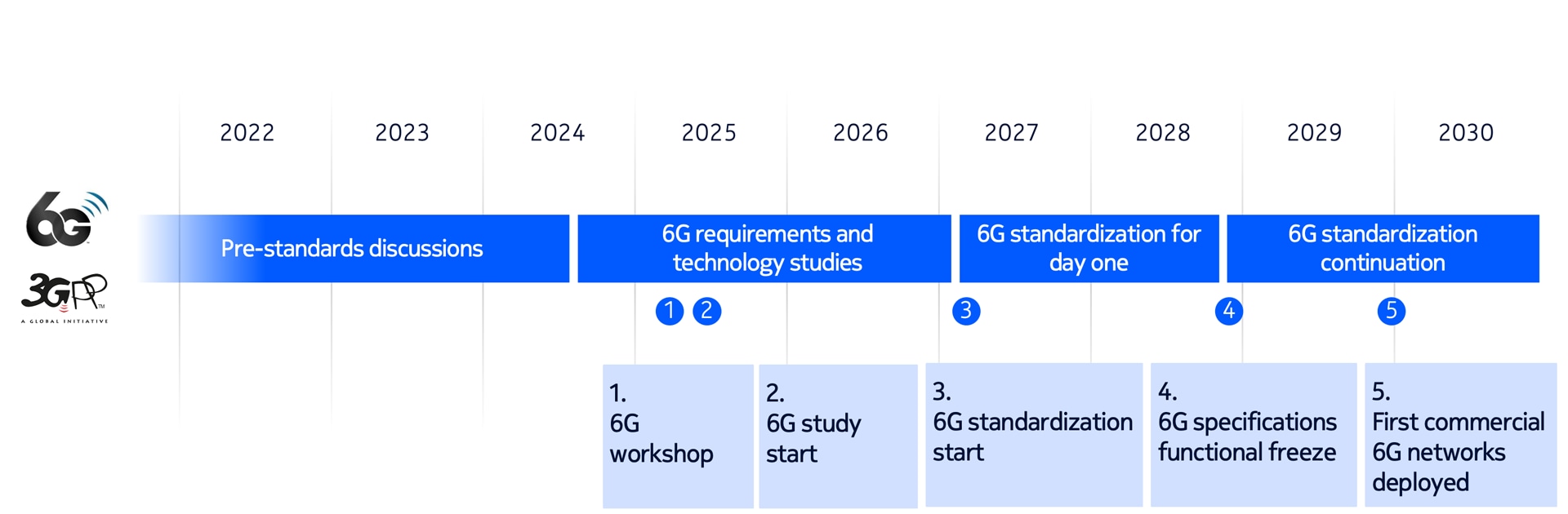
The jump to 6G won’t be a dramatic year-zero reset. It will be a long runway of 5G-Advanced upgrades from better uplink performance, more precise timing and synchronisation, more automation in the RAN and core, and early sensing capabilities introduced into the network.
Those don’t appear by magic. They’re pioneered and refined on top of widespread 5G Standalone.
Moving from the lab to reality
For the mobile network industry, 6G marks the shift from “mobile broadband” to a network that fuses intelligence in a single system. That requires consistency in ubiquitous, reliable, secure and high-performance connectivity for intelligence.
You can’t run sensing, distributed AI inference or real-time digital-twin loops on a patchy foundation. The coverage gaps that look inconvenient in 5G simply become unworkable in 6G, especially in the AI era where tolerance to downtime or delays will be significantly lower.
Building the right mobile networks today will enable the AI supercycle at scale, but it will also provide an onramp to 6G.
The countries that will lead in 6G are the ones that take 5G Standalone seriously now. And it would surprise few in the industry if success in deploying the right connectivity landscape also correlates with economic growth attributed to AI.
So, the argument for 5G Standalone isn’t just about improving today’s networks. It’s about making sure the next generation has room to exist. 6G will inherit whatever footprint, architecture and performance we build now.

About Ari Kynäslahti
Ari Kynäslahti, Vice President of Strategy & Technology and CTO at Nokia Mobile Networks, drives business, technology, and partnership strategies while contributing to Nokia’s overall direction. He oversees Mobile Networks' portfolio, investment management, and product roadmaps, focusing on areas like SoC, RF, AI/ML, ORAN/vRAN, and private wireless networks.
Having been with Nokia since 1995, Ari has held leadership roles in product management, global sales, and business development. He holds a Masters degree in Radio Technology with minors in Corporate Strategy, International Business and Economics from Helsinki University of Technology.