800G ZR/ZR+: The new currency in AI-scale connectivity

The AI era is prompting the optical networking industry to undergo one of its most dynamic periods of innovation. Among the many emerging technologies, 800G ZR/ZR+ coherent pluggable optics stand out as one of the fastest-growing segments in optical infrastructure.
Market research firms and industry analysts alike point to a dramatic surge in demand for coherent pluggable solutions driven by AI and cloud providers and amplified by enterprise bandwidth requirements, 5G backhaul and next-generation IP and optical transport networks. While exact figures vary by report, forecasts consistently agree a multi-billion-dollar market will emerge over the next several years, with 800G coherent optics representing a significant slice of that growth.
According to Dell’Oro, 800 ZR/ZR+ may account for over one-third of IPoDWDM revenue by 2026. Moreover, Cignal AI estimates 800G ZR/ZR+ will be the fastest-growing coherent pluggable shipments, with a 145 percent compound annual growth rate between 2025 and 2029.
What’s fueling this growth?
The main drivers behind this market growth are:
- The surge in data traffic triggered by AI: The massive scale of AI model training, inference and data movement between distributed compute clusters is dramatically increasing east-west and data center interconnect traffic, quickly overwhelming 400G ZR/ZR+ based connectivity solutions. In response, AI and cloud providers are accelerating deployments of 800G ZR/ZR+ to double fiber capacity, reduce cost per bit and improve power efficiency without expanding their physical infrastructure.
- Better network economics, enabled by technology innovation: Cutting-edge 3-nm-based CMOS technology used by DSPs is a key enabler for the latest generation of 800G ZR/ZR+ coherent pluggables. Gate density exceeding 400 million gates and significant performance improvements over the previous generation of 400G ZR/ZR+ pluggables have led to lower power consumption. They have also delivered the processing power required to support advanced features such as probabilistic constellation shaping (PCS), a wide range of modulation formats and high chromatic dispersion compensation, all in compact pluggable form factors, including QSFP-DD800 and OSFP.
As a result, network operators can achieve better network economics (lower capital and operating expenses) by maximizing capacity per fiber, with pluggable modules that fit easily into existing routers, switches or optical transport platforms.
- Expanded applications scope: The capability of coherent pluggables took a significant leap with the introduction of 800G ZR/ZR+. With higher bitrate and optical performance, simple and standardized Common Management Interface Specification (CMIS)-based management, open probabilistic constellation shaping and multi-vendor interoperability, the application scope has expanded well beyond metro data center interconnect (DCI), into applications previously dominated by embedded coherent technology, including:
- Metro aggregation networks: Telecommunication providers are now using 800G ZR+ for metro and regional optical transport to drive down the cost per bit per km.
- Backbone connectivity: Telecommunication providers are using the 800G ZR/ZR+ coherent pluggables in their routers to connect high-capacity backbone links.
- AI clusters: To help train the next generation of large language models, AI and cloud providers are scaling XPU clusters between geographically dispersed data centers. Scale across architectures have emerged as a result. 800G ZR/ZR+ coherent pluggables are enabling efficient connectivity of back-end networks. Scale across will help our industry to break through the one million XPU cluster boundary.
- Any-haul DCI: Compelling economics, ease of management and the record-setting optical performance available in small form factors, such as QSFP-DD800, are enabling DCI over much longer distances (up to 1,700km at 800Gb/s).
- Subsea Applications: It is becoming clear that coherent pluggables will have a role in subsea networks. While major transoceanic cables will still rely on embedded optics optimized for maximum performance, shorter regional subsea networks and festoon links can benefit from the economics and flexibility of 800G ZR/ZR+ technology. The ability to dial down bit rates or adapt modulation formats to long spans, with constrained optical signal-to-noise ratios and a compelling low cost and power per bit per km, make 800G ZR/ZR+ coherent pluggable a potential and interesting option for these types of new subsea buildouts.
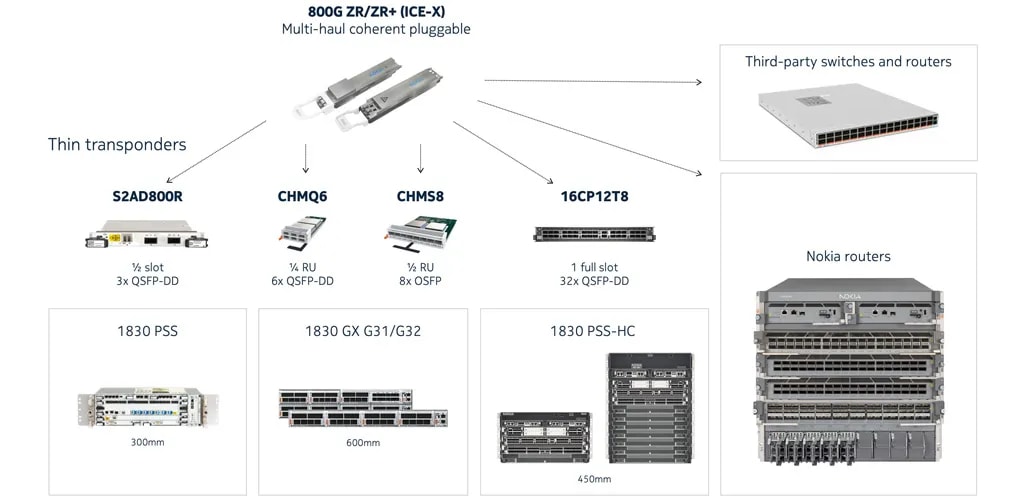
- Flexible deployment: While the IPoDWDM deployment model works for some operators and use cases, it doesn’t fit all. Thin transponders reduce operational complexity for the deployment of 800G ZR/ZR+ pluggables – enabling broader and more rapid adoption. Thin transponders offer multiple client ports (100G, 200G, 400G or 800G) to connect grey optics to routers and switches. Thin transponders offer lower CAPEX, lower power consumption and smaller footprint than embedded optical engines but avoid the operational challenges of deploying coherent pluggables directly into routers with the IPoDWDM deployment model. Thin transponders also deliver many of the advantages of embedded transponders, such as multiple client-side aggregation, operational domain separation and some of the optical capabilities of fully fledged embedded transponders. Figure 1 depicts Nokia ICE-X 800G ZR/ZR+ flexible deployment options in third-party routers, Nokia routers or Nokia Thin Transponders.
-
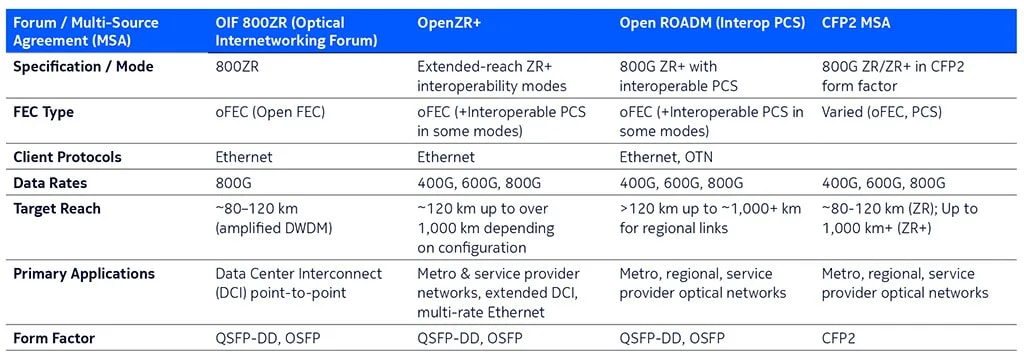
- Multi-vendor Interoperability: Just like their 400G predecessors, 800G ZR and ZR+ coherent pluggable optics benefit from strong industry support and ecosystem interoperability. Multiple interoperability forums and multi-source agreements (MSAs) have established common standards, test specifications and implementation guidelines. These industry efforts ensure that 800G coherent pluggable optics can seamlessly interoperate across a wide range of optical infrastructure, regardless of vendor (Table 1). Multi-rate interoperability is one of the most valuable features of industry leading 800G ZR/ZR+ due to its impact on network planning and operations. It delivers multiple benefits for telecommunication providers, including seamless deployment with third-party pluggables and host devices, accelerated network disaggregation and increased choice, and faster service turn-up and streamlined operations.
The most recent multi-vendor interoperability demonstration took place at the European Conference for Optical Communications (ECOC 2025) where 800G ZR/ZR+ coherent pluggables from multiple vendors participated in a live demonstration focused on open, standardized control and multivendor operations.
Looking Ahead: 1600G ZR/ZR+ and Beyond
While 800G ZR/ZR+ coherent pluggables are rapidly reshaping the market, the next evolutionary milestone is already on the horizon: 1600G ZR/ZR+ coherent pluggables. As AI workloads, edge computing, and cloud-scale interconnects continue to explode, the need for even higher-capacity, lower power per bit optical solutions will only intensify. However, delivering 1600G ZR/ZR+ isn’t just a matter of “scaling up speed”; it’s about evolving every aspect of building coherent pluggables, from the use of new materials and modulators, to a new generation of CMOS technology and packaging, including:
- Single or multi-subcarrier architecture.
- Advanced materials and integration leveraging a wider selection (and probably a mix) of advanced materials, including silicon photonics, indium phosphide, and thin-film lithium niobate.
- Next-generation DSPs that take advantage of 2 nm or 1.6 nm silicon geometries
- New form factors, such as OSFP-XD or QSFP-DD1600
The 1600G generation will build upon the principles of 800G, pushing new boundaries of performance, density, and energy efficiency.
Conclusion
The rise of 800G ZR/ZR+ coherent pluggable optics marks a pivotal shift in optical networking. From their roots in data center interconnects, these technologies have expanded into transport, IP over DWDM, metro aggregation and even select subsea applications. Fueled by strong ecosystem support and interoperability forums, 800G ZR/ZR+ coherent pluggables deliver a flexible, cost-effective path to meet bandwidth demand both today and tomorrow. And as the industry looks toward 1600G ZR/ZR+ and beyond, one thing is clear: coherent pluggables will be at the heart of the next wave of optical networking innovation.
- Multi-vendor Interoperability: Just like their 400G predecessors, 800G ZR and ZR+ coherent pluggable optics benefit from strong industry support and ecosystem interoperability. Multiple interoperability forums and multi-source agreements (MSAs) have established common standards, test specifications and implementation guidelines. These industry efforts ensure that 800G coherent pluggable optics can seamlessly interoperate across a wide range of optical infrastructure, regardless of vendor (Table 1). Multi-rate interoperability is one of the most valuable features of industry leading 800G ZR/ZR+ due to its impact on network planning and operations. It delivers multiple benefits for telecommunication providers, including seamless deployment with third-party pluggables and host devices, accelerated network disaggregation and increased choice, and faster service turn-up and streamlined operations.
-