Learn how to differentiate your wavelength services

The AI era is unleashing a new wave of data center interconnect growth. This was on display at a recent industry conference, where a leading AI and cloud provider revealed their AI-related backbone traffic is increasing at an astonishing 100% compound annual growth rate (CAGR). And at the ECOC 2025 conference, “scale across” (scaling AI training across multiple metro data centers) emerged as the killer application for 800ZR/ZR+ pluggables. Projections vary across analyst and research firms, but the consensus is clear – AI is reshaping network infrastructure demands.
The future points to a surge in new data centers, escalating capacity requirements and a growing need for low-latency, resilient connectivity to support increasingly distributed AI workloads. A recent Bell Labs Consulting study reinforces this trend, showing non-AI traffic growing at a CAGR of approximately 15%, while direct AI traffic — spanning both enterprise and consumer use cases — is accelerating at over 50% CAGR. These trends are unlocking new opportunities for network operators to leverage their optical network infrastructure to deliver wavelength services optimized for the AI era.
The combined growth of non-AI, and indirect and direct AI traffic, along with the rising number of data centers, is driving data center interconnect growth, increasing both their number and speed. 10G client services are being migrated onto 100G wavelength services, while 100G wavelength services are transitioning to 400G, and 400G wavelength services are moving to 800G. This aligns with the rapid adoption of 400GbE within data centers and on router ports, with 800G wavelength services corresponding to the availability and uptake of 800GbE router ports.
What is a wavelength service?
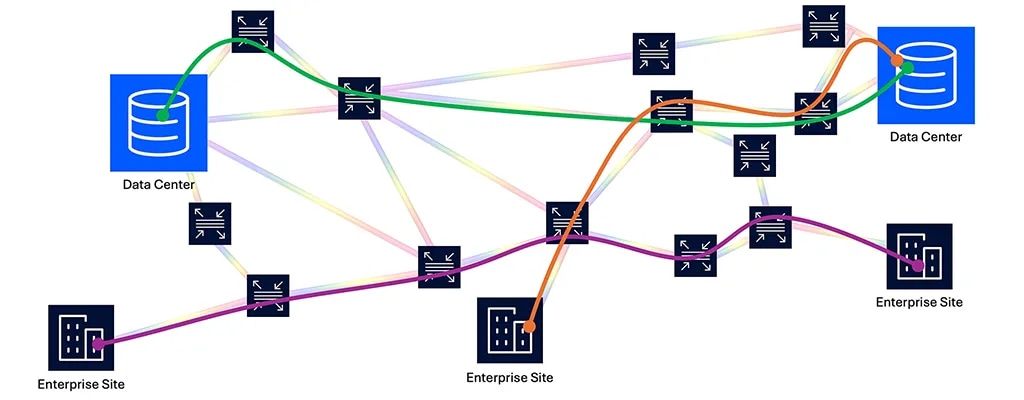
Figure 1: Wavelength services
For this blog, I define any optical service at 100 Gbps and above as a wavelength service. As illustrated in Figure 1, such wavelengths are typically used to connect one data center to another, a key enterprise site to a data center, or less commonly, one enterprise site to another. These services are typically delivered by a transponder or muxponder, which generates a high-speed coherent wavelength transported over a WDM optical line system.
These optical line systems usually comprise remote optical add-drop multiplexers (ROADMs) and in-line amplifiers, or in simpler cases, fixed point-to-point WDM. In addition, optical equipment vendors and service providers have collaborated on Metro Ethernet Forum (MEF — now Mplify Alliance) standards for 100 Gbps wavelength services for both retail (MEF 63) and wholesale (MEF 64) applications.
Wavelength service attributes: purchasing criteria and vendor differentiators
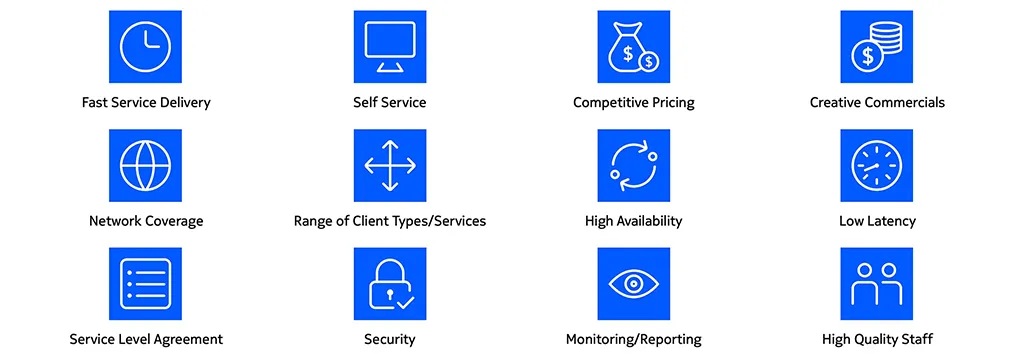
Figure 2: Wavelength services purchasing criteria and vendor differentiators
As Figure 2 illustrates, these services include a wide range of attributes that influence vendor selections and help providers of wavelength services to differentiate themselves, including:
- Fast service delivery: The time from order to service activation is important, as customers often need the service as soon as possible or by a strict deadline.
- Self-service: Some providers of wavelength services offer customers the ability to provision, upgrade and downgrade wavelength services remotely from a customer service portal.
- Competitive pricing: Price is always an important factor in vendor selection, though it is not typically the only one or even the most important.
- Creative commercials: Beyond price, some vendors differentiate themselves with creative and flexible commercial terms and conditions, including pay-as-you-grow pricing.
- Network coverage: The breadth of geographic network coverage and how this aligns with customer locations is key.
- Range of client types/services: Service speeds range from 100 Gbps to 800 Gbps and support multiple protocols, including Ethernet, OTN, and Fibre Channel.
- High availability: Wavelength service vendors often offer both unprotected and protected services. Target availability can be as high as 99.999%.
- Low latency: The length of the fiber route is typically the dominant factor influencing latency. Wavelength service providers differentiate on latency by offering the shortest fiber route.
- Service level agreements (SLAs): SLAs can cover a wide range of metrics and targets, with both commercial and non-commercial penalties.
- Security: Some wavelength vendors offer value-added security features, including wire-speed layer 1 encryption. Quantum-safe enhancements provide scope for further differentiation.
- Monitoring and reporting: Some wavelength service providers offer the ability to monitor the wavelength service’s performance in real-time from a customer portal.
- High-quality staff: Some wavelength services providers differentiate themselves with their experienced and dedicated staff.
Wavelength service providers can use these attributes to differentiate and compete successfully in the growing wavelength services market.
How optical equipment vendors can help
But what are vendors such as Nokia doing to help telecommunications providers successfully offer wavelength services? To meet the demand for higher service speeds and lower costs that enable competitive pricing, we are advancing coherent optical engines to support higher baud rates (up to 140+ GBaud), along with coherent pluggables.
To enable faster service delivery, innovations such as expanding the C-band to C+L (doubling available spectrum from 4.8 THz to 9.6 THz), extending the C-band to Super-C (6.1 THz) and Super-L (5.5THz, 11.6THz with Super-C), and using automation tools to defragment spectrum are all increasing the likelihood that end-to-end spectrum will be available for service delivery.
Providers of wavelength services are leveraging software tools, such as automated service fulfillment, to enable outcomes that include:
- End-to-end service and infrastructure creation.
- Real-time capacity planning and feasibility analysis.
- Zero-touch provisioning.
- Ongoing service assurance reporting.
When combined with pre-deployed hardware, automation delivers consistent and timely results, reducing delivery from weeks or months to just minutes. As a result, wavelength service providers can manage their supply chains and capital expenditures more effectively.
In addition, software functionality, such as transport network controllers that use open APIs (e.g., the Linux Foundation T-API), enable providers to easily connect into their business support systems. Open APIs also enable them to connect with third-party open line systems to offer services with end-points outside their traditional geographic markets.
To support high availability and strong SLAs, operators are using additional tools such as 100G+ network demarcation devices, integrated OTDR for rapid fiber-cut localization, optical protection and fast restoration. Security is also becoming an important differentiator, with options including wavelength encryption, security certifications such as FIPS, EAL, and NIAP, and additional quantum-safe enhancements.
Seize the opportunity
As AI continues to drive explosive growth in data center interconnect demand, wavelength services represent a compelling and potentially lucrative opportunity for network operators. By collaborating with industry-leading vendors like Nokia to rapidly deliver differentiable, high-capacity services with competitive prices, network operators are ready to seize the opportunity and meet the demands of the AI era.