The unifying role of subsea fiber networks
The world recently unified to celebrate a new year, with 2026 promising much change and progress for people and businesses. As our attention returns to work, the Pacific Telecommunications Council (PTC) annual conference being held January 18-21 in Honolulu, Hawaii (USA) serves as a great starting point to explore ways in which the AI era continues to pave the way for important changes, and how the underlying data center and connectivity technologies will make this possible.
As the world’s unity in the ringing-in of a new year slowly fades away, the theme of unification is an apt metaphor for recent developments in subsea fiber networks, spanning new cable builds, architectures and solutions. This blog will explore these themes and serves as an invitation to join my Nokia colleagues and I at PTC to learn more.
Unifying people across the globe
A key foundational technology needed for expanding AI and cloud services are the fiber optic networks that inter-connect data centers. These networks provide the connectivity ubiquitous to modern society, enabling the flow of data needed for financial transactions, business critical traffic, national defense, entertainment and personal interactions across the globe.
With connectivity to data centers being the enabler for accessing the cloud-based AI services that promise to change all aspects of society and business, the unifying power of fiber optic networks is becoming more important than ever, and plays a critical role in ensuring equitable global access to all peoples and countries.
The massive data-carrying capacity of optical fiber has led to wide deployment to homes and businesses, within metro areas and across countries, and spanning the globe via subsea fiber optic cables, which extend access to AI and cloud services across seas and oceans, by inter-connecting continents and island nations. There are currently over 570 subsea cables in service today, helping carry >99% of all international traffic.
Some interesting examples of how subsea fiber networks are helping to unify global connectivity to AI and cloud services can be found in some recent subsea cable build-outs, including:
- The Medusa submarine cable system, connecting the Atlantic coast, Mediterranean Sea and the Red Sea, will help close the digital divide between Europe and North Africa, connecting countries such as Morocco, Tunisia, Libya, Algeria, and Egypt with high-capacity fiber-optic links.
- The Bangladesh Private Cable System (BPCS) consortium will provide the first private subsea connections to Bangladesh to extend equitable access to AI and cloud services to the country.
- Also in Asia, a new subsea cable connecting Jakarta to Singapore built by PT Solusi Sinergi Digital Tbk (a.k.a. Surge) which will increase regional data center interconnectivity while expanding affordable broadband access to over 40 million people across Indonesia
With many new subsea cables being planned for the near future, we can expect greater access and more bandwidth to interconnect users across the globe.
Unifying subsea and terrestrial backhaul networks
Unlike historical consumer, business and telco traffic that connect points-of-presence (PoPs), carrier hotels and central offices (COs), the AI era is characterized by massive connectivity delivered to and from data centers (see figure 1). Fiber optic networks, including subsea fiber cables, currently connect over 11,000 data centers, with over one thousand large “hyperscale” data centers, collectively supporting over one thousand petabytes per day of WAN traffic. The network bandwidth supporting cloud services and AI WAN traffic is expected to grow subsea network bandwidth by approximately 30% per year for the foreseeable future.
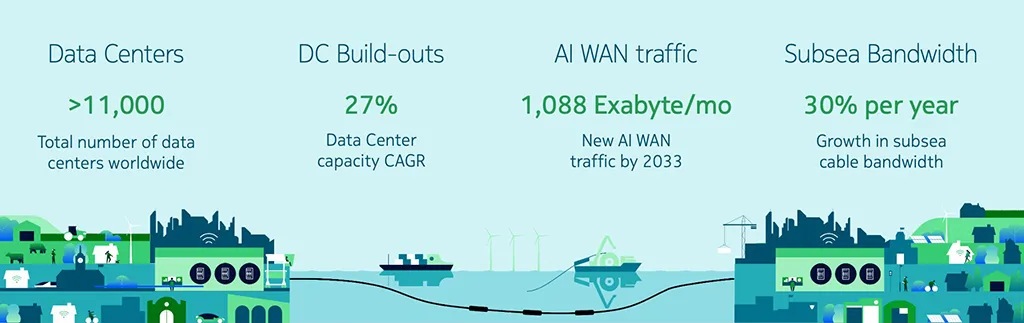
Figure 1: An ever-increasing number of data centers powering AI services is driving significant bandwidth growth over subsea fiber optic cables.
This shift in global traffic connections, combined with the growth of cloud-based and AI services, is leading to changes in how to optimize end-to-end subsea-terrestrial networks. Today’s AI and cloud traffic does not connect to PoPs and COs; it flows end-to-end between data centers across the globe, and across terrestrial backhaul networks that extend the DC-to-DC connectivity from the subsea cables that terminate at cable landing sites (CLS). This is leading AI and cloud providers to optimize their subsea and terrestrial backhaul networks with end-to-end connections in mind, encompassing everything between the data centers at each end.
By optimizing subsea and terrestrial backhaul networks in a unified fashion, network operators can simplify their networks, reduce CapEx and operational costs, and maximize their network capacity. These benefits are enabled through a combination of new architectures, such as using optical pass-through of end-to-end DC-to-DC traffic at cable landing sites to reduce cost, space and power and new technologies, such as expanding the wavelength division multiplexing (WDM) spectrum using C+L bands to provide a 2x or greater increase in terrestrial network capacity to significantly reduce the costs for subsea traffic backhaul to data centers.
Unified solutions for subsea-terrestrial networks
Unifying global access to cloud and AI services and optimizing unified end-to-end subsea-terrestrial network architectures, as described above, can be accelerated with another focus on unification; leveraging scalable and optimized optical transport solutions that unify all the specialized feature requirements needed for submarine line terminating equipment (SLTE) and terrestrial backhaul, thereby simplifying all aspects of network planning, training, sparing, deployment, operation and growth.
For Nokia’s customers this means leveraging the benefits of the 1830 Global Express (GX) compact modular DCI-optimized platform providing transponder, open optical line system (OLS) and SLTE solutions for all subsea and terrestrial backhaul network applications. This allows network operators to offer differentiated services and also leverage the operational benefits enabled from a unified end-to-end network.
The 1830 GX supports high-performance coherent transponders for transmission of high-speed data connections such as 800 Gigabit Ethernet (800GE) across trans-oceanic distances, leveraging features such as Probabilistic Constellation Shaping (PCS), Nyquist filtering and continuous baud rate adjustment to maximize optical reach and fiber capacity up to the Shannon Limit. The 1830 GX OLS supports all needed SLTE functions including ROADM-based wavelength switching and spectrum management, insertion of ASE spectrum or continuous-wave (CW) idler channels, and optical channel monitor.
For terrestrial backhaul networks, use of WDM spectrum across C+L bands provides a twofold or greater increase in capacity per fiber and reduces costs for leasing backhaul fiber capacity. Other new 1830 GX OLS features, such as constant power mode ILAs, support end-to-end DC-to-DC connections across unified subsea-terrestrial networks. Other options designed to meet operators’ needs include an integrated OTDR for fiber monitoring and fault localization, and a full range of optical protection options for service protection and restoration.
Nokia’s commitment to technology innovation and feature leadership is also extending to what’s next. At PTC’s 2026 conference in Honolulu, Hawaii, you can join discussions with our technology and business leaders to hear how new technologies, such as pluggable coherent optics and fiber sensing are being introduced for use in subsea networks.
Today ICE-X 800G coherent pluggables are enabling speeds of 400G, 600G and 800G per wavelength for regional subsea cables spanning over 4000km, and future increases in chromatic dispersion compensation will enable the benefits of using a Thin Transponder Layer across trans-Atlantic routes as well.
Operators seeking to benefit from their vast footprint of fiber cables, and who also seek to protect them from damage or sabotage, can engage us on how to leverage ongoing trials of fiber sensing capabilities, enabled by machine learning and advanced coherent techniques.
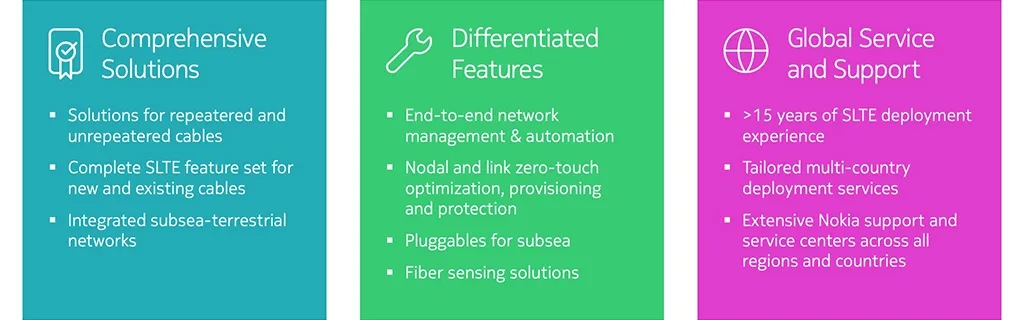
Figure 2: Nokia’s solutions optimized for all subsea and terrestrial backhaul applications are complemented by a long history of helping customers deploy advanced cable systems across the globe.
Advancing connectivity for the AI supercycle
It is not a coincidence that the title of these parting thoughts is Nokia’s mission purpose slogan. The AI supercycle and growth to a unified, cloud-connected world, will depend on two key missions; advancing connectivity for scale, performance and sustainability; and expanding that connectivity globally, to all.
Nokia is proud of our >15-year commitment to helping subsea network operators and users build advanced end-to-end SLTE and terrestrial networks, supported by our global service and support for multi-country projects.
This focus on our customers’ success, and with Nokia’s unification with Infinera, has led Nokia to be the #2 vendor of subsea optical transport equipment globally. Most recently, many new subsea fiber cables are being built across the Asia-Pacific, and Nokia has earned the trust of over two-thirds of the operators involved to help scale and unify their networks for the AI supercycle.
I’m looking forward to learning and sharing more with you at PTC 2026, and if you can’t make the conference, please follow us for future thoughts and news.