Video innovation made possible by new Video-based Dynamic Mesh Compression standard
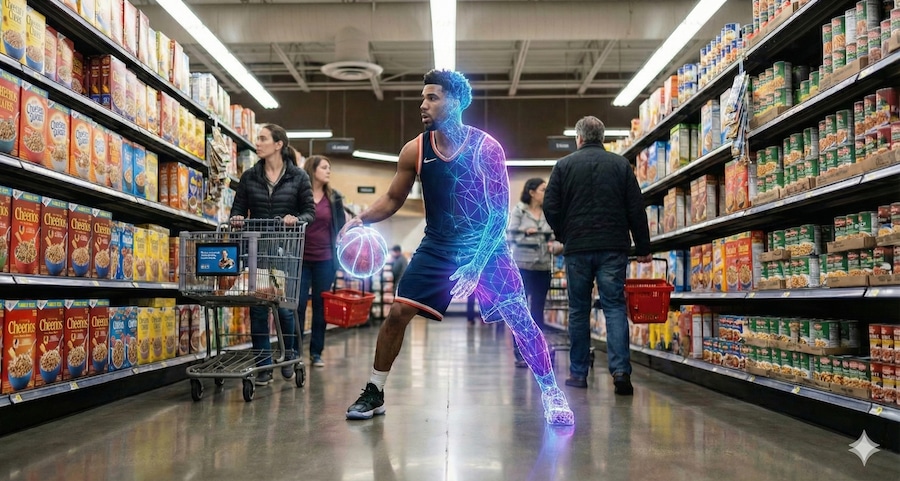
Image generated using AI
Real-time 3D has always had a scaling problem. Each captured moment generates a mesh filled with thousands – or millions – of vertices that move unpredictably frame to frame. While tracked mesh compression has worked well for predictable, animation-like sequences, the industry has lacked an efficient way to handle non-tracked dynamic meshes. Dynamic meshes, such as people moving freely, deforming clothing, or shifting objects in a scene, rarely maintain per-vertex correspondence, making previous compression methods brittle. Compression has been slow, CPU-to-GPU transfer large, and real-time streaming challenging.
Recognising this growing need, ISO/IEC JTC1 SC29 has created the Video-based Dynamic Mesh Compression (V-DMC) standard specifically to handle dynamic, fast-changing mesh sequences. Instead of treating 3D as a special case, the V-DMC standard converts the original meshes to a simplified version with additional parameters mapped to 2D video frames, reducing the mesh decoding complexity and allowing existing hardware-accelerated video decoder to decode the bitstream more efficiently.
Nokia has played a pivotal part in the standardization process, contributing core technologies and actively participating in the editorial work.
Today V-DMC stands as the next piece of the ecosystem the industry has needed to bring real-time volumetric media into everyday applications, from Extended Reality (XR) to industrial automation and beyond.
How does the new standard work?
At the core of V-DMC is a change in how dynamic 3D content is represented and delivered. Traditional methods treat every frame of a dynamic mesh as a large, irregular structure that must be processed in full. This makes real-time performance challenging, especially for non-tracked dynamic meshes, where the number of vertices and faces changes unpredictably from frame to frame.
V-DMC decimates the original mesh into a lightweight base-mesh and the essential updates into the form of 2D video data. This means it's easier for the CPU and GPU to transfer the base-mesh, because the V-DMC video codec is decoding directly to the GPU, which is always a crucial aspect in real-time 3D workflows, and makes interactions more responsive. On top of this base-mesh, the standard uses video-based tools to encode the dynamic details, allowing it to tap into the efficiencies, maturity and scalability of the global 2D video ecosystem.
This approach delivers two major benefits. First, it enables high-quality, real-time rendering, preserving the detail and fluidity needed for immersive XR, volumetric media and digital twins. Second, it ensures broad compatibility. Because V-DMC is built on established video coding technologies, it can run on existing devices, without the need for specialised hardware or heavyweight native applications.
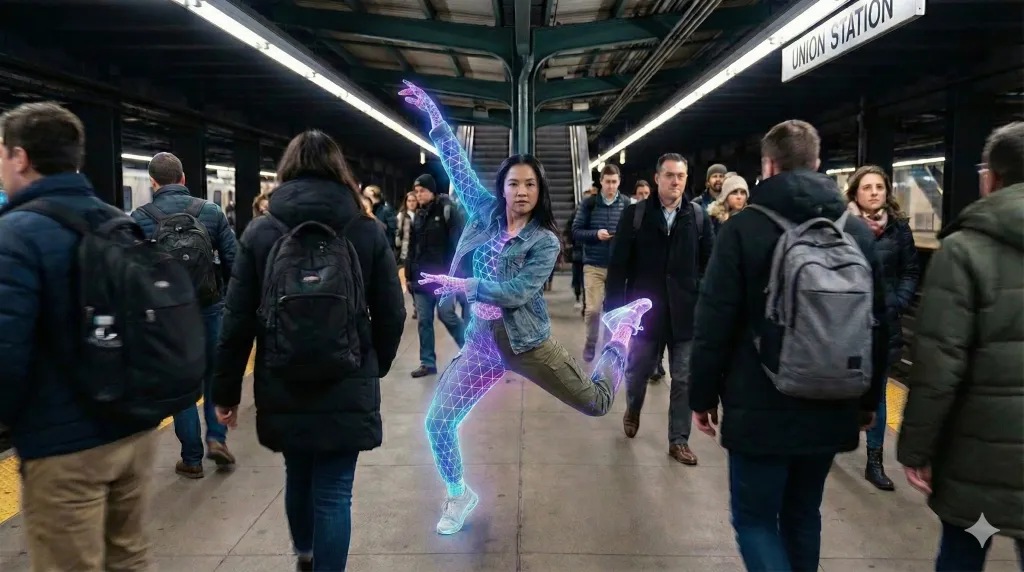
Image generated using AI
How V-DMC will change industries
The arrival of the V-DMC standard marks a turning point for anyone working with high-quality video production as well as real-time 3D content. The custom pipelines, heavy applications and/or specialised hardware that were needed to deliver dynamic meshes at scale can be put to rest. This typically limited deployment and slowed progress. With V-DMC, the industry finally gains a unified, efficient way to compress and deliver dynamic 3D data at practical bandwidths and low latency.
Take media and XR. Creators can distribute volumetric performances, immersive scenes, and interactive 3D storylines without relying on bespoke delivery systems. Real-time 3D becomes accessible on more devices and across more platforms, lowering the threshold for widespread adoption.
Industries building digital twins or running time-sensitive operations also stand to benefit. Utilities, manufacturers and infrastructure operators can monitor assets as they evolve, overlaying critical information through XR. The reduced CPU-to-GPU transfer times enabled by V-DMC make interactions faster and more reliable, which is essential for mission-critical workflows.
Regardless of the sector, the common thread is clear: V-DMC means fewer bottlenecks for dynamic 3D content. Fragmented, proprietary approaches will be replaced with a globally recognised standard designed for the real-world. Thousands of new applications that simply weren’t possible before are now in touching distance.
Real-time 3D at scale draws nearer
The V-DMC standard is breaking down the obstacles to dynamic mesh compression and streaming, regardless of whether they originate from photorealistic offline production or real-time-constrained workflows. V-DMC gives creators, developers and industries the foundation they have been missing. And with Nokia’s contributions helping shape the standard, the path toward practical, scalable volumetric media is clearer than ever.
As the standard matures, the next step is building robust reference implementations and integrating V-DMC into tools, engines, and pipelines already used across XR, gaming, and industrial simulation. The opportunity now is to accelerate adoption, through refining implementations, expanding interoperability, and bringing a new capability into commercial applications. The obstacles that once made efficient real-time compression for streaming dynamic meshes difficult are no longer fixed constraints, opening the door to the next generation of immersive and spatial experiences.