

Short Message Service Function
SMS delivery for next generation cores
Secure and scalable delivery of traditional SMS—the essential short message service that played a critical role in legacy 2G, 3G, and 4G mobile networks—across the latest generation core networks
Bring dependable messaging service capability into the center of your 5G core with Nokia Short Message Service Function (SMSF), keeping every device reachable with simple and trusted short message service (SMS).
What is Short Message Service Function?
Nokia SMSF delivers SMS over Non Access Stratum (NAS) as a native Service Based Function (SBF) defined by the Third Generation Partnership Project (3GPP). It works with the Access and Mobility Management Function (AMF), Unified Data Management (UDM), and Charging Function (CHF) to provide secure and reliable messaging as part of the 5G core.
SMS has evolved side by side with voice services since the earliest mobile networks, and this close relationship continues in 5G. While voice services such as Voice over 5G and Voice over LTE carry real time conversations, SMS remains the trusted companion channel for reach, reliability, and critical signaling. Together, SMS, Voice over 5G, and Voice over LTE form a familiar and dependable communication foundation that users and enterprises rely on every day.
Nokia SMSF integrates smoothly with existing Short Message Service Centers (SMSC), Home Location Register (HLR), Unified Data Management (UDM), and charging systems, protecting earlier investments while supporting the evolution of the 5G core. It includes registration and subscription management, originating and terminating message handling, charging, lawful interception, and cloud native operability. All of this is built on Nokia core design principles focused on performance, scale, and quiet reliability.
Convergence with other IMS products
Nokia SMSF anchors messaging inside the 5G core and sits naturally alongside voice and application core elements. In the Nokia Cloud Native Core Solutions portfolio, it operates smoothly with Voice over LTE, Voice over 5G, and the Telephony Application Server (TAS), using the same cloud native foundations for automation, observability, and life cycle management.
The Telephony Application Server provides a programmable services environment for voice, messaging, and multimedia sessions and exposes a rich set of APIs that operators can build on. TAS not only enables advanced voice services but also makes SMS capabilities available through its programmable feature-set, making it easier to create value-added services that combine messaging with voice logic and applications.
By exposing these APIs and service capabilities on developer-friendly platforms such as Nokia Network as Code, operators can open up SMS and voice functions to internal and external innovation. This creates opportunities for new services built on network programmability and enhances how SMS works with other IMS and 5G core services.
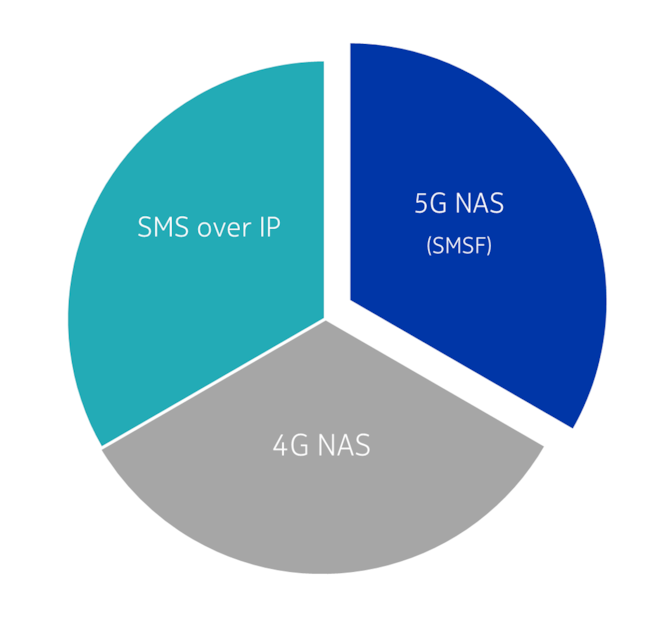
SMS Delivery Paths
Core capabilities of Nokia SMSF
Designed for real world networks, Nokia SMSF brings cloud optimized operation, seamless interworking, global roaming support, and built in resilience into the 5G core. This foundation keeps SMS reliable, secure, and available under all conditions
Cloud optimized
Enable faster upgrades, elastic scaling, and consistent operation across the 5G core, built for cloud deployments.
Essential for full 5G core
Bring universal messaging into the 5G core, reaching smartphones and connected devices through a trusted and widely supported channel.
Proven interworking
Preserve existing messaging, subscriber, and charging systems while evolving smoothly toward 5G.
Roaming ready
Support reliable messaging for roaming users worldwide, designed for global operation across international networks.
Security and compliance
Meet security and regulatory requirements with safe and compliant SMS delivery in any market.
Resilient and intelligent
Maintain continuous message delivery under changing conditions by adapting to load, handling failures gracefully, and staying available.
Where Nokia SMSF creates value
Critical notifications that must get through
Use SMS for one-time passwords, service notifications, and network alerts that need to reach users instantly and reliably. Nokia SMSF ensures these messages are delivered even as devices, access types, and network conditions change.
Messaging continuity during 5G transition
Keep existing SMS services running as networks move toward standalone 5G. Nokia SMSF supports uninterrupted messaging throughout modernization, avoiding service gaps while core architecture evolves.
SMS working alongside voice services
Support voice services such as Voice over 5G and Voice over LTE with a dependable messaging channel. SMS continues to play a key role for call related notifications, fallback communication, and user interaction before and after voice sessions.
Enterprise and network driven messaging
Enable secure SMS for enterprise use cases and network-initiated messages, including service information, policy notifications, and operational communication that depend on trusted delivery.
Related solutions and products
Solution
Reaping the benefits of 5G and cloud
Product
Leverage cloud-native design to boost performance and scalability
Product
Take advantage of 5G monetization opportunities with Nokia Convergent Charging solutions
Product
Nokia Registers; the unified solution for subscriber access management.
Product
Agile and innovative communication services for voice networks
Learn more
Video
Cloud Packet Core - AI/ML: Use case results in 5G Packet Core networks

Video
Nokia session restoration service

Blog

Video
Nokia & Google: Why Generative AI is the Key to Autonomous Networks
Video
Nokia Core Talk: In Discussion: Nokia Core & Autonomous Networks with Red Hat OpenShift

Report
Video