Europe’s AI Ambition needs more investments in advanced and trusted connectivity
By Marc Vancoppenolle
Vice President, Geopolitical and Government Relations, EU & Europe at Nokia
15 Jan 2026


It seems impossible to have a conversation today without AI playing some role, demonstrating the massive power of the technology. It has the potential to impact every part of business, and European policymakers are on board.
In February 2025, Ursula von der Leyen, European Commission President, said, “We want Europe to be one of the leading AI continents... AI can help us boost our competitiveness, protect our security, shore up public health, and make access to knowledge and information more democratic.”
Research from Nokia suggests that businesses share this enthusiasm and ambition.
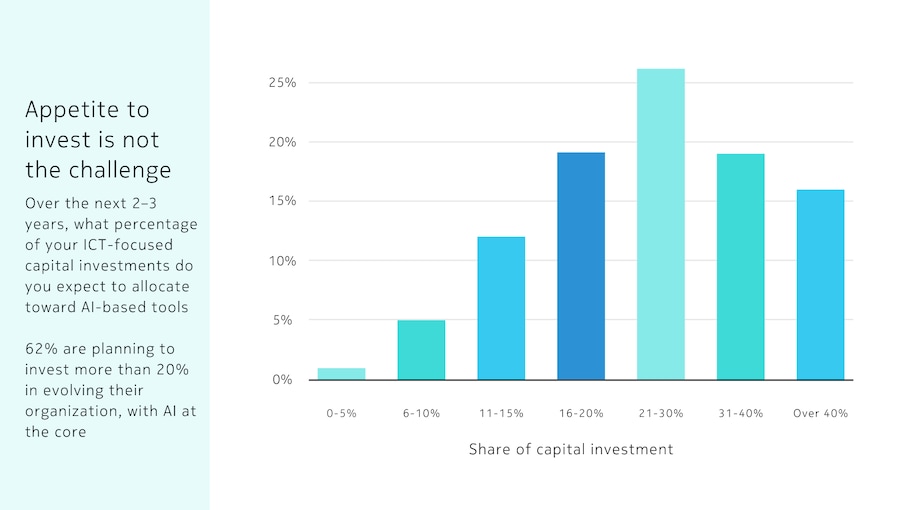
84% of more than 1000 respondents said AI features in the growth strategy of their organization, while 62% are directing at least 20% of ICT capex budgets towards the technology.
However, the equation is not yet balanced.
75% state current telecom infrastructure limits the ability to deliver on those ambitions. 45% suggest these limitations would delay, constrain, or entirely limit investments.
There is clearly a disconnect between the ambition and the ability to deliver.
At present, Europe lags the US and parts of Asia in areas such as network deployment, related investment levels, and scale.
What we must remember primarily is that AI does not happen without advanced, trusted and future-proofed networks. Infrastructure is not a “nice to have” it is a fundamental part.
If AI does not reach its full potential, EU competitiveness will suffer, economic growth will have a ceiling, the creation of new jobs will have a limit, and consumers will not see the benefits.
When we asked businesses during for our research, out of 15 potential options, the lack of adequate connectivity infrastructure came fourth.
Our telecom connectivity regulatory approach must be more closely aligned with the goal of fostering AI. That means progressing towards a genuine telecom single market, adopt a novel approach to competition policy to allow market consolidation leading to more investments, and ensuring connectivity is always secure and trusted.
Supporting more investments in next-generation networks through consolidation
AI places heavy demands on networks. It requires low latency, high bandwidth and reliability, and efficient traffic management. To deliver this, Europe needs to accelerate investment in 5G Standalone, fibre to enterprises, edge data centres and IP-optical backbone networks optimised for AI.
Consolidation (i.e. reducing the number of telecom operators within the national telecom markets of EU Member States) is part of the solution. Consolidation will allow operators to achieve economies of scale, improve operating efficiency, and thus is a means to encourage investment and a catalyst for innovation.
As industry voices such as Nokia have emphasised, the networks that power AI must themselves make greater use of automation and artificial intelligence. Policy support should therefore extend to both innovation and deployment.
Trust: a precondition for AI adoption
Intellectual property theft is a threat to Europe’s industrial future and only trusted technology should be used in core functions, systems and sectors (energy, transport, defense…). In this context, the underlying connectivity should always be secure and trusted. The 5G Security Toolbox, restricting untrusted technology, should therefore be extended to all telecom technologies (including fiber, optics, IP,…) and made compulsory in all EU Member States. European governments must put high priority in protecting their industries and citizens.
Completing the digital single market
Although the single market is one of Europe’s defining projects, the reality in telecoms - a key part of the digital single market - is still fragmented. As an example, different spectrum policies and create barriers across borders and limit network rollouts.
Levers on top of advanced connectivity
To enable the AI ecosystem in Europe, there are several different enabling levers European policy makers should advance on top of fostering advanced and trusted connectivity:
The AI Continent Action Plan, as well as the IPCEI Compute Infrastructure Continuum, and the European High-Performance Computing Joint Undertaking (EuroHPC JU) should facilitate the building of AI data centers in Europe.
There should also be clear support for securing Europe’s access to and leadership in edge solutions and building out edge capacity. Edge solutions can increase processing speeds and are important for enabling AI adoption, while also creating a catalyst for economic growth
With the right data center capacity and edge compute capabilities available, European businesses can meet the new requirements of AI use cases.
There are currently implications for AI in several policy areas, including the AI Act, GDPR, Data Act, cybersecurity laws, and sector-specific regulations. This creates confusion, whereas AI requires clarity.
Simplification and harmonization of these regulations should be pursued.
There are concerns about the implementation of the AI Act. The standards for high-risk AI may not be available before the obligations of the AI act enter into force, hampering business ambitions due to legal uncertainty. The application date of the AI Act’s provisions on high-risk AI should be postponed by two years to align with the development of standards.
There needs to be greater clarity on definitions, simplification measures should pursued across the entire ecosystem.
Policies must be simple enough to follow, otherwise adoption may falter. Policy needs to act as an enabler, not a barrier to innovation
AI will require new skills of employees and users, as well as create entirely new career paths. Europe needs to prepare for this new world.

Get the latest insights, download the AI will Break the European internet report
If Europe can deliver on these priorities, the benefits will be tangible: improved services, stronger industries, increased competitiveness, and higher economic growth. AI will deliver to those who best prepare themselves.
We must act now with the urgency and consistency that the moment demands.

About Marc Vancoppenolle
Marc Vancoppenolle is leading the Geopolitical and Government Relations EU & Europe function at Nokia. He and his team are working with institutions and stakeholders in Europe to create a favorable political and regulatory environment fostering broadband investments and cross sectoral digitalization at large.
Marc has over 30 years of experience in the telecommunication industry. He joined Alcatel in 1991, and then Alcatel-Lucent, where he took various international and worldwide Technical, Commercial, Marketing, Communication and Government Affairs leadership roles based in Belgium and in France.
Marc is a Belgian and French national. He holds a Master of Science, with a specialization in Telecommunication from the University of Leuven complemented with marketing studies from the University of Antwerp. He is a member of the DIGITALEUROPE Executive Board, Associate to Nokia’s CEO at the ERT (European Round Table for Industry), and advisor to FITCE Belgium (Forum for ICT & Media professionals). He has been Vice-Chair of the BUSINESSEUROPE Digital Economy Taskforce as well as a member of the board of IICB (Innovation & Incubation Center Brussels).