From Espoo to New York, from Ipswich to Dubai, our journey spans continents, but the mission is singular: to prove that spectrum in the 6–8 GHz range is the backbone for 6G. Partnering with leading telecommunication providers, we deployed a trial system that demonstrated this spectrum’s suitability to achieve both wide reach and seamless indoor performance. Also, we demonstrate mandatory regulatory conditions to ensure success. The ultimate test was often deceptively simple: a speedometer on a screen. In those moments, the potential of 6G wasn’t just theoretical; it was alive, tangible, and undeniable. We pushed even further and tried out whether Wi-Fi and 6G can coexist, and in doing so, we challenged a myth that some administrations still maintain. We demonstrated that using the same frequencies for mobile and Wi-Fi leads to a high risk of substantial impact on performance of both technologies due to mutual interference.
In this blog, we take you on a global tour and share insights into how different regions and administrations are currently approaching the allocation of new spectrum for 6G and how Nokia is helping telecommunication providers around the world trial the new systems.
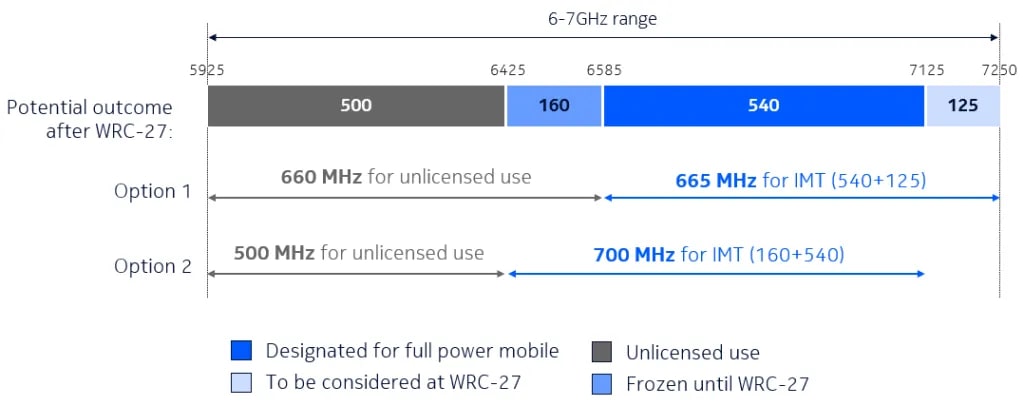
Our story starts two years ago as we spent several weeks in Dubai taking part in, and contributing to the deliberation at the WRC-23, where some initial directions for 6G were agreed upon. They laid the groundwork for the spectrum resources needed to enable future connectivity and support continued growth. The ITU WRC agreed to study for WRC-27 spectrum bands from the 4.4-15.35 GHz range as future candidates for 6G while designating the upper 6 GHz band for mobile broadband services.
Fast-forward to today. With WRC-23 now behind us and WRC-27 on the horizon, we are pleased to see the progress made by many regional and national administrations. The debate is no longer about the value or necessity of 6G. Instead, the focus has shifted to how much spectrum, and from which bands, should be made available to allow the next era of connectivity to truly flourish.
The transition to 6G will coincide with an unprecedented increase in mobile data traffic driven by the AI supercycle, ubiquitous immersive services (XR) and video, across consumer and industrial domains. To meet these demands, 6G networks need to deliver substantially higher peak and average data rates, also in the uplink, support extremely low end-to-end latencies including low time-to-first-token of LLMs, and provide reliable connectivity at scale, all of which require wider contiguous channels and therefore additional spectrum resources.
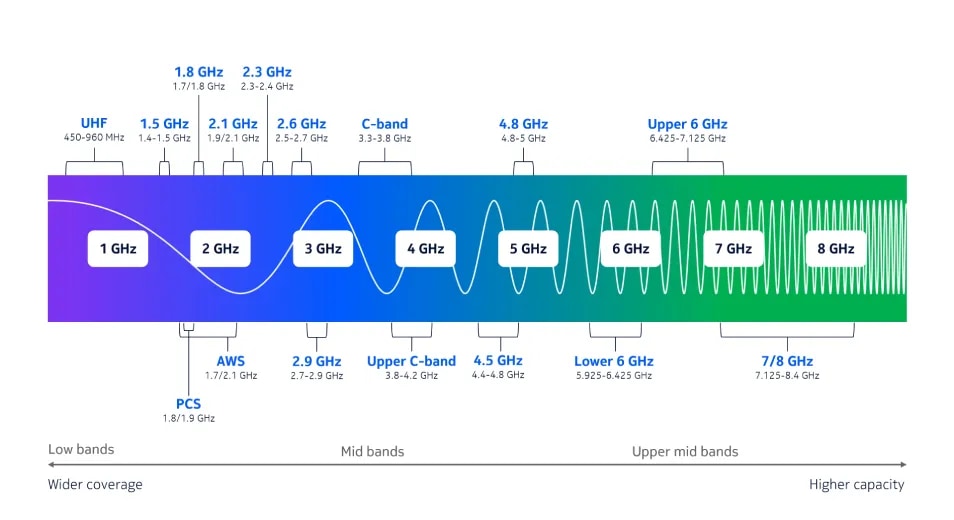
The existing low- and mid-band spectrum, with a total bandwidth of 1-1.2 GHz, is insufficient to meet the capacity and performance targets envisioned for 6G, making availability of new spectrum a prerequisite for 6G. The industry estimates that additional 2-3 GHz mid-band spectrum is needed for 6G, to accommodate the wide-range channel bandwidths of at least 400 and up to 750 MHz per telecommunication provider. This will enable them to handle not only traffic-hungry applications, but also latency-sensitive ones. The image below shows the naming of the different spectrum bands in the low and mid-bands in use and under evaluation for 6G.
As we moved towards the second half of the decade, the outlook for 6G development and standardization is increasingly positive. There is a real shift across regions, as policy decisions and industry actions converge on a common objective: finding the spectrum foundation that will unlock the next generation of digital infrastructure.
While the details are still evolving, the direction is clear: the world is set to prepare a home for 6G in the mid-bands. In particular, the upper 6 GHz and 7/8 GHz ranges emerge as potential options. The physical characteristics of these bands together with advancements in antenna technology make them a sweet spot for balanced capacity and coverage when used on the existing C-band grid.
Europe: the long-term vision for Upper 6 GHz points to at least 650 MHz for 6G by 2027
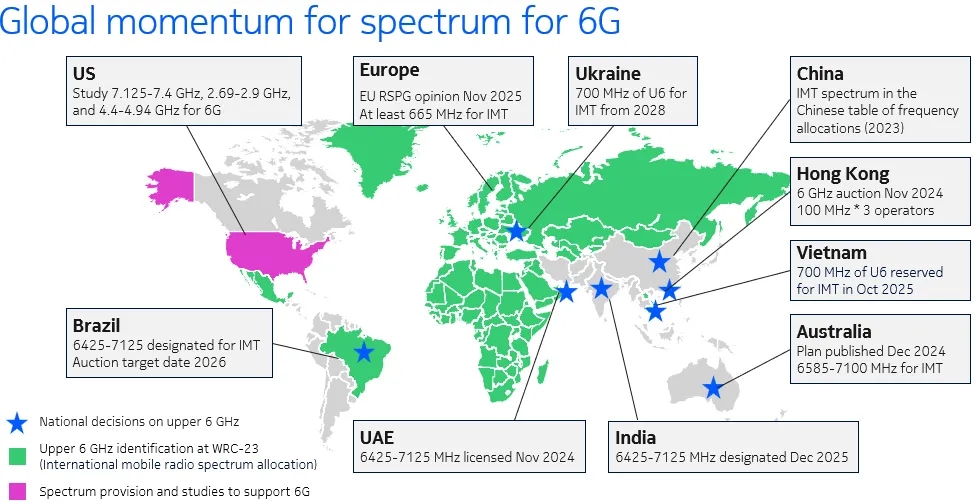
Europe has taken a significant step forward with the RSPG's long-term vision on the use of the upper 6 GHz band. The direction outlined creates a clear path towards securing at least 665 MHz of spectrum for 6G, acknowledging the strategic importance of wide, harmonized mid-band resources for 6G performance targets.
This aligns with Europe’s long-standing commitment to balanced spectrum policy that supports both innovation and societal needs, while preparing the demands that 6G services will place on national networks.
Nokia is working closely with telecommunication providers and research partners across Europe to establish the upper 6 GHz band as a cornerstone for 6G. Field trials conducted with operators across Europe last year validated the potential of reusing the existing outdoor macro grid, demonstrating comparable performance to that of the 3.5 GHz deployment in real-world setups, as well as the multi-gigabit potential of the upper 6 GHz band. We did successful trials with Telia, A1, BT, Orange (France and Belgium) and Telefonica, amongst others.
United States: for the next wave of connectivity, up to 800 MHz under consideration
Recently the U.S. released the Presidential Memorandum Winning the 6G Race which represents a good step in advancing 6G development and recognition of the role of spectrum in 6G leadership. It complements the spectrum provisions in the One Big Beautiful Bill Act (OB3). The memorandum directs federal agencies to identify and study spectrum bands for future 6G use, requires NTIA to finish its study of the 7.125-7.4 GHz band by end of year 2026 and identify the band for high-power commercial wireless. It also requires agencies to immediately study 2.69-2.9 GHz and 4.4-4.94 GHz, making up to ~600 MHz additional spectrum for 6G. In addition, under the OB3 spectrum provisions the upper C-band (3.98-4.2 GHz) is to be auctioned no later than July 2027. These spectrum provisions under the memorandum and OB3 secure as much as 800 MHz of mid- and upper-mid-band spectrum to power up the future connectivity, playing a crucial role in the U.S. to develop 6G and emerging technologies. However, subsequent steps are needed to complement these decisions and ensure that at least 400-750 MHz of contiguous spectrum per carrier is available for 6G to enable a robust national 6G spectrum strategy and leadership.
India: ambitions for more than 1300 MHz between 6-8 GHz
India has emerged as one of the most forward-leaning markets in the global 6G discussion. Policymakers are examining ways to make over 1300 MHz in the 6-8 GHz range available for IMT. Given its rapidly expanding digital economy and strong national focus on advanced R&D, India’s engagement signals a strategic determination to ensure that the availability of spectrum keeps pace with its national digital ambitions. The mid-2025 decision of allocating the upper 6 GHz for mobile has been a cornerstone towards being a leader in the 6G discussion and in December India published its updated national frequency table in which the decision is confirmed and the band is designated for IMT.
Japan: exploring the promise of 7 GHz
Japan continues its long tradition of proactive spectrum planning by initiating detailed studies around the 7 GHz band. This includes technical work, engagement with the ecosystem, and propagation assessments aimed at understanding how this spectrum can power new 6G capabilities, particularly in ultra-reliable, high-capacity deployments. The latest report of the XG Mobile Promotion Forum (XGMF) evaluates the 6-8 GHz range. Last summer, Nokia collaborated with Softbank on a trial that confirmed the feasibility of the 7 GHz band for 6G in Japan.
Middle East: regional leadership in 6G exploration
Likewise, Middle Eastern countries are positioning themselves for early leadership in 6G. In November 2024, the United Arab Emirates decided to award the full upper 6 GHz to the mobile telecommunication providers, and national 6G initiatives are shaping up, reinforcing the country’s strategic intent to be among the first adopters of next-generation connectivity frameworks. We did a live 6 GHz field deployment on du’s commercial spectrum.
Similarly, Saudi Arabia investigates into the 7 GHz band, supported by hands-on technology exploration including our proof-of-concept with CST, which demonstrated the potential of future 6G applications in the upper-mid-band.
Positions from Saudi Arabia and the wider MEA region indicate the interest towards 6G as early movers and the 7 GHz band is anticipated to be standardized as an IMT band around 2030.
Additional developments across the globe
Other key markets such as China and Brazil are stealing a lead over other regions in assigning the upper 6 GHz band for mobile use. In July 2023, China added IMT identification for the upper 6 GHz band to its National Table of Frequency Allocations (NTFA) and Hong Kong concluded in January 2025 the world’s first auction of the band. This year, the Brazilian regulator will award the entire upper 6 GHz band to fulfill the promises of 5G-Advanced and 6G.
Other countries in the Asia-Pacific region are also moving forward with planning spectrum for 6G, with Sri Lanka, Indonesia, Thailand, Bangladesh and Cambodia adding the upper 6 GHz band into their spectrum roadmaps. Vietnam approved the upper 6 GHz band in its new national radio frequency master plan, opening it for 6G.
Solidifying the foundations of 6G
Making new harmonised spectrum available is a lengthy process for national administrations and can take years. Every four years, the ITU’s World Radiocommunication Conference (WRC) reviews and updates international spectrum agreements, bringing together administrations and policymakers to determine future allocations that support countries’ digital-connectivity goals.
The current 6G momentum shows a clear shift from exploration to preparation. Decisions made in the run-up to ITU WRC-27 will be critical, setting the direction for 6G spectrum availability and harmonisation for decades to come.
With regulators increasingly aligned around securing substantial upper-mid-band spectrum, 6G’s spectrum story is beginning to crystallize. This alignment will accelerate innovation, trials, and ecosystem development. As spectrum is the core resource upon which tomorrow’s networks will be architected, the choices made now will play a pivotal role in shaping global connectivity in the next era of digital transformation.
About Mirela Andouard
Mirela Andouard is Senior Spectrum Standardization Specialist in Nokia’s Strategy & Technology team, contributing to the definition and execution of the Nokia spectrum strategy and engaging with customers, regulators and ecosystem partners worldwide on spectrum matters. She handles aspects from technical analysis and recommendations for policies and standards related to spectrum management for mobile technologies to shaping harmonized regulatory frameworks on spectrum matters in Europe and worldwide.
Eiman Mohyeldin is the global Head of Spectrum Standardization for Nokia, responsible for defining and executing Nokia's spectrum strategy and leading Nokia's engagement on spectrum matters with customers, regulators authorities and partners in the ecosystem worldwide. She is actively involved in the World Radio Conference (WRC) process, participating in the WRC Conferences and preparatory meetings (CPM). Eiman has also contributed and led groups for the IMT technology process (4G, 5G and recently the 6G) in ITU and CEPT. Eiman is Co-Coordinator in CEPT NOW4WRC23 promoting gender equity and parity in CEPT and ITU.