

Cable operators
Advancing connectivity for a new generation of cable services

The cable industry is at the cusp of its largest transformation in its history. Cable operators are pivoting from being primarily providers of video and broadband. They are increasingly the connectivity engine behind internet-based OTT, streaming, enterprise and IoT services, as well as the critical conduit for generative and agentic AI services. Cable operators are poised to capture large shares of these emerging and fast-growing markets by investing in network and digital transformation, convergence and virtualization. Nokia can prepare you to meet these opportunities head on.
Evolve your network
Boost network scalability and performance while reducing operating expenses. Go cloud-native and leverage AI to innovate and automate.
Grow market share
Support new business models while dynamically and cost-effectively adapting to changing customer demands.
Go to market quickly
Automate the design, delivery and assurance of AI-era services and offer them with minimal disruption.
Explore our cable operator solutions

Fiber broadband for cable operators
Maximize your investment as you evolve from HFC to FTTH. We deliver four generations of PON technology on the same hardware: GPON, XGS-PON, 25G PON and 50G PON. And the…

Gigabit Connect
In buildings where fiber cannot be cost-effectively deployed, our fiber-extension technologies deliver gigabit and multi-gigabit services over a building’s existing coaxial…

In-home connectivity
Nokia’s advanced mesh Wi-Fi 7 technology – embedded in our fiber optical network terminals (ONTs) and WiFi beacons – guarantees the highest speeds with the lowest latency in…

Optical Data Center Interconnect
Simple, scalable and efficient data center connectivity will maximize your return on investment and leverage key fiber assets to generate new revenue opportunities in the new…

Quantum-safe optical networking
Nokia’s quantum-safe solutions protect against the threat of future quantum-computing attacks by utilizing a unique symmetric-key management architecture.

Coherent Routing
Nokia’s coherent routing solutions turns the promise of IP over DWDM into reality, delivering 100G to 800G ZR/ZR+ across vendors with the operational simplicity your need.

Thin Transponder Layer
Streamlined pluggable transponders deliver much of the economic benefits of coherent routing without any of its operational challenges or any loss of functionality.
Broadband edge
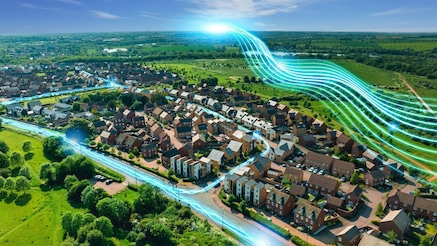
The Nokia Multi-Access Gateway plays a crucial role in delivering, assuring and monetizing broadband services over any type of access technology.

Deepfield
Our unified software platform provides the actionable network intelligence and automated DDoS security you need to deliver flawless service, neutralize security threats and…
Featured insights


Solution brochure
Broadband Network Gateway
Why choose Nokia?
A leader in advanced connectivity, Nokia has the expertise to help cable operators of any size plan, build and deploy networks with the highest performance, scalability, reliability and security. We have a deep understanding of the trends, opportunities and challenges facing the industry including fiber-to-the-home evolution, IP/optical network convergence, edge-data center migration and interconnect, and AI-driven network automation. Our comprehensive portfolio enables cable operators to innovate, introduce new services and streamline operations with next-gen networks that are AI-driven, autonomous and programmable.
Customer success stories

Customer success

Customer success

Customer success

Case study

Case study
Frequently asked questions
FTTH uses fiber all the way to the premises, giving operators more capacity, symmetrical multi-gigabit speeds, lower latency and more consistent signal quality than HFC. Its passive outside plant has no powered amplifiers, which can improve reliability and reduce energy use and maintenance. FTTH also provides a simpler long-term upgrade path: operators can introduce newer PON generations by changing equipment at the network endpoints while retaining the same fiber infrastructure. HFC remains valuable where existing coax can be reused, but reaching comparable performance generally requires more active equipment and ongoing outside-plant upgrades.
Cable operators should strengthen the network from access to core to prepare for the fundamental shift in the nature of traffic — as well as the volume — due to AI. They will need to expand symmetrical, low-latency capacity with fiber where practical; scale IP and optical transport to handle large, bursty flows between users, edge sites and data centers; and use coherent optics and high-capacity data center interconnects to add bandwidth efficiently. Cloud-native control, telemetry and AI-driven automation can help forecast demand, optimize traffic, accelerate service activation and detect faults before they affect customers. End-to-end visibility and automated DDoS protection are also essential as encrypted traffic and cyberthreats grow.
A thin transponder layer is a streamlined optical transport layer that provides a compact, power-efficient host for coherent pluggable optics. It delivers many of the cost, space and power benefits of coherent routing while preserving the operational separation and capabilities of a dedicated optical domain, including client aggregation, telemetry, alarm isolation and optical-layer resiliency. This enables operators to scale 100G, 400G and 800G transport more economically without placing coherent optics directly in routers or changing established IP and optical operating models.
Cable operators carry sensitive consumer, enterprise and infrastructure traffic that may need to remain confidential for years. Future quantum computers could break widely used public-key encryption, while attackers can already capture encrypted traffic today and save it for later decryption. Quantum-safe networking helps protect data in transit, maintain customer trust and support regulatory and critical-infrastructure requirements. Because identifying vulnerable cryptography and upgrading networks takes time, operators should begin now with a risk-based migration plan, crypto-agile systems and layered quantum-safe protection across IP and optical transport.
The broadband edge is the network boundary that connects subscribers to digital content and services. It manages access, service delivery, assurance and monetization across technologies such as fiber, cable and fixed wireless. A flexible broadband edge helps operators scale capacity, improve security and support new services with consistent performance.
Learn more

Topic

Blog

Blog

Blog
Blog

Blog

Blog

Blog
Ready to talk to a Nokia expert?
Please complete the form below.
The form is loading, please wait...
Thank you. We have received your inquiry. Please continue browsing.