

Reliability first
The new mandate for modern data center networks

Data centers have evolved to become critical information hubs that power everything from the apps on our mobile phones to the most complex industrial operations. Their role is being amplified by the rise of intensive artificial intelligence (AI) workloads that require instant processing and real-time insights.
To meet these new demands, modern data centers need reliable networks. Reliable data center networking is the foundation that enables traditional and AI workloads to deliver consistent performance. It’s also essential for preserving the continuity of every interaction.
Recent research by Futurum and Nokia confirms that IT leaders are focused on reliability when it comes to data center planning. Asked to identify the main decision criteria for building their next data center network, 86% of IT leaders surveyed named reliability. This outranks important factors such as ease of integration, operational simplicity and automation.
The reliability imperative in modern data centers
Data centers have never faced workloads as intensive as those presented by AI applications. To handle these workloads and deliver superior experiences, data center teams need reliable, high-performance data center networks that “just work” and are easy to operate.
Why is data center network uptime priority #1?
Businesses are highly motivated to invest in data center reliability because downtime is costly. Consider these results for a survey question about the impact of an unforeseen one-hour data center network outage.
said the outage would critically disrupt internal workflows
said it would create a major customer-facing service disruption
said they would lose significant revenue

What causes data center network outages?
A data center network outage clearly isn’t just an IT issue. It directly affects an organization’s plans, operations, customers, revenue and bottom line. Simply put, an unreliable data center network brings business risk.
Unfortunately, outages happen all too often, and network hardware failures and human errors are the most common causes. The survey revealed that 74% of companies had at least one significant data outage in the past 12 months. They fared better than the 46% that had one to two outages, 17% that had three to five outages and 11% that had six or more. Outages lead to productivity loss, extra work for IT teams and unhappy customers—all of which are bad for business.

Research report
The data center networking imperative
What’s driving the next era of data center networks?
The good news is that organizations can make their data center networks more reliable. By building reliability into system design; choosing modern technologies, architectures and tools that enhance reliability; and making quality testing a key focus area.

Infographic
The modern data center network checklist

How do you quantify the impact of reliability?
Bell Labs Consulting and Futurum recently collaborated on a comprehensive data center fabric reliability study. The study aims to identify the factors that contribute most to network reliability, quantify the operational and financial impacts of downtime, and provide actionable guidance for making data center networks more reliable.
Using a model developed by Bell Labs Consulting, the study compares a legacy (existing data center networks that may include proprietary operating systems, manual operational processes and minimal automation) present mode of operation (PMO) with a best-of-breed future mode of operation (FMO). The FMO is based on the Nokia Data Center Fabric solution.

Executive summary
Redefining reliability in modern data center networking
How do new tools unlock the full benefits of reliability?
Nokia uses the Data Center Fabric solution as the key enabler for its Human Error Zero strategy to eliminate vendor mistakes (such as software bugs) and user mistakes (such as misconfigurations) from data center networks. The data center fabric reliability study shows how the solution helps data center teams eradicate human error by:
- Adopting a unique quality-first approach to hardware and software design.
- Leveraging Nokia SR Linux network operating system (NOS) and Nokia Event-Driven Automation (EDA) platform to bring greater reliability and predictability to network operations.

Infographic
The path to 5-Nines for data center networks
The Nokia Data Center Fabric-powered FMO delivers major availability improvements, downtime reductions and financial benefits compared to the legacy PMO.
reduction in downtime vs. PMO
5.1 nines availability with FMO
reduction in downtime for configuration and provisioning
reduction in downtime for operations and monitoring
How a global enterprise modernized its data center network
Nokia is using its own Data Center Fabric solution for a major brownfield data center network migration project. The project involves replacing legacy data center networking equipment in 17 global data centers that support 88,000+ employees working remotely and in more than 200 offices.
Migrating to SR Linux and EDA allowed the IT team to take advantage of the solution’s enhanced abstraction, programmability and digital twin functionality to simplify network operations. The team experienced an 80% reduction in data center network incidents. It also spent much less time on repetitive tasks and more time on strategic work.
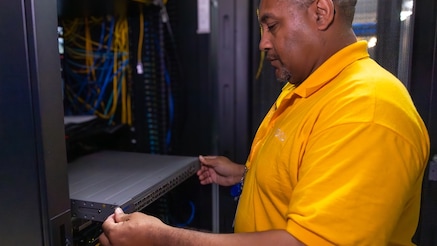

Nokia SR Linux and EDA are boosting reliability at more Nokia data center sites by:
- Making network operations more predictable.
- Ensuring simple deployment, configuration and operations.
- Simplifying migrations, infrastructure changes and software upgrades.
- Keeping experts from having to do repetitive work.
Four things to know about data center fabric reliability
1. Turn high availability from an aspiration into a measurable, cost saving reality
High availability in the data center is no longer a dream. With a best-of-breed modern data center fabric, organizations can implement and benefit from it today.
2. Network teams need to be empowered
Operations teams need new tools to achieve their mean time to innocence goals. The right solution and a quality-first approach can ensure the data center network is no longer the cause of high downtimes.
3. AIOps and automation can ease pressure on network teams
Implementing data center network automation and AIOps helps reduce alert fatigue and work stress for network teams.
4. The barrier to adopting network automation just got lower
It’s easier than ever to embrace intent-based automation that improves data center reliability and drives operational agility and efficiency.
Learn more











The Age of Operations: Third Party Views of DCF Innovation

Please complete the form below.
The form is loading, please wait...
Thank you. We have received your inquiry. Please continue browsing.