Board of directors
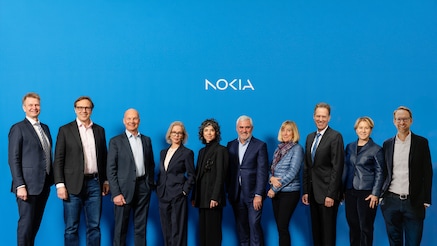
Meet the board
Nokia board members

Committees of the board
Committees of the board
Election and composition of the Board of Directors
Under our Articles of Association, the Board has between seven and 12 members, elected annually by the Annual General Meeting. Candidates are considered individually. Board members’ terms begin at the close of the meeting at which they are elected and end at the close of the next Annual General Meeting.
The Board annually elects a Chair and Vice Chair, confirmed by the independent directors upon the recommendation of the Corporate Governance and Nomination Committee. The Chair’s duties are set out in Finnish law and our Corporate Governance Guidelines. The Vice Chair acts for the Chair when needed.
The Board has adopted diversity principles to support a well-balanced composition. Board composition evolves with Nokia’s business objectives and future needs. We view Board diversity as a factor that supports the Board’s overall effectiveness. Diversity is considered by reference to skills and experience, tenure, age, nationality, cultural and educational backgrounds, gender and other individual qualities.

Operations of the Board of Directors
The Board represents and is accountable to Nokia’s shareholders, while also considering the interests of other stakeholders. The Board of Directors oversees Nokia’s governance and administration in accordance with the Finnish Companies Act, Nokia’s Articles of Association, and the governance framework approved by the Board, including the Corporate Governance Guidelines and the charters of the Board committees. The Board regularly evaluates Nokia’s strategic direction, management policies and their effective implementation by management.
Board members must act in good faith and with due care, exercising informed business judgment in the best interests of Nokia and its shareholders. The Board and its Committees may appoint independent legal, financial or other advisers as needed, with sufficient Company funding for their work.
The Board is ultimately responsible for monitoring and reviewing Nokia’s financial reporting process, related control and audit functions, the independence of the external auditor and the statutory audit. It also oversees top management structure and composition, legal compliance and operational risk management. The Board may set annual ranges or limits for capital expenditures, investments, divestitures and other financial or non-financial commitments requiring separate approval if exceeded. Risk management is part of Board deliberations, including financial, strategy and business reviews, updates and decision-making proposals.
The Board appoints and discharges the President and Chief Executive Officer, Chief Financial Officer and Chief Legal Officer. The Board approves, and the independent directors confirm, the President and CEO’s compensation and employment terms under Finnish law, upon Personnel Committee recommendation. Compensation and employment terms for other Group Leadership Team members are approved by the Personnel Committee upon the President and CEO’s recommendation.

Board oversight of environmental and social activities and governance practices (ESG)
Under Nokia’s Corporate Governance Guidelines, the Board oversees Nokia’s environmental and social activities and governance practices, including related risks, opportunities, targets, disclosures and performance. The Board reviews the effectiveness of these activities and provides direction on matters relevant to Nokia’s strategy, long-term value creation and stakeholder expectations. The Board Committees monitor ESG-related developments and activities within their respective areas of responsibility.
The Audit Committee reviews sustainability disclosures and information relating to conflict minerals in Nokia’s products. Its responsibilities include oversight of sustainability reporting, regulatory developments and Nokia’s ethics and compliance program. The Personnel Committee oversees human capital management, including Nokia’s culture, physical safety, employee well-being, workforce composition, recruiting, development and retention. The Corporate Governance and Nomination Committee assesses and advises the Board on ESG-related activities, practices and governance structures. The Technology Committee reviews how ESG considerations are reflected in Nokia’s technology strategy and roadmaps.
While oversight of security risks, including cybersecurity, is a Board-level responsibility, detailed reviews are allocated to the Board Committees within their respective areas of responsibility. The Audit Committee oversees IT and services security risks and related controls, compliance and risk management processes, while the Technology Committee oversees product and customer security risk management. The Committees report regularly to the Board and make recommendations as appropriate.
The Board’s oversight of artificial intelligence is based on principles similar to those applied to other advanced technologies. The Technology Committee oversees Nokia’s AI governance framework and the arrangements supporting compliance with applicable AI-related requirements. The Committee also monitors the strategic and operational use of AI and reports regularly to the Board on related developments.

Independence
The current members of the Board are all non-executive.
The Board annually evaluates the independence of its members in accordance with the Finnish Corporate Governance Code, the rules of the New York Stock Exchange and Nokia’s Corporate Governance Guidelines. The assessment considers all relevant facts and circumstances that may affect a director’s independence.
The Board has determined that all current Board members are independent of Nokia’s significant shareholders. Meredith Whittaker has been determined not to be independent of the Company due to her research-focused advisory role with Nokia Bell Labs. All other current Board members are independent of the Company.
The Board has determined that all current Committee members meet the applicable financial literacy and financial sophistication requirements. Certain Committee members have also been designated as audit committee financial experts in accordance with applicable U.S. securities laws and regulations.
All Board members’ positions of trust in other public companies are disclosed and their independence is reviewed and assessed on a regular basis.

Board evaluation
In line with our Corporate Governance Guidelines, the Board conducts an annual performance evaluation covering the Board, its Committees, the Board and Committee Chairs, and individual Board members. The evaluation is typically conducted as a self-assessment using a detailed questionnaire, while external evaluators are engaged periodically. Feedback is also sought from selected members of management.
The evaluation assesses the Board’s processes, structure, accountability, transparency and effectiveness, and identifies strengths as well as areas for further improvement. The results are reviewed and discussed by the Board each year, and improvement actions are agreed upon.

Meetings of the Board of Directors
The Board of Directors constitutes a quorum if more than half of its members are present.
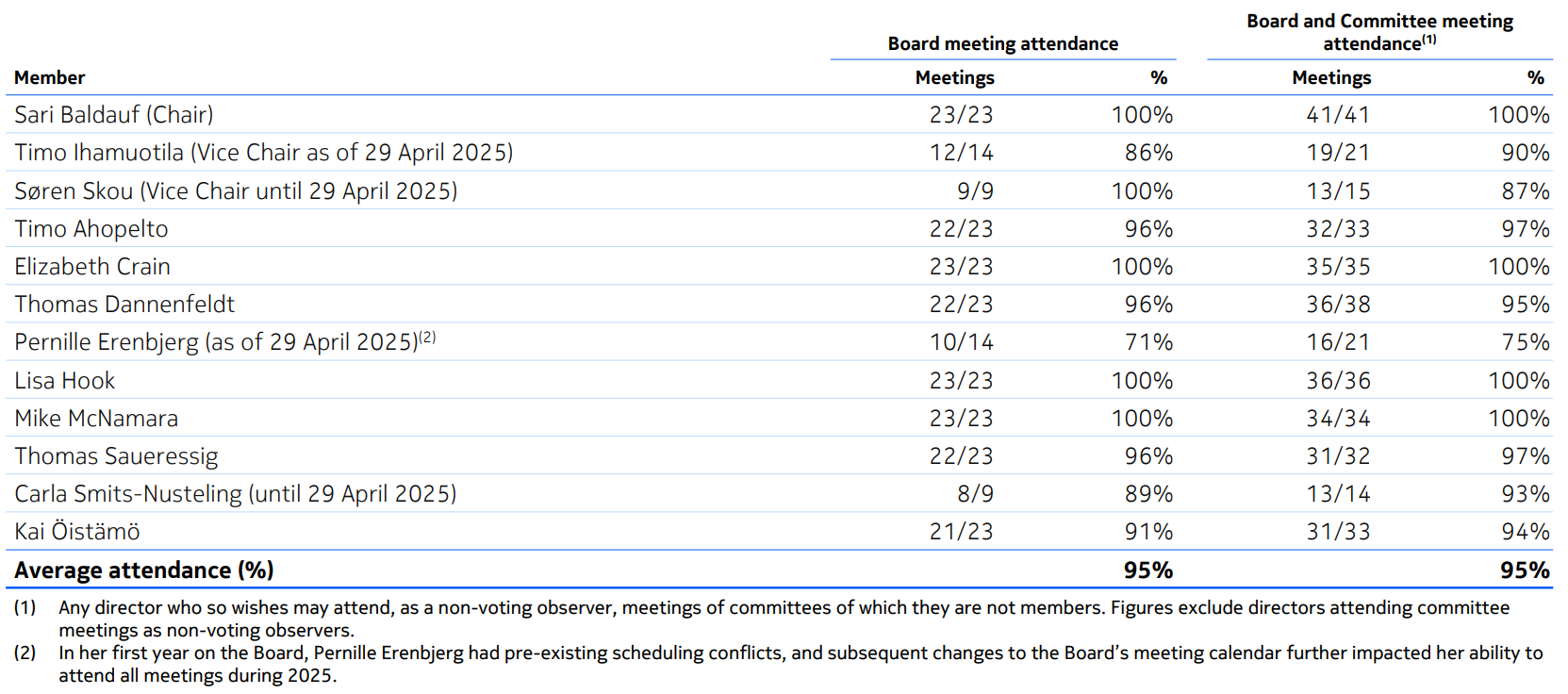
Directors’ attendance at Board and Committee meetings for the previous reporting year is set forth in the table below.