Subsea network solutions
Seamless and automated connectivity across global subsea and terrestrial networks
Unlimited connectivity for the AI era
Nokia subsea network solutions power many of the world’s longest fiber optic cables, delivering resilient and scalable transport connectivity across oceans and continents. Our solutions connect countries, data centers, and global networks, enabling high-capacity optical transport for AI, cloud, and telecom providers as well as subsea cable consortiums. Designed for both repeatered and unrepeatered subsea networks, Nokia subsea solutions deliver the unique features needed in subsea network applications, and maximize capacity and performance on the most demanding links. Built on our scalable, open, and compact modular platform, we provide a unified, optimized architecture for seamless end-to-end subsea and terrestrial backhaul networks.

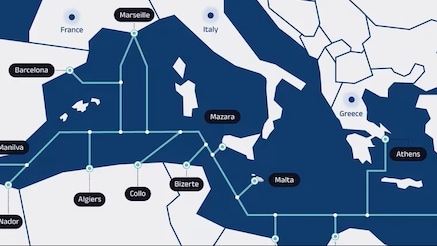
Nokia subsea network deployments
Seamless connectivity across subsea-terrestrial networks
Unified, open, compact modular platform delivering end-to-end subsea-terrestrial connectivity with transponder, SLTE ROADM and C+L backhaul support.
Complete solution for all subsea applications
Comprehensive support for all SLTE and subsea features across repeatered and unrepeatered festoon cable systems.
Intelligent automation and control
Simplified operations via end-to-end management, intelligent power control, automated planning and optimization, provisioning and protection.
Empowering worldwide reach for subsea
Fully featured end-to-end solutions for subsea networks.
Optimizing end-to-end subsea-terrestrial networks
Subsea and terrestrial backhaul networks for all use cases.


The unifying role of subsea fiber networks
Learn about the role of subsea fiber networks to enable the AI supercycle.
Nokia Subsea Network Solutions
Seamless global connectivity engineered for the AI-driven world
Customer success highlights


Frequently asked questions
In subsea networks, a “repeater” refers to electrically powered, erbium-doped in-line amplifiers (ILAs) placed along the subsea fiber cable to boost optical signals over long distance. For spans greater than a few hundred kilometers – especially trans-oceanic links exceeding 10,000 km – repeaters are essential to maintain signal strength across the link. Unrepeatered cables, by contrast, rely on high-power optical amplification at the cable end points on land, enabling links up to 500 km without any subsea repeaters. This is achieved using high output power EDFA and Raman amplifiers, including remotely-pumped Raman amplifiers where the pump laser is on land and the Raman gain occurs undersea.
To transmit data across trans-oceanic distances spanning thousands of kilometers, the fiber cables used in subsea networks use optical ILAs at regular intervals to boost signal power and maintain optimal optical signal-to-noise ratio (OSNR). These ILAs operate in constant power mode and require a full load of WDM channels. When some WDM data channels are inactive – such as when adding additional capacity on a fiber, or due to equipment outages – ASE is inserted to “fill” unused spectrum. This ensures the ILAs receive the desired input power levels to preserve performance and stability across the subsea network.
SDM or Spatial Division Multiplexing, increases subsea network capacity by increasing the number of parallel fibers between endpoints. SDM is the spatial equivalent of Wavelength Division Multiplexing (WDM), which increases fiber capacity by transmitting multiple data channels, each on a different wavelength, in parallel over a single fiber. In subsea networks, the term SDM is often applied when 24 or more fibers are bundled together in a single cable, and/or when multi-core fibers are used, where a single fiber may have two or more cores that can carry separate data streams.
Resources
Related solutions and products
Product
Product
Product
Learn more

Blog

Blog
Blog
Blog