
Articles
6G explained
Every generation of communications technology shifts the network's focus. In the 6G era, digital, physical and human worlds will seamlessly fuse.
Select your country
We have limited content available for some countries. Find office information and country specific informations through our country hub.


Expand and transform your connected world
5G-Advanced will bring out the richest capabilities of 5G over the coming years, breaking down boundaries and expanding connectivity. From immersive extended reality (XR) experiences to high-precision location, presence and timing technologies, 5G-Advanced will profoundly transform what you can achieve with a cellular network.
AI data collection and analytics, coupled with introducing AI technologies in Core, RAN and network management, is expected to bring many benefits including vital new levels of energy efficiency.
Through the 3GPP standards body, Nokia is in the process of making 5G-Advanced happen. The specification of the first release of the 5G-Advanced era, Release 18, was frozen in June 2024, meaning that the specification has reached a stable state where no further technical changes are permitted. It is a crucial step in the standardization process, providing a clear and stable foundation for the development and deployment of this new technology. The second and last major release of 5G-Advanced, Release 19, started recently and will be completed by the end of 2025.
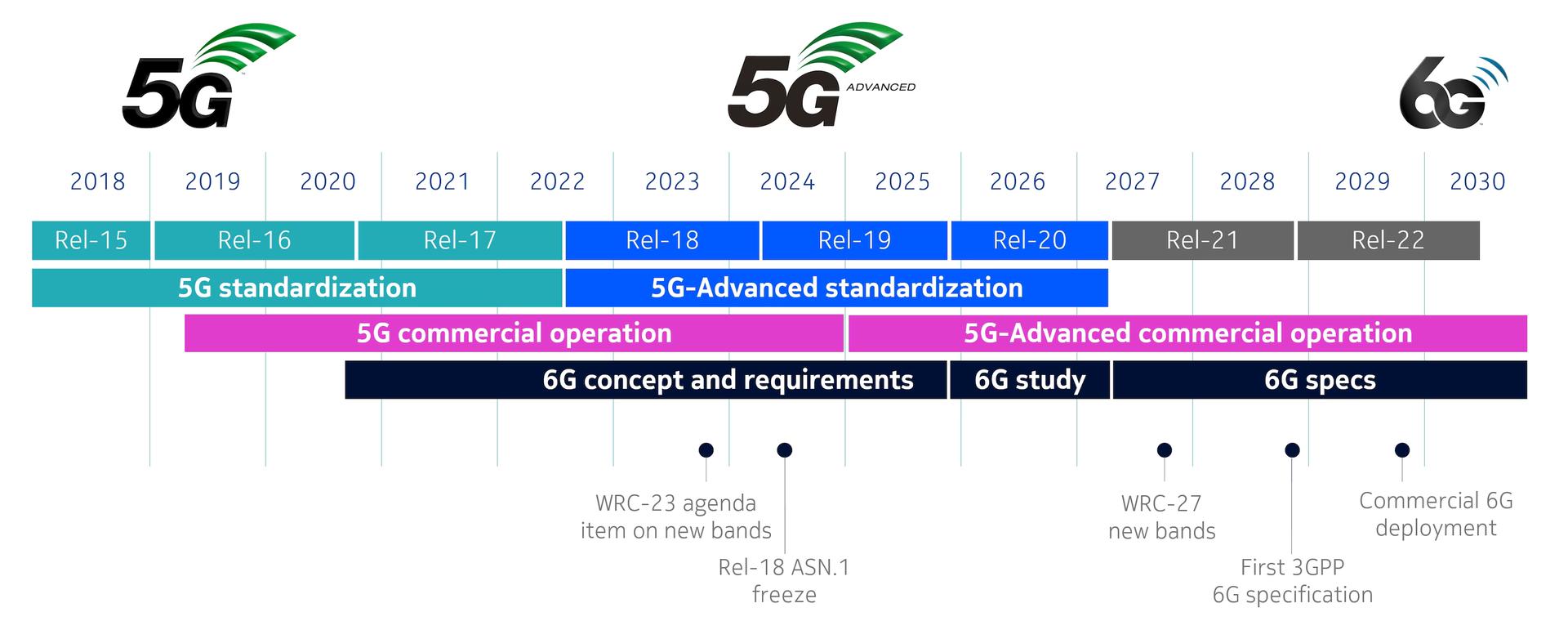
Nokia and its research arm Nokia Bell Labs have already started the research and pre-standardization work on 6G with the aim of making it commercially available by the end of this decade.
The 6G era will radically transform what a network can do, seamlessly fusing the digital, physical and human worlds to trigger extrasensory experiences. Intelligent knowledge systems will combine with robust computation capabilities to redefine how humans will live, work and take care of the planet.
Articles
Every generation of communications technology shifts the network's focus. In the 6G era, digital, physical and human worlds will seamlessly fuse.
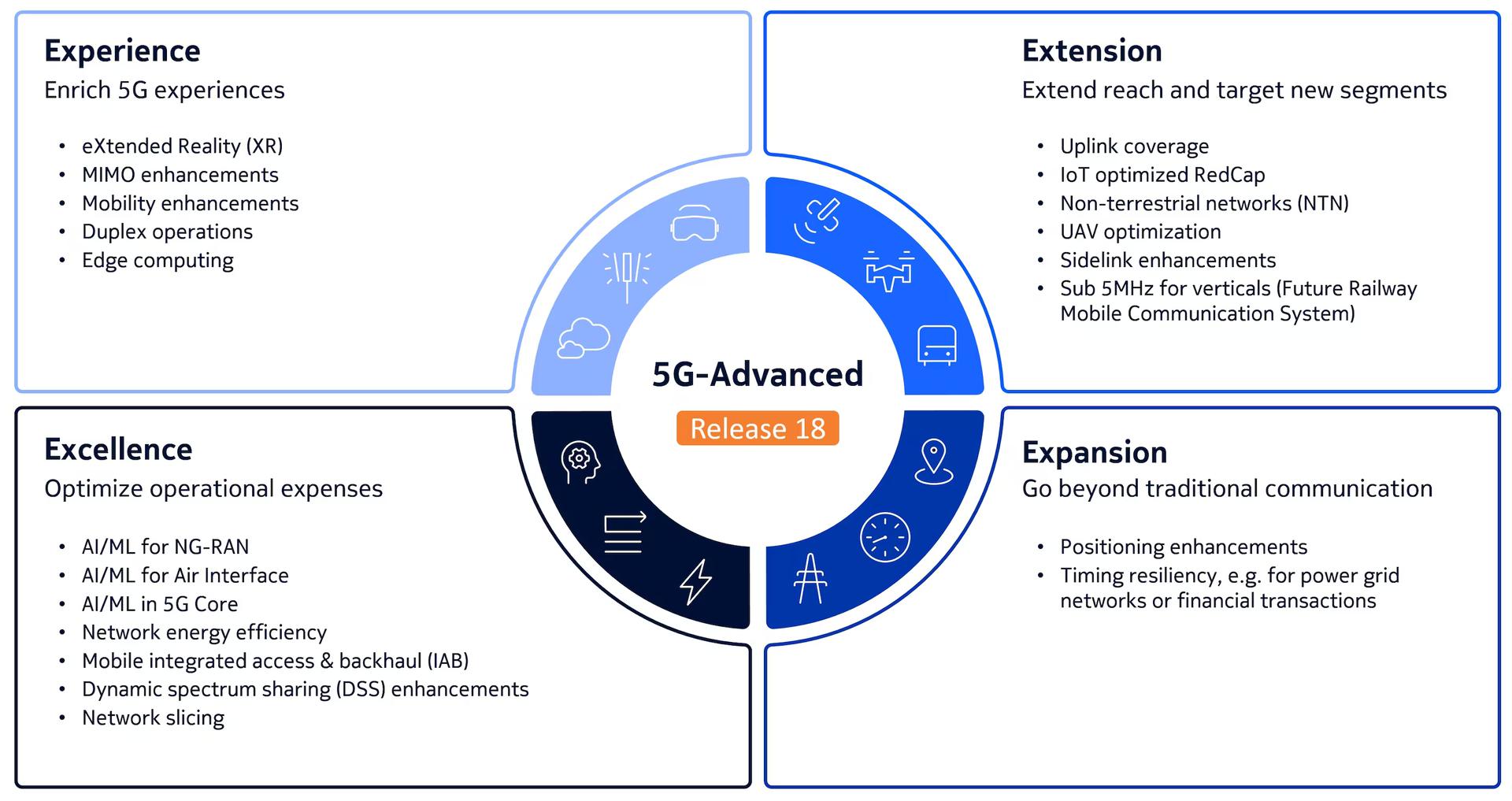
As a prominent player in the standards community, Nokia has been deeply engaged in shaping the specification work across all Technical Specification Groups of the 3GPP over the past 25 years. Our broad perspective on 5G-Advanced goes beyond viewing it as a mere collection of enhancements and features compared to 5G. Instead, we see it as a transformative tool for service providers to revolutionize their networks in significant, yet well-defined ways. Specifically, 5G-Advanced will improve network capabilities across four dimensions: experience, expansion, extension, and operational excellence. We refer to these dimensions as "the four E’s."

With experience, we are targeting augmented user experiences. 5G-Advanced will revolutionize digital experiences, making them truly immersive and allowing us to interact with distant physical environments and people in exciting, novel ways. We are making the network ready to support immersive XR experiences such as events and concerts.
With extension, we want to reach and target new segments. Broadband is crucial to social life and economic activity, yet many areas still lack coverage. With the advancements in Non-Terrestrial Networks (NTN), 5G-Advanced will help close this gap, providing more people and industries with access to the economic benefits of mobile connectivity.
With expansion, we can go beyond traditional communication. While today's 5G networks excel in delivering information, 5G-Advanced will excel in providing precise answers to “where” and “when” questions. Innovations in high-precision location, presence, and timing technologies will expand the network’s role beyond just communication.
With excellence, we want to optimize the operational expenses of deploying a cellular network. 5G-Advanced will continue to evolve 5G features like network slicing and wireline-wireless convergence, enhance mobility, and introduce new capabilities for exceptional operational performance. Energy efficiency is a key focus, with AI and machine learning driving significant energy savings across the Radio Access Network (RAN) and core network.

5G-Advanced is compatible with a broad array of connected devices beyond the smartphone, as new advanced features are introduced to enable a wide IoT ecosystem that allows for low-cost and low-data rate connections. These connections can power always-on, automated, mission-critical applications with extremely low latency and pin-point accuracy. Together with upcoming network slicing innovations, 5G-Advanced is set to enable and expand many exciting new consumer and industrial use cases in 2025, and beyond. Such as:

Topics
Enhance performance, unlock new revenue opportunities and optimize network efficiency with 5G-Advanced.
Videos

Videos

Topics

Articles
Topics

Articles