

How are coherent pluggable optics evolving from terrestrial to subsea networks?

Darwin’s observations of natural adaptation led to his theory of evolution, now recognized as continuous improvement in living things. Nature abounds with examples: giraffes evolved long necks to reach high leaves other animals couldn’t eat; cheetahs have powerful legs and lean frames to outrun antelopes, and today’s Homo sapiens evolved speech, manual dexterity, and an expanded frontal cortex that enabled deep reasoning, planning, and complex social cooperation.
The invention of the transistor in 1947 enabled the development of silicon integrated circuits (ICs) and spawned another evolutionary theory: the famous Moore’s law. This drove the evolution of silicon ICs: today’s 14A silicon is now approximately 10-million-fold denser than six decades ago, spawning devices such as CPUs, GPUs, TPUs and digital signal processors (DSPs).
How have coherent optics evolved?
Leveraging Moore’s law, DSPs became powerful and efficient enough for the complex processing needed for coherent transmission over optical fiber. Coherent DSPs enabled another evolution, from simple on-off-keyed (OOK) optical transmission that limited practical data rates to 10Gb/s to coherent transmission at speeds of 40Gb/s and 100Gb/s initially, and 1.6Tb/s today.
Early coherent DSPs initially designed in 130nm to 65nm silicon were large, power-hungry, and embedded in linecards. However each new generation leveraged the latest silicon node geometry, increasing speed and computational complexity to raise capacity per wavelength while reducing power use. Continued DSP power reductions and miniaturization eventually enabled coherent optics for small form-factor pluggable modules, initially sacrificing transmission performance compared to performance-optimized embedded optics.
First introduced in 100G CFP then 200G CFP2 variants, the next evolution of pluggable coherent optics was enabled by the introduction of coherent DSPs in 7nm silicon that supported 16QAM modulation and enabled wavelength speeds up to 400G in compact QSFP-DD form factors (figure 1). Industry standards including 400ZR, 400OpenZR+ and OpenROADM helped support widespread adoption of 400G coherent pluggables, leading to large deployment volumes of 400ZR by cloud and AI providers for metro data center interconnection (DCI), and 400G ZR+ by telecommunications providers for regional transport applications over hundreds of kilometers, with research firm Cignal.ai reporting nearly $6 billion of shipments by end-2025.
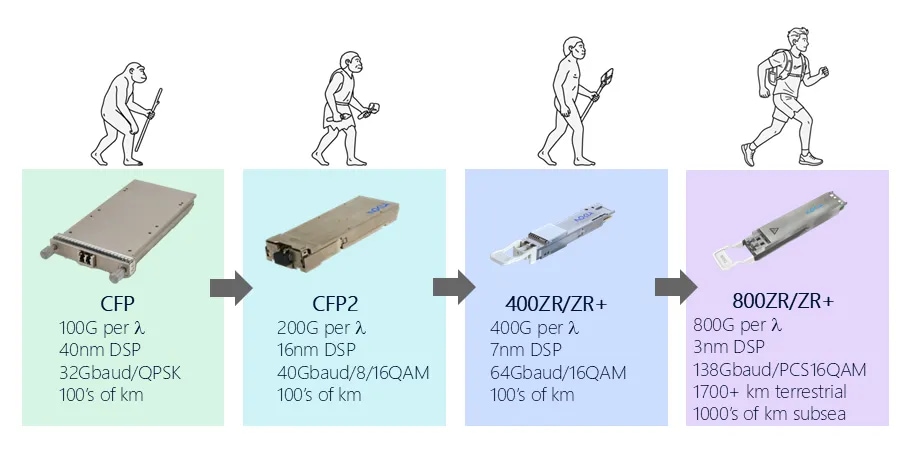
Figure 1: Pluggable coherent optics have evolved to enable greater capacity, smaller form factors and longer reach
But evolution doesn’t stop. The latest generation of 800ZR/ZR+ pluggable coherent optics continues to leverage Moore’s law with 3nm DSPs to further reduce power per bit, while simultaneously increasing functionality and performance. This includes use of interoperable probabilistic constellation shaping (PCS), doubling baud rate to 138 GBaud, supporting speeds of 800G per wavelength and increasing chromatic dispersion compensation for operation over thousands of kilometers, with the result that 800G coherent pluggables are now widely deployed in DCI and scale-across applications over metro and long-haul distances.
Evolving coherent pluggables from terrestrial to subsea applications
So what comes next in the evolution of pluggable coherent optics?
If we go back to Darwin’s theory of evolution, it is well known that life initially evolved in the oceans, before “coming ashore” onto land about 3 billion years later. Interestingly, for coherent pluggables the reverse evolution is happening; from land to sea. Why is that?
Pluggable coherent optics, whether deployed in routers or in thin transponders, provide undeniable benefits for network operators in terms of lower power, greater system density and reduced cost per bit. Proven deployment in metro and long-haul networks thus has subsea cable operators asking whether these benefits can also be leveraged in subsea applications?
For example, subsea network operators can utilize coherent pluggables in unrepeatered festoon cables spanning hundreds of kilometers, and also across repeatered subsea cables spanning thousands of kilometers. In a trial on the Brazil-USA (BRUSA) cable operated by Telxius, Nokia and Telxius utilized ICE-X 800G coherent pluggables to transmit at 600G per wavelengths over 2,841km, and set a transmission record operating at 400G per wavelength over 5,862 km (figure 2). Future versions of coherent pluggable optics will further evolve performance to enable 800 Gb/s or more per wavelength over trans-oceanic cable distances, for example.
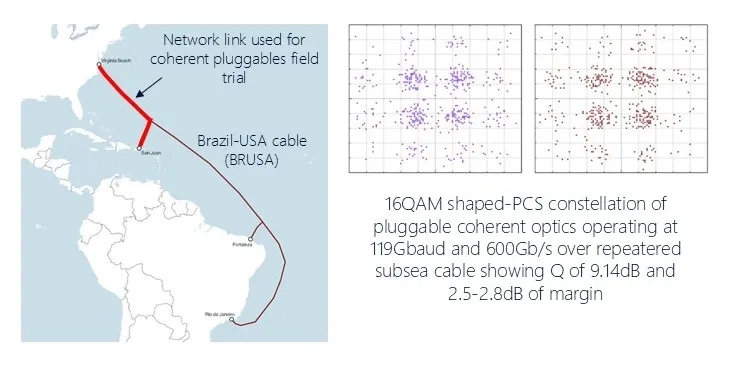
Figure 2: Telxius and Nokia demonstrated record transmission speeds using coherent pluggables over a repeatered subsea cable.
The use of coherent pluggable optics provides an additional tool for network operators to optimize their end-to-end networks. Performance-optimized coherent optics will remain a valuable tool for challenging applications such as extra-long subsea cables of 15,000km or more, or where operators require the absolute greatest capacity per fiber. However, in many cases subsea cable operators can now also consider coherent pluggables to optimize for power, space or cost.
For example, subsea operators deploying spatial division multiplexing (SDM) cables with capacities of 0.5 to 1 Petabit/sec may face increasingly congested and power-limited cable landing sites. This congestion at CLS sites is sometimes compounded when multiple newly deployed SDM cables converge onto the same, already congested CLS, driving even greater need to reduce power and increase density. Network operators may also desire operational simplicity by using the same 800G pluggable coherent optics for both their terrestrial backhaul and subsea networks.
In all these examples, coherent pluggables used for the subsea connections can enable the same reductions in power and cost per bit, operational simplicity and increased density that drives their adoption in terrestrial networks (Figure 3), with only minimal reductions in spectral efficiency on some subsea cables compared to performance-optimized optics.
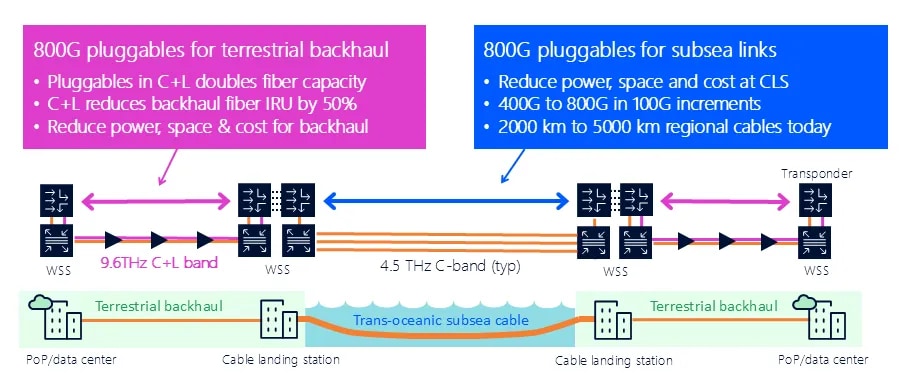
Figure 3: The latest generation of pluggable coherent optics provide new opportunities for network operators to optimize both terrestrial backhaul and subsea networks.
As coherent pluggables continue evolving from terrestrial to subsea networks, they give operators a practical new option for balancing reach and capacity with lower power, greater density, simpler operations and improved cost per bit—while performance-optimized embedded optics remain essential for the most demanding routes.
