How optical line systems are evolving for the AI era: the longer term

In part 1 of this blog series, I described the drivers for optical line system (OLS) evolution and the short-to-medium term trends. This blog will explore key potential long-term evolutions.
Beyond C and L (O, E, S, U)
As discussed in part 1, C and L bands can provide up to 11.6 THz with Super C plus Super L. Amplifier innovation may yet increase Super L spectrum from 5.5 THz to 6 or more THz, taking total capacity to 12.1 THz or beyond. For fiber-constrained network operators, using additional bands to maximize the capacity of deployed single-mode fiber (SMF) could be a very attractive option. These bands include the O-band, E-band, S-band and U-band, with their single mode fiber (SMF) properties summarized in Table 1.
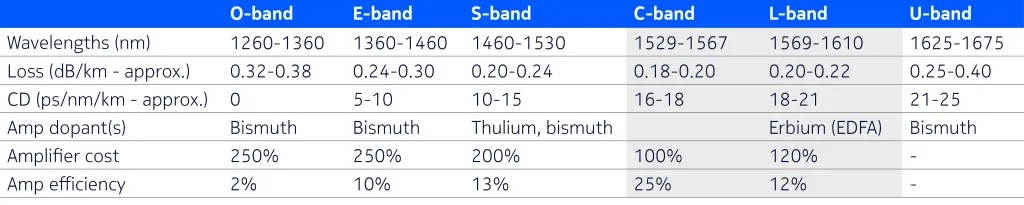
Table 1 - Band comparison: O, E, S, C, L and U (for SMF)
Adopting these additional bands, however, faces significant challenges. For the O-band, near-zero chromatic dispersion (CD) limits coherent performance, as high CD is needed to mitigate nonlinearities, including cross-phase modulation (XPM) and self-phase modulation (SPM). The O-band, E-band, U-band and, to a lesser extent, the S-band have high loss relative to C-band and L-band. Furthermore, the E-band can suffer from very high loss (approx. 2-3dB/km) in older SMF with high water peak absorption. The U-band is also limited by low bend tolerance.
Amplification is also a challenge. Bands beyond C and L require dopants such as bismuth and thulium rather than the erbium used for C and L. These amplifiers have much higher costs and deliver lower power conversion efficiency (Table 1).
A key challenge with using these bands alongside C and L is stimulated Raman scattering (SRS) tilt. For example, just as the C-band pumps the L-band, the S-band pumps the C-band. SRS tilt is therefore likely to limit which combination of bands can be used, and in turn the total useable spectrum.
Existing deployments add further complication, as some OLS already use these bands for the optical supervisory channel (1510 nm in the S-band) and OTDR (1625 nm in the U-band). Going beyond C and L also faces significant ecosystem challenges.
The next section discusses how hollow core fiber could be the catalyst for using bands beyond C and L.
Support for new fiber types: HCF and MCF
Unlike traditional fiber which has a glass core, hollow-core fiber (HCF), as the name implies, is hollow and filled with air or, more typically, a gas. Its refractive index is around 1, meaning light travels 50% faster and latency is reduced by approximately 30% compared to solid-core fibers such as SMF. In the short term, this lower latency is the primary driver for HCF adoption. However, HCF also has the benefit of low loss, with 0.04 dB/km the current state of the art. Nonlinearities are minimal, which has the potential to enable much higher launch power into the fiber. This higher power could be used to extend the distance between in-line amplifiers (ILAs) and require fewer ILA sites overall.
Alternatively, if traditional ILA spacing (e.g., 60-80 km) is maintained, this increased launch power could be used for higher OSNR at the receiver, enabling increased wavelength capacity and better spectral efficiency. HCF also offers much wider low-loss spectrum, and the absence of SRS tilt simplifies the use of bands beyond C and L.
Today’s OLS can be deployed with HCF using SMF-HCF adaptors, which may come integrated with the HCF. However, to take full advantage of the benefits of HCF, OLS will need to add the following capabilities:
- Higher power amplification, to benefit from HCF’s low nonlinearities.
- OTDRs with much higher transmit power (and/or dynamic range), to overcome HCF’s low backscattering.
- Support for bi-directional single fiber, to benefit from HCF’s low backscattering.
- Support for additional or different bands (O, E, S, U), including WSS and amplification.
Another novel fiber type gaining traction is multi-core fiber (MCF). These are typically uncoupled MCFs with between two and four cores. To adopt MCF, OLS could evolve with native MCF connectors, efficient MCF amplification (e.g., shared cladding, cladding-pumped) and core selective switching (CSS).
Full-spectrum transponders with integrated OLS functions
As the larger AI and cloud providers deploy multi-rail line systems, their capacity requirements are reaching levels where each fiber pair is fully loaded on day one. This is driving the industry to develop full-spectrum transponders (FSTs), which are a single transponder card with multiple coherent engines capable of filling an entire band (e.g., 16 x 300 GHz 1.6T) or full fiber (e.g., 32 x 300 GHz 1.6T) in a compact shelf.
A key driver for FSTs is faster and simpler deployment. FSTs can also take advantage of integration (e.g., co-packaged optics, client/line DSP integration, double-sided pluggables/media converters, large scale photonic integrated circuits, comb lasers), and innovative multi-wavelength modulation techniques to deliver significant cost, power and footprint savings. From an OLS perspective, FSTs typically integrate line system functions such as mux/demux and EDFAs, potentially significantly simplifying the OLS at the terminal sites.
Fiber switching and hybrid wavelength/fiber switching
As the industry shifts to multi-rail and FSTs, switching will evolve from wavelength-based ROADMs using wavelength selective switches (WSS) to fiber-based switching using optical circuit switches. Hybrid wavelength/fiber switching is a likely transitional step, offering significant scalability, Capex and power consumption benefits over wavelength-only switching as capacity scales in high-capacity core networks.
Meeting the longer-term requirements of the AI era
OLSs are evolving to increase capacity, reduce cost, space and power, simply operations and increase availability. In the near term, OLS innovation is focused on scaling capacity by improving coherent performance, increasing the available spectrum and by enabling multi-rail architectures. Longer-term evolutions may include bands beyond C and L, optimizations to maximize the value of new fiber types (HCF, MCF), FSTs with some integrated line system functions and a gradual shift toward hybrid wavelength/fiber switching and eventually fiber-only switching. Nokia recognizes these trends and has the R&D resources to evolve its broad OLS portfolio to meet the diverse requirements and applications of AI and cloud providers, telecommunication providers and mission-critical enterprises.
To learn more about this important topic download the new Nokia white paper: Optical line system evolution for the AI era