

Why Intelligent Care matters in the AI era

The network infrastructure industry is entering a new era. Artificial intelligence is moving rapidly from experimentation into operational reality. It is becoming embedded in networks, products and operations platforms, helping service providers improve efficiency, accelerate troubleshooting, predict issues earlier and make better-informed decisions.
The vision is compelling: fewer incidents, faster resolution, greater network resilience, lower operational costs and, ultimately, networks capable of managing many operational challenges autonomously.
But as networks become smarter and more automated, complexity does not disappear. It shifts behind the scenes, where it continues to evolve.
The paradox of intelligent networks
Open architectures, cloud-native and multi-vendor ecosystems create significant opportunities for innovation. They offer greater flexibility, scalability and choice. AI-powered automation can further simplify operations by identifying patterns, accelerating analysis and resolving routine issues with limited human intervention.
However, as networks become increasingly interconnected, controlling and recovering from unexpected situations becomes more challenging. The incidents that remain are often the most difficult ones: ambiguous situations, conflicting indicators, new failure patterns and unprecedented events with potentially significant business consequences.
As AI recommendations become increasingly embedded in operational workflows, there is a risk that users accept recommendations without fully considering the broader operational context. When recommendations are incorrect, errors can propagate quickly before they are detected.
Known faults can increasingly be prevented or resolved automatically. Predictable degradations can be identified before they affect service. Standard configuration issues can often be corrected using established automation and AI-driven procedures.
What remains are the exceptions: ambiguous, interconnected, and previously unseen situations that often carry the greatest business risk and potential impact. They require context, judgment, accountability, and expertise capable of navigating uncertainty when there is no predefined answer.
Why AI still needs human judgement
The future of network operations is sometimes framed as a choice between human-led operations and AI-led operations. I believe this is the wrong question.
The most effective model is not AI instead of people. It is AI working alongside people, with each contributing their unique strengths.
AI can process large volumes of information, identify patterns, retrieve relevant knowledge and propose possible actions at a speed that would be impossible for an individual expert. Human specialists contribute technical judgment, contextual understanding, experience and accountability. They can interpret conflicting signals, evaluate risk and decide how to proceed when a situation falls outside known patterns.
As networks become more autonomous, the value of human expertise does not disappear. Instead, it becomes concentrated around the moments that matter most, helping protect network performance, business continuity and customer outcomes.
This is the foundation of Nokia Intelligent Care.

Introducing the Intelligent Care model
Intelligent Care represents the next evolution of network support services. It combines the speed and scale of AI with the judgment of experienced professionals and the depth of knowledge accumulated across products, support cases and diverse network environments.
The principle is straightforward: let AI address what is routine and predictable, while experts focus on what is complex, uncertain and business critical.
This is not a competition between AI and expertise. It is a complementary operating model, where AI helps organizations manage the expected and Intelligent Care helps them manage the unexpected.
Realizing this vision will require new capabilities that combine AI-driven intelligence with human expertise, operational context and connected systems. Some of these capabilities are already delivering value today, while others represent the direction Intelligent Care is evolving toward to support increasingly autonomous networks and more complex operational environments.
o Selective intelligent swarming
For many years, technical support organizations have relied on sequential escalation models. A complex case moves through different support levels until the right specialist is identified.
Human expertise has always been one of the industry's greatest assets, but traditional escalation models can make that expertise difficult to scale. Cases accumulate handoffs, investigations may be repeated and valuable time can be lost before the right expertise is engaged.
Selective Intelligent Swarming will offer a different approach to incident resolution. Rather than moving incidents through predefined escalation paths, AI will analyze the available information, compare it with historical cases and determine the most appropriate resolution strategy.
Some issues may be resolved automatically, others may be directed to the most relevant expert, and only the most complex cases may trigger a dynamic collaboration of specialists across domains. This "swarm" of expertise is assembled around the problem rather than forcing the problem to move through multiple support layers.
As new evidence emerges, AI continuously adapts the swarm, bringing together the right expertise at the right time.
The result is a shorter path to restoration and better first-time decisions. In an AI-enabled environment, the challenge is no longer just finding information. It is connecting the right knowledge with the right expertise at the right time.
o Context intelligence
Bringing the right specialists together is important, but those subject matter experts also need the right information.
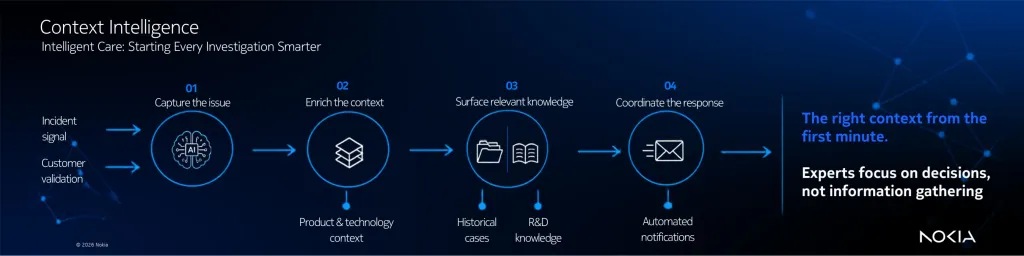
When a significant incident occurs, valuable time is often spent collecting logs, recreating timelines, validating symptoms and transferring details between teams. Customers may need to explain the same situation repeatedly, while experts begin investigations without knowing which actions have already been completed.
AI can fundamentally improve this starting point. When an incident is identified, AI can automatically assemble a comprehensive view of the situation by correlating reported symptoms, live and historical network data, technical context, relevant product knowledge, historical support cases and actions already taken. AI can then surface potential recommendations for expert validation.
This allows Care specialists to begin with a stronger understanding of the problem rather than starting from zero. Their effort can focus on evaluating evidence, validating recommendations and determining the right next action.
AI accelerates the investigation. Human experts remain responsible for judgment, resolution and accountability.
While AI can recommend actions and surface insights, accountability for operational outcomes cannot be delegated to an agent. The result is not simply a faster response. It is a smarter and more confident response.
o Connecting intelligence
The AI Supercycle is reshaping every part of the telecommunications industry. Operators, vendors and technology partners are all investing in AI-driven platforms, automation and intelligent troubleshooting systems.
The challenge is no longer access to AI. The challenge is connecting intelligence across an increasingly complex operational ecosystem. This is where Intelligent Care creates additional value.
Intelligent Care connects system to system, Customer AI platforms, automation tools, network management and ticketing environments, enabling intelligence to flow seamlessly across technology boundaries.
At the same time, it leverages Nokia's unique knowledge assets, built from millions of historical support cases, decades of product expertise and deep R&D insight.
For example, an operator's AI troubleshooting platform may investigate an issue directly in the live network. If automated remediation is unsuccessful, it can automatically initiate a support case with Nokia Intelligent Care, transferring diagnostics, investigation history and operational context. Nokia Intelligent Care can then enrich the case with historical knowledge, cross-domain expertise and recommended actions before feeding insights back into the operator's operational environment.
The result is a shared operational context across AI systems, operations teams and suppliers. Everyone works from the same information, enabling faster decisions, more effective resolution and reduced operational risk.
In many situations, the greatest delay is not identifying the solution itself. It is moving information between systems, teams and organizations. Connected intelligence helps remove that friction and creates a faster path from incident detection to service restoration.
o From support experience to intelligent care platform
As networks become more autonomous, the way customers consume Care will also need to evolve. For many years, Care has been delivered through support interactions and portals primarily designed to manage incidents and access information. While these capabilities will remain important, the future of Care will increasingly be enabled through intelligent platforms that continuously combine AI-driven insights, live network insights and expert guidance.
By bringing together intelligence and expertise in a single experience, the Care platform can help customers move from reactive support to more proactive operations. It can provide greater visibility into network health, operational risks and optimization opportunities, while enabling self-care capabilities that allow customers to diagnose issues, access recommendations and act more independently.
The platform can also become a gateway to on-demand Care services, giving customers access to optimization expertise, advanced analytics and value-added services when and where they are needed most. In the AI era, the Care platform will become a strategic enabler of resilience, helping customers transform intelligence into faster decisions, improved outcomes and greater confidence in increasingly autonomous operations.
The new value of care in the AI era
The future of network operations will be defined by a combination of intelligent automation and trusted expertise.
As AI reduces the burden of routine operational work, the remaining challenges will carry greater complexity and business impact. Success will depend not only on access to intelligence, but on the ability to apply that intelligence with context, judgment and accountability.
That is the role Intelligent Care is designed to play: helping customers operate more autonomous networks with greater confidence, resilience and business assurance.
AI creates speed. Automation creates scale. Intelligent Care creates confidence.