Building autonomous RAN together: NTT DOCOMO and Nokia’s SMO journey

Why SMO is becoming a strategic control point for RAN
Radio networks are becoming increasingly sophisticated, while at the same time needing to meet the evolving requirements of growing AI traffic. A key challenge for telecommunication providers is how to deliver deterministic connectivity without increasing operational burden and cost pressure. Traditional network management and optimization solutions relying on manual operations quickly reach their limits.
This is where the Service Management and Orchestration (SMO) framework becomes critical. SMO is not simply another operational layer. It acts as an intelligent orchestrator, using AI and automation to manage and optimize the RAN across multiple radio technology generations and multi-vendor environments.
Japan’s NTT DOCOMO and Nokia approach the challenge with a clear vision: autonomy must be built on openness, interoperability and intelligence from day one.
NTT DOCOMO’s approach: OREX SMO as a foundation for autonomy
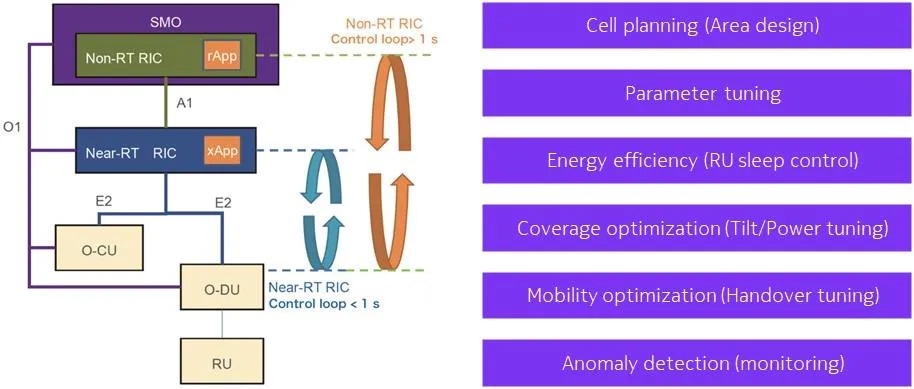
NTT DOCOMO introduced its OREX SMO platform in 2023. It is a fully Open RAN–compliant SMO, designed to operate across multi‑vendor environments. From the outset, the objective was not only for automation itself, but also for the ability to continuously integrate new capabilities and innovations through open interfaces. Today, OREX SMO enables automated network design, configuration and optimization across NTT DOCOMO’s multi-vendor open radio network (O-RAN). Key use cases such as energy efficiency, parameter tuning and network optimization are already deployed and automated.
An integral component of this solution is the O-RAN-defined non-real-time RAN Intelligent Controller (non-RT RIC) for radio application (rApp) automation, which supports NTT DOCOMO’s long‑term direction. The goal is to evolve from predefined KPI‑based automation toward intent‑based, autonomous RAN operations. It means the network will dynamically adapt to human-defined, high‑level business objectives and real-time user needs, rather than working against predefined thresholds for each individual KPI.
Nokia’s role: next-level AI efficiency enabling autonomous RAN operations
Nokia is supporting NTT DOCOMO’s journey with an Open RAN-compliant SMO framework based on trusted, field-proven products that deliver advanced AI and automation capabilities. It is the first SMO in the market to reach level 4 of TM Forum’s autonomous networks framework.
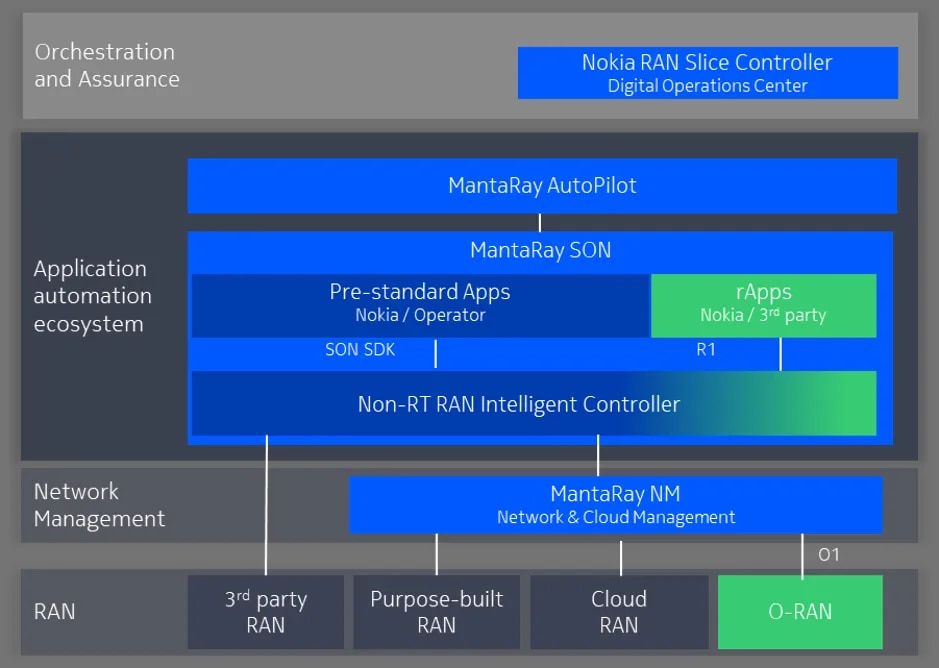
Nokia’s SMO and Non‑RT RIC architecture is open and vendor-neutral by design, enabling the orchestration of both Nokia and third-party rApps. It helps telecommunication providers safely introduce AI into operational control loops, enabling the RAN to operate autonomously.
The SMO solution is based on Nokia’s MantaRay portfolio, which major telecommunication providers use today in large, multi-vendor radio networks. Nokia SMO evolves the market-leading self-organizing networks (SON) capabilities into a non-RT RIC, supporting AI‑driven rApps, with intelligent orchestration delivered by MantaRay AutoPilot.
With automation and adaptive optimization across multi-vendor RAN environments, this approach enables intent-based operations and a path toward a higher level of RAN autonomy. For telecommunication providers, it delivers enhanced RAN performance and efficiency, ensuring a more reliable, high-quality customer experience.
Co-innovating for RAN autonomy: the NTT DOCOMO–Nokia collaboration
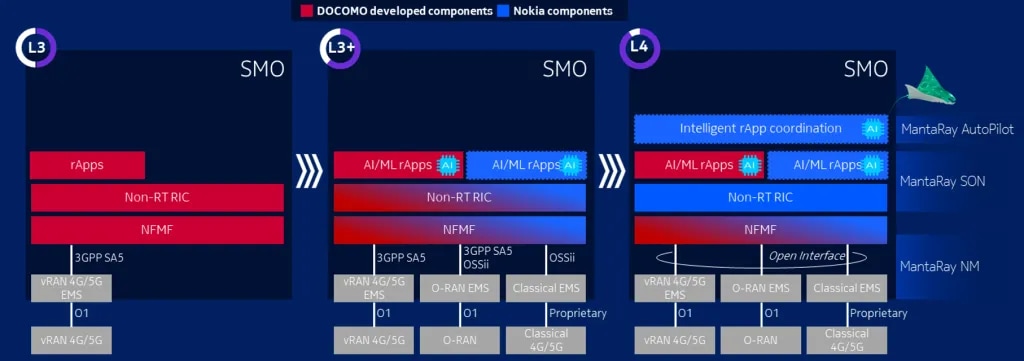
A tangible example of this collaboration is the deployment of Nokia’s MantaRay SON in NTT DOCOMO’s multi‑vendor 5G network. SON is one of the key products that enable an evolution to the full SMO solution, allowing NTT DOCOMO to optimize its multi-vendor RAN environment autonomously while maintaining full architectural openness.
More importantly, this integration demonstrates the wide range of possibilities Nokia SMO can offer as a platform. Benefiting from their vendor-neutral design, NTT DOCOMO’s in‑house SMO and Nokia’s SMO can coexist within the same operational framework, coordinated through open interfaces to enhance their autonomous capabilities.
Governing autonomy: why intent matters
As AI becomes an essential part of network operations, it opens new possibilities for telecommunication providers to harness autonomous operations. To leverage these opportunities, they must have the right network management and orchestration architecture in place. Intent‑based automation is one of the key ingredients, as it provides a critical abstraction layer between business objectives and network execution.
Rather than defining thousands of static KPIs that the network must meet, the telecommunication providers define the intent, or, in other words, tell the autonomous SMO system what they want to achieve. Examples include energy reduction, performance consistency or user experience targets. The SMO autonomously determines how best to meet those intents by optimizing various network parameters.
Agentic AI can help the SMO decide how to satisfy intents while meeting the requirements for robustness and glass-box governance. This shift is essential to reach higher levels of network autonomy, including TM Forum Level 4, without sacrificing end user experience, quality, trust, transparency and operational control.
Building the future together
What makes the NTT DOCOMO and Nokia collaboration distinctive is not a single technology or deployment, but a shared mindset. Autonomy is treated as a journey, built incrementally through open architectures, real operational use cases and close co‑innovation.
As Open RAN continues to mature, SMO will increasingly define competitive advantages through the ability to integrate, govern and evolve intelligence at scale with open and vendor-neutral architecture.
Building autonomous networks is not something telecommunication providers or vendors can do alone. It is something we must build together.
To learn more about Nokia’s approach to SMO, AI‑native networks and autonomous operations, explore our latest insights on autonomous networks and MantaRay SMO.