
ECOC 2026: Innovations for the AI era
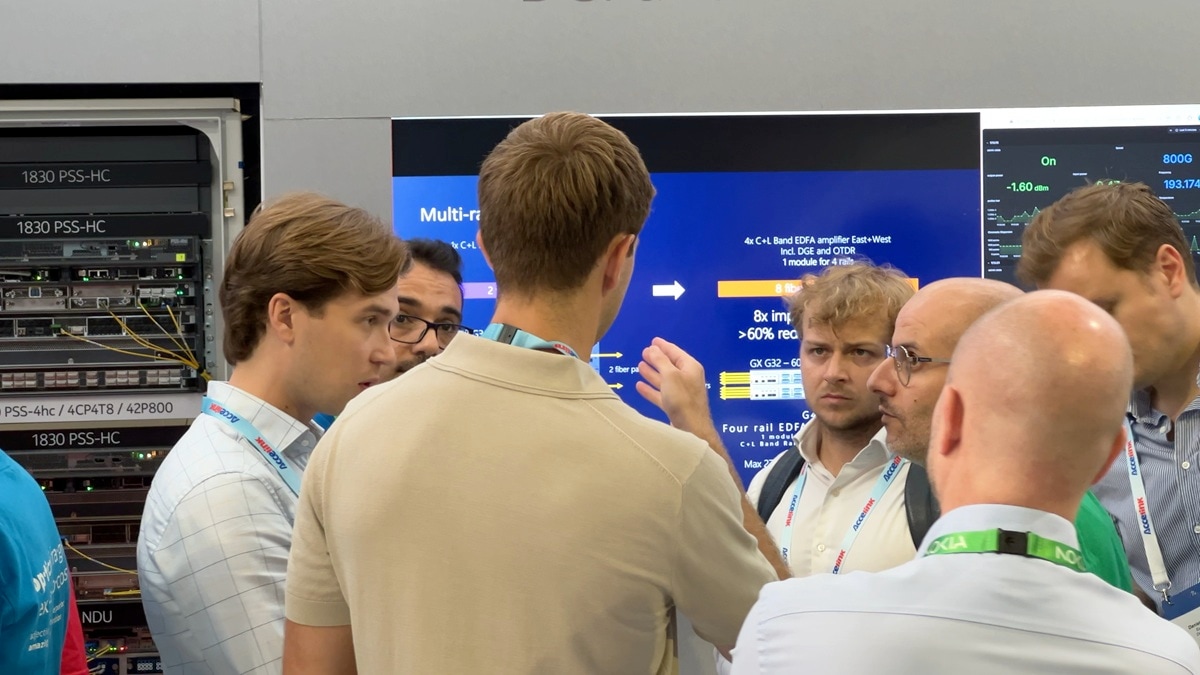
ECOC 2026 was held in Malaga, Spain, with the technical conference held September 20–24, and the exhibition taking place in parallel from September 21–23. It was a record year, with total attendance exceeding 8,000 (2,479 conference attendees plus 6,552 exhibition-only attendees) and 399 exhibiting companies. Having attended all five days of the technical conference and spent time in the exhibition hall, I came away with the following key takeaways on several of the big questions facing the optical industry:
How will agents impact optical networks?
AI was again a meta-theme for the conference. New this year, compared to ECOC 2025, was a focus on agents managing the optical network, with a wide variety of agents working together to optimize and operate the network. These include orchestrator agents, strategy agents, planning agents, monitoring agents, optimization agents and digital twin agents. A number of presentations looked at how these agents advertise their capabilities and communicate with each other, with Google’s A2A proposed as a good option. Other AI insights include the growth of frontier LLMs to more than 10 trillion parameters requiring 2.2 GW, and the adoption of focused small language models (SLMs) by enterprises. Another interesting topic related to latency requirements for scale-across, with the performance of larger LLMs less impacted by higher latency low latency while more powerful GPUs are more impacted by higher latency.
What’s new with intra-DC interconnect?
The co-packaged optics (CPO) versus near-packaged optics (NPO) debate continues. Both CPO and NPO products were widely visible on the exhibition floor, including the OIF area with a multi-vendor and multi-form-factor NPO demo. Extending the life of copper for scale-up was also a key topic. One way the industry is achieving this is with liquid cooling, enabling GPUs, CPUs, memory and switches to be kept closer together and within the ~1.5 meter range of passive copper at 200Gb/s per lane which is around half that of today’s 100Gb/s per lane copper. Options for extending the reach of copper include active electric cables (AEC) delivering ~4.5 meters, and a new approach with an analog redriver at the receiver. This new approach provides ~ 3.5 meter reach with much lower power and comes with a new active copper cable multi-source agreement, the ACC-MSA. Vertical-cavity surface-emitting lasers (VCSELs) were also discussed, including the challenges of commercializing 200Gb/s per lane, the move from 850 nm to 1060 nm, “slow and wide” VCSEL arrays leveraging multi-core fibers, and VCSEL-based CPO.
What is the state of fiber optical sensing?
Sensing is an increasingly hot industry topic, with presentations covering a wide range of sensing approaches, including backscattering (e.g., DAS/ Φ-OTDR). OTDR, C-OTDR, C-OFDR) and feedforward, such as longitudinal power monitoring (LPM) and state of polarization (SOP). Vibration sensing applications varied by the number of Hz, from very low (tsunamis) to very high (whale acoustics). One interesting application was measuring the wind via vibrations in aerial cables (OPGW). This wind can cause cable fatigue so this can be used to ensure mitigation methods (e.g., dampeners) are working. Another presented application was detecting rockslides to prevent train derailments. The ability of SOP to detect magnetic changes makes it possible to monitor solar flares. SOP-detected magnetic changes have even been observed as a precursor to recent earthquakes. LPM presentations focused on reducing complexity, overcoming limitations related to spans with mixed fiber types, and the ability to measure nonlinear interference (NLI).
How is hollow core fiber (HCF) maturing?
HCF was again a hot topic. YOFC announced a new world record for loss: 0.032 dB/km. Another record was 532 km for unrepeatered HCF transmission (15.73 Tb/s without ROPA and 30.66Tb/s with ROPA) presented by Haik Mardoyan of Nokia Bell Labs. I learnt about new bands beyond O/E/S/C/L/U that are being considered for HCF: the “T-band” (1,000~1,260 nm, below the O-band) which has the widest spectrum and the “V-band” (>1675 nm, above the U-band) which has the lowest potential loss. I learnt that HCFs are not typically filled with gas, as it takes too long to draw in. What’s more, gas line absorption (GLA) does not prevent L-band use for metro distances but could prevent the L-band from being used in long-haul and subsea applications.
Another interesting topic was how HCF designs can be varied to select the low-loss band(s), how wider spectrum through thinner inner membranes can result in higher loss, how larger core fibers have lower loss but worse bend tolerance. Microsoft also presented designs that lower the chromatic dispersion from 2.5~5 ps/nm/km to zero, though at the cost of higher loss or larger fibers. Zero chromatic dispersion would be especially valuable for extending the data rates and reach of IM-DD for intra-datacenter applications including scale out.
What’s new with optical line systems?
Optical line systems (OLS) are getting more and more attention. A Google presentation showed OLS now accounting for 50% of the power (based on an 800 km link with nine ILAs), while Cignal AI forecasted OLS will account for 55% of scale-across revenue by 2030. Interesting technology presentations focused on the amplifiers, including an integrated C+L amplifier that combined erbium- and bismuth-doped fibers, resulting in lower cost and footprint while eliminating band mux/demux losses, though no power consumption was provided. Hollow-core amplifiers were also a topic, including a native HCF amplifier that uses quantum dots inside the HCF, and a high-power amplifier for HCF that uses a large effective area silica core fiber to mitigate nonlinearities caused by the high power as presented in a poster by Leonardo Braga of Nokia Bell Labs.
How are coherent engines evolving?
In terms of coherent engine evolution, one hot topic was the difference between coherent lite and a new term, “ZR lite”. While opinions differ and there is no formal definition, coherent lite is being used in the O-band and ZR lite for C-band operation, with some ZR lite products leveraging regular ZR/ZR+ DSPs but with fixed lasers and lower TX power (e.g., no micro EDFA or SOA). My colleague Annalisa Morea presented the results of a modelling exercise that demonstrated the benefits of proprietary PCS modes in 800ZR+ pluggables and thin transponders. The proprietary PCS modes enabled up to 25% fewer coherent interfaces (i.e., 800ZR+ pluggables) and up to 10% higher total network capacity while thin transponders enabled up to 50% regen power savings relative to router-based regen.
Callum Deakin from Nokia Bell Labs presented a novel approach to coherent modulation that leverages multiple stages that each combine phase modulation and chromatic dispersion. Benefits of this include zero loss, higher bandwidth than the individual modulators could support, and the ability to modulate multiple wavelengths simultaneously. And finally, Di Che from Nokia Bell Labs presented a 450 GBaud 3.83Tb/s single wavelength demonstration leveraging DAC multiplexing.
Innovation for the AI era
Overall, ECOC 2026 showed a wide range of innovations, from agent-driven automation and evolving intra-data-center connectivity to advanced fiber sensing, maturing hollow-core fiber, more efficient optical line systems and next-generation coherent engines. Together, these developments point toward optical infrastructure that is evolving to meet the needs of the AI era.