Transitioning to a circular economy
People and Planet impact snapshot

circularity waste rate in 2025
packaging recyclability rate in 2025
recycled content in cardboard and plastic packaging in 2025
Nokia operates at a significant global scale, which means our material footprint is also significant. In 2025, Nokia delivered more than 73,000 tons of hardware, components, and materials to customers. To make that more tangible, this is equivalent to more than seven Eiffel Towers. Of this material, 17% — more than 12,500 tons — came from recycled sources, which is more than one Eiffel Tower’s worth of recycled material.
Through product design, reducing waste, and lifecycle management, Nokia supports the transition to a circular economy while aiming to minimize embodied emissions across our infrastructure and value chain.
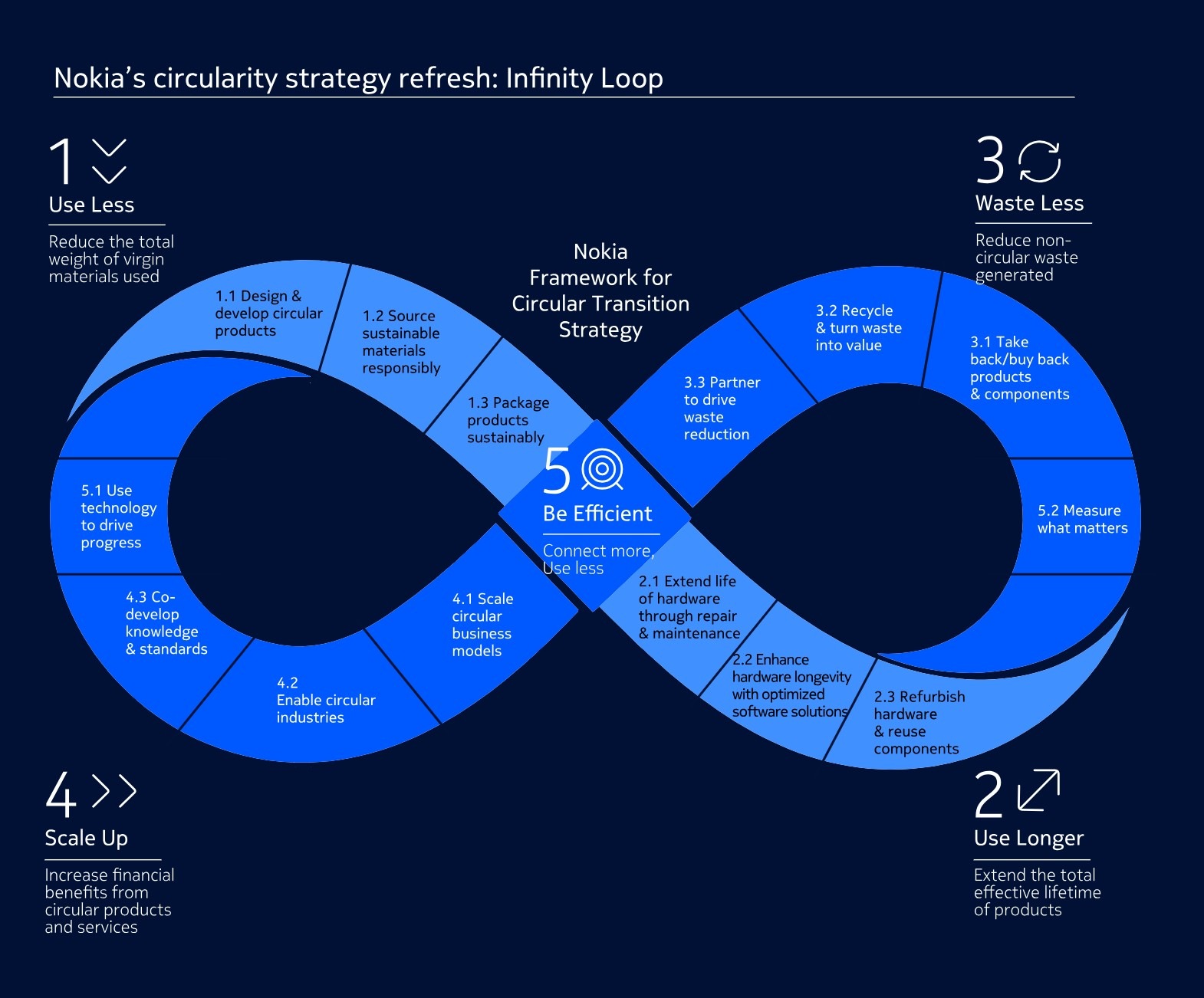
Our circularity strategy is presented in the Infinity Loop that touches on five central calls-to-action:
Use less
Reduce the total weight of virgin materials used through the design and development of circular products, responsible and sustainable materials sourcing, and sustainable product packaging.
Use longer
Extend products’ total lifetime through regular hardware repairs and maintenance, the implementation of optimized software solutions, and the use of refurbished hardware and other reusable parts.
Scale up
Increase financial benefits from circular products and services by scaling circular business models, enabling circular industries, and co-developing circular knowledge and standards.
Be efficient
Connect more and use less through technology that drives progress and by measuring what matters.
Waste less
Reduce non-circular waste generated through takeback and buyback programs, reusing recyclable materials, and leveraging strategic partners to drive waste reduction.
We’ve made significant progress toward achieving our 2030 circularity targets. In 2025, we achieved a circularity waste rate of 90% covering the waste from our offices, labs, own manufacturing, installation, product take back and final assembly suppliers, just five percentage points from our 2030 goal. At the same time, we achieved a 98% recyclability level for our packaging in 2025, just two percentage points away from our 2030 target of fully recyclable packaging. We achieved our 2030 product packaging target five years ahead of schedule, with our cardboard and plastic packaging materials containing 50% recycled content in 2025.
Beyond our direct operations, Nokia works with partners and customers across our value chain to implement programs that support the circular transition.
For example, we provided refurbished equipment to Deutsche Telekom to demonstrate how sustainable solutions can move from concept to large-scale customer deployment. At the Telecom Campus Fair 2026, we were named Deutsche Telekom’s Partner of the Year for Sustainability and Circularity as our partnership continues to advance circular practices, support responsible network operations, and drive progress toward the telecom industry’s sustainability targets.
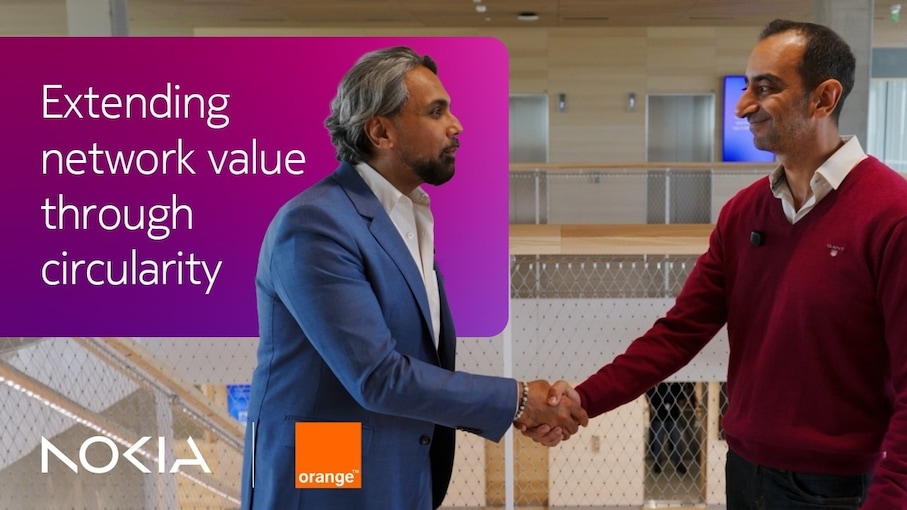
Our One Circle pilot was launched by Orange Egypt and Nokia in Cairo. By enabling network equipment to be tested, repaired and reused locally, the initiative is turning circularity into a practical operating model and helping recover more value from assets already in the network. The pilot has already collected and screened more than 400 network modules and saved about 35.8 tonnes of CO2e. It is also building local technical expertise, reducing unnecessary international transport and creating a foundation to improve asset utilization, strengthen supply-chain resilience and support more cost-efficient network modernization.
In 2026, we also extended our 5G partnership with Taiwan Mobile to advance AI-powered networks. Part of the agreement includes the introduction of Predictive Hardware Analytics (PHWA), which will enable predictive maintenance and reduced operational complexity, thereby extending the lifespan of our hardware equipment.
Across the broader ecosystem, Nokia contributes to the development and standardization of Digital Product Passports (DPPs) for the information and communications technology (ICT) sector to support supply chain transparency and a circular economy. A DPP securely and efficiently collects and shares product and value-chain information among key stakeholders such as suppliers, consumers, repairers, recyclers, and market authorities. Among its advantages, a DPP is expected to showcase a product’s sustainability credentials and improve the traceability of a product’s history, enabling innovation in product design, usage, reuse, supply-chain management, and end-of-life practices. This ultimately supports circularity and a reduction in environmental impacts across all sectors’ value chains.
By focusing on improving resource efficiency, reducing virgin material usage, minimizing waste, and scaling up innovative circular business models and solutions, Nokia is working to create long-term value while addressing resource use challenges and resiliency in support of the circular transition.