Revolutionizing in-building connectivity design: Nokia Automated Indoor Design and Validation

At Nokia, we are constantly pushing the boundaries of what's possible in network technology, continuously advancing connectivity to meet the demands of an increasingly digital world. Our latest innovation, showcased at MWC in Barcelona, is a clear testament to that commitment. We're thrilled to introduce the Nokia Automated Indoor Design and Validation solution, a gamechanger in how indoor networks are planned, deployed and optimized.
For years, our Nokia Network Planning and Optimization Services have been building AI-powered radio network digital twins, providing a comprehensive view of city-wide networks. Now, we're bringing that same powerful concept indoors, addressing the complexities of in-building connectivity with unparalleled precision and efficiency.
The challenge of indoor networks
Designing and validating indoor networks has traditionally been a labor-intensive, time-consuming and often costly process. Manual surveys are prone to human error, limited by accessibility and can even pose safety risks in industrial environments. Our new solution has been developed to address these challenges head-on.
Introducing precision, efficiency and safety through automation
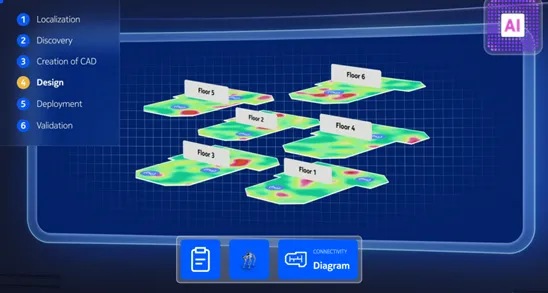
The Nokia Automated Indoor Design and Validation solution leverages cutting-edge robotics and AI, specifically a quadruped robot equipped with lidar scanners and connectivity planning SW. This fundamentally transforms how indoor network design and validation will be carried out:
- Unmatched efficiency: Imagine a solution that's up to 70% more efficient than traditional methods. Our robot can operate continuously, day or night, without fatigue, dramatically accelerating both design and validation phases.
- Zero-touch ambition: While we currently support a 3-tier operational model (on-site supervision, remote supervision and ultimately autonomous operation), our goal is clear: a fully zero-touch approach with minimal human intervention.
- Superior accuracy: This is the most accurate indoor mapping solution on the market, producing a complete and highly precise site plan in CAD format. This level of accuracy is critical for optimized 2G/3G/4G/5G and FWA coverage and quality of service, ultimately driving higher end-user satisfaction.
- Health & safety gains: The robot can safely operate in industrial or hazardous environments that would otherwise put human teams at risk, protecting our workforce while maintaining operational continuity.
- Environmental sustainability: By using robotics for autonomous, in-building walk tests and site surveys, we're also reducing the carbon footprint associated with traditional, resource-intensive operations.
Beyond design: Monetization and validation
The benefits of Nokia’s digital twin technology extend well beyond network design. We have also showcased how this technology enables smarter network validation and monetization.
For example, the Nokia XR Network Visualizer allows operators (and even end-users) to validate whether a specific Fixed Wireless Access (FWA) product will work at a given address. Using immersive VR and AR visualizations, customers can see network performance before purchase, helping operators prevent churn and ensure service expectations are met from day one.
A glimpse into the future of network planning
This is more than a technology demo; it's a glimpse into the future of network planning and operations. Nokia's Automated Indoor Design & Validation reflects how we are harnessing AI and automation to keep advancing connectivity and help our customers lead through the AI supercycle.
Stay tuned as we continue to innovate and bring these cutting-edge solutions to our customers! For further reading, take a look at our Design & Optimize website.