Decarbonizing Nokia operations
People and Planet impact snapshot

reduction of total GHG emissions (Scopes 1, 2, 3) from 2019 baseline
reduction of Nokia facilities’ emissions from 2019 baseline
renewable electricity in Nokia’s own operations
With our technologies powering more than 4.4 billion mobile subscriptions across 150+ countries, Nokia’s sustainability strategy prioritizes connecting intelligence worldwide without sacrificing our responsibility toward today and tomorrow’s people and planet. This includes reducing greenhouse gas emissions across our entire value chain in alignment with the goals of the Paris climate agreement.
By 2025, Nokia reduced Scope 1, 2, and 3 greenhouse gas emissions by 27% compared to a 2019 baseline. At our own facilities, emissions declined by 89% from 2019 to 2025 as we achieved 96% renewable electricity within Nokia operations last year.
This reduction in our overall emissions is driven by more energy efficient products, smarter logistics, as well as onsite energy-efficiency measures and the use of renewable energy.
Onsite energy-efficiency measures
Site selection
Choosing locations with good energy performance and sustainability certifications such as LEED, BREEAM, and NABERS.
Workplace design
Assessing opportunities to improve energy efficiency and sustainability within our buildings.
Infrastructure upgrades
Improving energy efficiency through cooling and electrical systems when practical.
Building management
Maintaining optimal temperature settings and switching to LED lighting for lower energy use.
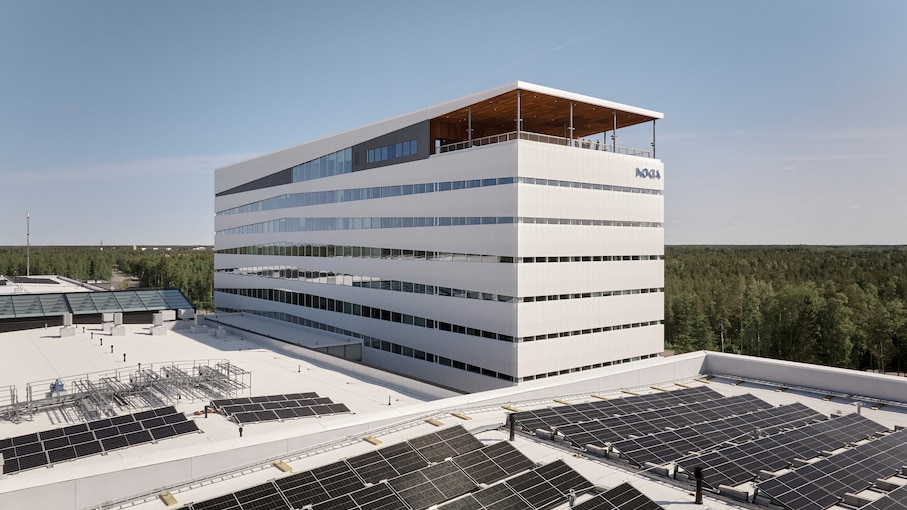
Nokia's Oulu campus: Sustainable R&D for AI networks
In 2025, Nokia opened a state-of-the-art R&D and manufacturing campus in Oulu, Finland, to design, test, and deliver next-generation networks built for AI. Home to some of the world’s leading telecommunications experts, the Oulu campus prioritizes energy efficiency and sustainability. The facility uses 100% renewable energy and uses waste heat and excess energy to heat 20,000 local homes in Oulu. The on-site energy station is also one of the world’s largest district heating and cooling plants that boasts a 100% waste utilization rate and a 99% avoidance in CO2 emissions.
These efforts are an important part of our SBTi-approved climate transition plan and demonstrate Nokia’s ongoing commitment to decarbonizing our operations.
Learn more

Blog