Omdia insight: Quantum-safe planning ramps up, driven by a new sense of urgency

In interviews with Omdia, network operators said they have moved into the planning phases for quantum-safe networking as an increasing awareness of quantum threats drives decision-making forward
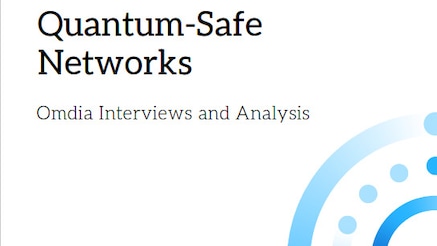
Leading network operators have begun exploring quantum-safe-networking (QSN) options and strategically planning their future networks with quantum security in mind. This shift in mindset is driven by a growing awareness among their end customers of the threats quantum computing-fueled cyberattacks pose to their businesses, according to a new report from Omdia.
Nokia commissioned the Omdia study to gain insight into how our customers are thinking about QSN. Omdia conducted in-depth interviews with experts from six major telecommunication and IT infrastructure providers across Europe, North America and Asia as well as a key enterprise IT system integrator. Six of the interviewees agreed to be named in the final report.
The results are both enlightening and encouraging. A cryptologically relevant quantum computer (CRQC) ¬— a computer capable of cracking the asymmetric public-key encryption that protects today’s network traffic — may still be years away, but there is a growing understanding that we must now start the complex process of modernizing cryptography to secure our networks and critical infrastructure against this inevitable threat.
As Prasanna Sundaram, Director of Optical and Fiber Network Engineering at Colt Technology Services, put it: “customers are more aware, more interested, and more engaged. They're asking what they need to do to begin their quantum-safe journey.”
Let’s take a closer look at Omdia’s findings.
QSN preparation has begun
BT Senior Research Fellow Andrew Lord said BT has embarked on its quantum-safe planning, revealing the full extent of the project ahead but also the potential benefits for the service providers that move first.
According to Lord: “We have thousands of devices that need upgrading. This won’t be a trivial task, so we need to act quickly. We also hope to position ourselves as a market leader, learning from our experiences and helping our customers on their own journeys.”
Omdia also found that network operators were leaning toward hybrid QSN strategies. Because their end enterprise customers often favor one QSN technology over another — for instance post-quantum cryptography (PQC) or quantum-key encryption (QKD) — service providers need to support the entire menu of solutions to meet their needs.
BT’s Lord added that as knowledge of QSN’s various applications increases, end customers may also become more receptive to multi-pronged quantum security solutions.
“It’s frustrating when people position PQC and QKD as being in opposition. They’re not,” Lord said. “PQC should be implemented everywhere, while QKD is reserved for use cases where the highest level of security is required.”
As awareness grows, so does urgency
The study’s participants all stated that their end customers’ awareness of the threat of quantum computers has increased sharply over the past couple of years, as well as their interest in identifying solutions that will help them combat this threat. This growing awareness comes from several sources.
The threat of harvest-now decrypt-later (HNDL) attacks is one factor. There is growing evidence that malicious actors are today intercepting sensitive encrypted data and storing it, waiting for the day a CRQC becomes available to decrypt it.
Another factor is AI. The enormous potential of AI is spurring anxiety that AI could be used in conjunction with quantum computing to accelerate the decryption of current cryptography algorithms and produce even more sophisticated cyberattacks.
James Knights, Principal at Kyndryl’s Network & Edge Center of Excellence, put it this way: “In 2025, the rapid acceleration of AI fundamentally shifted perceptions. The convergence of AI and quantum computing has made the security implications immediate, driving a new level of urgency among customers.”
One surprising insight from the Omdia survey was that risk-management issues like insurance implications may soon become part of the QSN discussion. While network operators and their enterprise customers today aren’t focused on how they will insure against future quantum attacks, the issue of cyberattacks in general is a huge risk-mitigation concern.
ORION CTO Robert Eveleigh pointed out that insurance companies are already having difficulty with the actuarial science behind cyberattack risks. “In some cases, insurance companies outright refuse to provide coverage,” Eveleigh said. “If you don’t have the necessary controls in place, they won’t sell you a policy — no matter how much you’re willing to pay.”
Advanced connectivity means advanced security
As we dive into the AI supercycle, it’s abundantly clear many new technologies will come to the forefront — not just AI. Quantum technologies like quantum computing, quantum networking and quantum security all will play a much bigger role as the AI supercycle progresses.
The Omdia report clearly shows that there is an increasing understanding of the risks — as well as the significant benefits — future quantum computers pose, and that key service and infrastructure providers are taking the critical first steps to ensure the risks posed from quantum threats do not outweigh quantum computing’s potential.
The end-users of these networks, be they commercial enterprises, government agencies or service infrastructure providers, will pay a premium for quantum-safe services. This gives network operators who move first on QSN a key competitive advantage, according to Lyntia Head of Innovation Javier Ruiz.
“The bottom line is we see quantum-safe services as helping us differentiate in a wholesale market,” Ruiz said. “It matters to end customers who are looking for future proof connectivity and data protection as well as for our integrator partners.”
Nokia’s mission is to advance connectivity. Customer insight is invaluable to achieving that goal, and what we’ve learned from Omdia’s survey shows there is an urgent need to focus on quantum-safe networking, and that there are first-mover advantages to doing so. We have always advocated early preparation and a multi-layer, defense-in-depth approach for quantum security, which is precisely the direction network operators are heading. The best-prepared network operators will deliver the trusted security technologies their enterprise customers require to navigate this new era of quantum threats.
We encourage you to read the full Omdia report to gain insight into the how network operators are thinking about QSN. And if you would like to learn more about Nokia’s quantum-safe networking solutions, visit our QSN webpage here.
Nokia’s mission is to advance connectivity. Customer insight is invaluable to achieving that goal, and what we’ve learned from Omdia’s survey shows there is an urgent need to focus on quantum-safe networking, and that there are first-mover advantages to doing so. We have always advocated early preparation and a multi-layer, defense-in-depth approach for quantum security, which is precisely the direction network operators are heading. The best-prepared network operators will deliver the trusted security technologies their enterprise customers require to navigate this new era of quantum threats.
We encourage you to read the full Omdia report to gain insight into the how network operators are thinking about QSN. And if you would like to learn more about Nokia’s quantum-safe networking solutions, visit our QSN webpage here.