Goggles and 6G: celebrating innovation and sports on World IP Day 2026

Watching the winter games in Italy this year literally took my breath away. I could feel the speed thanks to the first-person view drones, which followed the athletes in real time during their runs. This new experience has transformed sports viewing for me, and likely for millions around the globe. Whether in luge or downhill skiing, ice-skating or speed-skating, the perspective and the proximity are in a new dimension, thanks to technology.
World IP day 2026 celebrates innovation -and IP protection - in sports
The World Intellectual Property Organization (WIPO) has chosen to focus this year’s World IP day celebrations on IP and Sports, which puts a spotlight on innovation in conjunction with athletic performance. This aligns with the ‘wow’ experience during the recent games.
As a global event of exceptional scale with multi-channel broadcasting, they stress-tested the technology focusing on the viewing experience including real-time high-volume data analytics, data transfer, broadcast operations converging in real-time, and supporting peak traffic in remote locations (think the Alpine valleys).
In fact, the immersive experience is the visible tip of a much larger technology iceberg. For example, in addition to FPV drone technology, being brought so close to the action is only possible due to the standardized technologies for advanced connectivity (5G), and video and voice codecs, such as High Efficiency Video Coding (HEVC), or so-called H.265 codec.
The virtuous cycle enables the innovation and open standards ecosystem
The foundational technologies for advanced connectivity and the video and audio codecs are standardized. These global technology standards are developed within the ecosystem of innovation and open standards, which operates in combining three major components:
1) Investment in risky R&D. Inventors protect the outcomes with patents rights. For example, since 2000, Nokia has invested around €160 billion in R&D and has built a patent portfolio of 26K patent families.
2) Standardization, whereas international standards are mostly created in Standards Development Organizations (SDOs), such as the European Telecommunications Standards Institute (ETSI). And,
3) Commercialization. This typically occurs in two forms: productization – the implementation of technology in marketable products - and monetization – the licensing of patent rights.
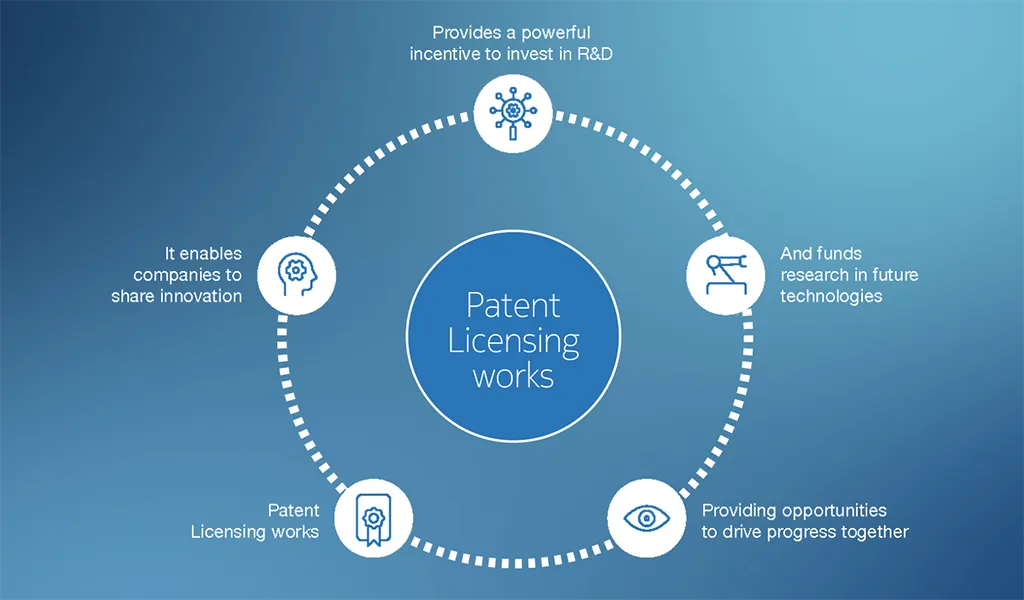
Each stage depends on the previous one and closing the loop creates a virtuous cycle, where patent licensing creates a strong incentive to (further) invest in R&D using licensing income, which itself is a return on the investment in research and innovation.
The system works well thanks to the multilayer global legal framework, which consists of international agreements and principles, regional and national legislation and regulations as well as jurisprudence, and private contracting. It is global, reliable and robust. Together the various layers support a successful ecosystem, as demonstrated by the global adoption of cellular mobile standards (2G, 3G, 4G) and advanced connectivity (5G, 5G advanced) standards and the widespread use of the video and voice codecs. A topic that I will return to in a future post.
The ecosystem of innovation and open standards creates a competitive edge.
Innovation is a key driver of competitiveness and market growth. Entities funding R&D contribute to the innovation - and growth - economy. SDOs provide forum for technology innovators to develop the best quality solutions to technical questions. These outcomes - the standards - result in technology being interoperable and accessible globally. Implementing standardized technology facilitates access to global markets and leads to scaling effects. That is one reason why developing technology standards is pro-competitive.
In addition, the follow-on, downstream, innovation resulting in specialized implementations of the standardized technology results in new lines of products, which provide consumers with new better quality and variety in the market. This has two effects: increased adoption of new technology in the market, as well as increasing consumer welfare, through improvement of quality of life.
In line with the competitive theme, the ecosystem of innovation and open standards is a champion of competitiveness and dynamic growth. This is especially significant for the European Union, diagnosed by the Draghi Report with “a static industrial structure which produces a vicious circle of low investment and low innovation.”
The ecosystem of innovation and open standards needs a stable legal framework to continue delivering.
From policy perspective a key factor is ensuring stable and reliable legal framework with effective protection of intellectual property rights and their enforcement. At the highest level, this means:
- Unity of vision: high-level policy goals of encouraging innovation as the best tool to improve competitiveness translate into coherent, holistic approach at the policy implementation level.
- Evidence-based: Regulatory intervention is justified, balanced, and necessarily based on rigorous scientifically verifiable evidence.
- Reality check: Data, evidence, and potential policy options are put in perspective in an open dialogue with the industry. In an ecosystem with long-term investment and R&D development timelines, calibration against unintended consequences helps to avoid shocks, which impact adversely R&D investment decisions and could result in lasting and irreversible harm for European leadership in global standards.
The best is yet to come
Right now, the international standardization effort is focused on developing the sixth generation of advanced connectivity, or 6G. 6G development is focused on making advanced connectivity AI native, meaning networks will not just enable intelligence, they will use the AI to adapt and improve according to the needs. For immersive sports viewing, where broadcasting appears to be moving ever closer to cinematic storytelling, it is expected that 6G XR audio will create fully immersive, three-dimensional soundscapes. It surely means an even more thrilling viewing experience in the future, building on innovations audiences have already seen at the winter games, such as volumetric video.