Maximize the value of programmable coherent engines with elastic photonic networking

Generalized Multi-Protocol Label Switching (GMPLS) distributed control planes have been deployed for more than 20 years, with key standards published in 2001 (ITU-T G.8080/Y.1304 - architecture), 2003 (IETF RFC 3471 - signaling), 2004 (IETF RFC 3945 - architecture) and 2006 (IETF RFC 4426 - recovery). Since then, GMPLS has been widely adopted, with Nokia having deployed more than 100 networks globally, delivering benefits that include higher availability, reduced costs, faster provisioning, simplified operations and the ability to offer differentiated services.
Despite its maturity, GMPLS technology continues to evolve and innovate. Nokia enhancements include rapid restoration, multi-layer support and, most recently, elastic photonic networking (EPN). EPN will enter networks globally in mid-2026.
Coherent engine programmability
As coherent technology has evolved, optical engines have become increasingly programmable. Today’s 90+ GBaud (PSE-Vs and ICE6) and 140+ GBaud (PSE-6s and ICE7) embedded coherent optical engines enable a wide range of parameters to be programmed to maximize wavelength capacity, reach and spectral efficiency for the given conditions in a metro, long-haul or submarine application. These parameters include baud rate, with PSE-Vs, PSE-6s and ICE7 all supporting continuous baud rate tuning, while ICE6 supports approximately 45 baud rates. In addition to conventional modulation (e.g., 64QAM and QPSK), they support probabilistic constellation shaping, which provides granular control of the bits per symbol. Other settable parameters include forward error correction (FEC), framing (e.g., Ethernet- or OTN-optimized), center frequency, transmit power and submarine-optimized modes.
Flexible grid ROADMs
At the same time, ROADM-based optical line systems have evolved, from 100 GHz fixed grid channel spacing, to 50 GHz fixed grids, then to flexible grids with 12.5 GHz or 6.25 GHz granularity. This enabled support first for super-channels that bundled multiple wavelengths into a more tightly packed chuck of spectrum (i.e., five 30 GBaud 100 Gb/s wavelengths in 200 GHz rather than 250 GHz) and then for higher baud-rate wavelengths that could not fit into 50 GHz and needed 75 GHz, 100+ GHz or, more recently, 150 GHz. These line systems also evolved with more flexible add/drop capabilities, including colorless, colorless/directionless and colorless/directionless/contentionless.
Elastic photonic networking
To better leverage these coherent engine and line systems capabilities while also taking advantage of the many benefits provided by a distributed GMPLS control plane, Nokia has enhanced its industry-leading GMPLS control plane with support for EPN. EPN marries the intelligence of a distributed GMPLS control plane with the programmability of advanced coherent technology and flexible grid optical line systems.
Optical wavelength data rate, modulation, baud rate, spectral occupancy, FEC and other parameters can be changed by the control plane to cost-effectively maximize availability in response to changes in network conditions, as illustrated with the following three examples.
Example 1: Elastic restoration
As shown in Figure 1, after a failure, the only path available cannot support 800 Gb/s due to lower OSNR and higher nonlinear penalties. The GMPLS control plane calculates 600 Gb/s can be supported and adjusts the probabilistic constellation shaping (PCS) bits per symbol and other parameters, then establishes a 600 Gb/s wavelength. In scenarios where there is insufficient spectrum to support 800 Gb/s the control plane reduces the baud rate to fit within the available spectrum.
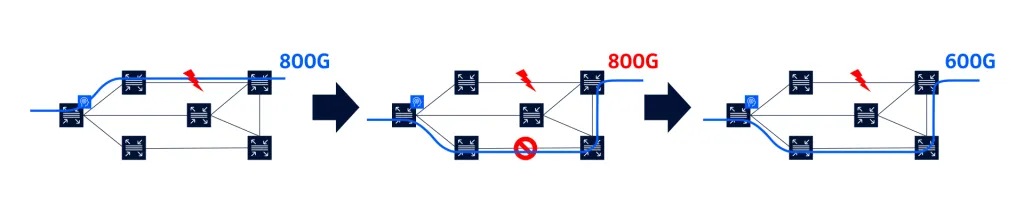
Figure 1: Elastic restoration
Example 2: Elastic regen pools
Elastic regen pools are pools of transponders configured for OEO regeneration, for cases where restored wavelengths cannot be supported without intermediate OEO regeneration. These regen pools can be shared across multiple services. All potential profiles on the transponders are usable, with the GMPLS control plane automatically selecting and assigning a matching profile. This is illustrated in Figure 2, where after a second failure, the wavelength uses a regen pool to restore.
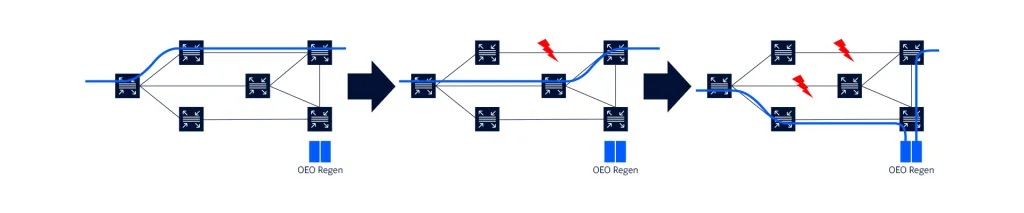
Figure 2: Elastic regen pools
Example 3: Elastic channel optimization
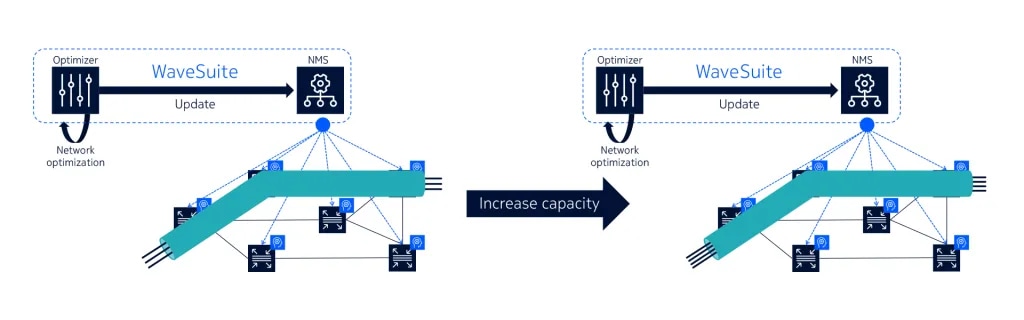
Figure 3: Elastic channel optimization: increase capacity example
In elastic channel optimization, Optimizer, an application within the Nokia WaveSuite automation platform, analyzes the network searching for optimizations. If it finds an opportunity to increase the capacity of a wavelength, it updates the NMS function within WaveSuite (Figure 3). The NMS then instructs the GMPLS control plane to take all the required actions along the path to implement this capacity increase.
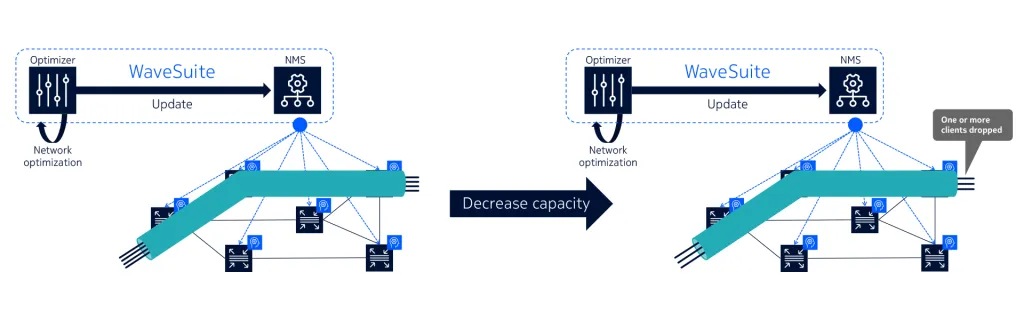
Figure 4: Elastic channel optimization: decrease capacity example
If WaveSuite Optimizer identifies capacity needs to be decreased, it can also update the NMS and instruct the GMPLS control plane to make the appropriate changes along the path. This includes removing one or more clients which the transport capacity can no longer support, with the decision of which clients to drop based on service priority (Figure 4).
EPN is key for GMPLS evolution
Elastic photonic networking enables GMPLS control plane-enabled optical networks to better leverage coherent optical engine programmability and optical line system flexibility, reducing costs and maximizing network availability as a result.
To learn more about this important topic, download the new Nokia white paper: The Five Vectors of GMPLS Evolution.