

Shared data layer
How to optimize telco cloud applications and architecture to achieve maximum benefit from the cloud
What is cloud optimization in telco?
Cloud optimization represents a strategic advancement for telecom operators wanting to modernize and streamline their core networks This process involves optimizing Virtualized Network Function (VNF) deployments within cloud environments. Nokia's approach is built on the consolidation of all subscriber and session data into a single, centralized, and highly robust repository: the Nokia Shared Data Layer (SDL).
By using this unified shared data, stateless VNFs gain significant operational advantages. This architecture facilitates rapid service innovation and accelerates revenue growth by providing operators with deeper, real-time insight into subscriber behavior. This improved understanding allows telecom operators to develop highly innovative, personalized, and customized services, directly contributing to increased profitability of their cloud-native infrastructure.
Why should you consolidate all the data into one network data layer?
The data held by the Shared Data Layer will be accessible by the network’s family of VNFs via industry standard protocols. Consolidating all the data into one network data layer also makes it easily available through standard northbound interfaces to data analytics and third-party applications Nokia SDL simplifies cloud operations, allowing simpler upgrades, scaling and failovers, as well as the integration of new applications. For example, should one VNF fail or suffer a problem, another VNF can be activated and immediately access the same data held in the Shared Data Layer to maintain a seamless service.
Shared Data Layer is a key technology driver enabling the cloud native architecture, implementing 5G data storage functions (UDR and UDSF).
Video
The easy way to migrate subscriber data to the 5G Shared Data Layer
Video
Cloud-Native SDL for 5G Core
Video
SDL 5G readiness with Service Based Interface
How does the Nokia Shared Data Layer (SDL) work?
With Nokia SDL, the user data is centralized in a secure, highly scalable back-end repository, servicing several front-end applications, instead of each data repository servicing one application. This single point of provisioning offers cost savings, minimizes risk for downtime and substantially shortens the time taken to launch new technologies and services for customers.
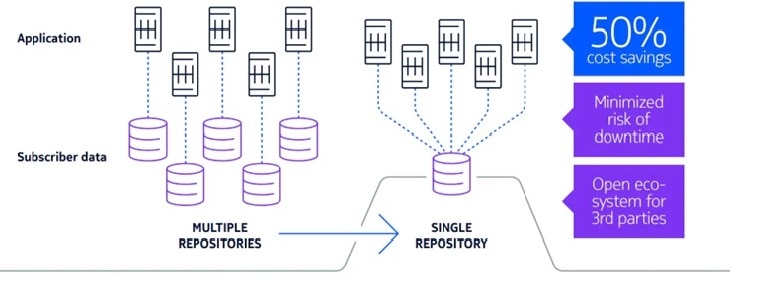
Benefits of Shared Data Layer
The new data sharing platform architecture separates the data storage from the service logic to introduce a fully virtualized, distributed, geographically redundant and strongly secured Shared Data Layer (SDL). This secure SDL will store and make available all the data required by the VNFs, including subscription data, policy data, charging data and session data, which includes VNF state information.
With this robust and unified data foundation, the SDL offers significant advantages:
Helps operators to realize the full business potential of their core network data
Prepares operator networks to meet the demands of the programmable world, IoT and 5G
Unifies data exposure and serves as an enterprise data layer, supports open APIs to enable new services and provides new cloud revenues from SDL data analytics
Stateless VNFs are less complex and easier to manage than conventional VNFs, so cloud operations will be much simpler
Related solutions and products
Solution
Reach new heights in performance to deliver 5G services with confidence.
Solution
Make your telco software upgrades so smooth, you won’t even notice
Solution
Provide homeland wireless broadband connectivity to multiple defense agencies.
Solution
Deploy a modern 5G private wireless network for railway operations.
Solution
Nokia’s robust, open and scalable core that hands control of the infrastructure back to you.
Solution
Deploy a converged private LTE FAN that provides the mission-critical communications you need for Industry 4.0.
Learn more about core and data center networks

Event

Event

Event
Report

White paper

Report
Video
Innovate. Collaborate. Validate.

Partner release
Please complete the form below.
The form is loading, please wait...
Thank you. We have received your inquiry. Please continue browsing.