To win at NaaS, telecommunication providers need to think like a webscale company

Telecommunication providers who want to seize the $15 billion Network-as-a-Service (NaaS) opportunity need to be sure they can deliver. Fortunately, the investments required line up nicely with the digital transformations they’re already pursuing. Winning their share means going “all in” and adopting the mindset of the big webscale cloud computing companies.
While the services associated with the NaaS model may be familiar to telecommunication providers — private WAN/LAN, virtual private networks and network security, for example — the way they’re delivered represents a considerable shift in the way they need to do business. There’s no “easy button” to press to just make NaaS happen.
“CSPs continue to sell connectivity services based on a 100 year-old business model. NaaS changes the game”
Karl Whitelock, IDC
“CSPs continue to sell connectivity services based on a 100 year-old business model,” says Karl Whitelock, Research Vice President, Communications Service Provider Operations and Monetization, IDC. “NaaS changes the game by letting customers choose the services they want. Providers need to tear a page from the webscale cloud playbook and come ready to be agile and responsive.” That means building a foundation of cloud-native technologies and automation, which then enables the programmability, self-service and monetization needed for NaaS — most of which are already on telecommunication providers' digital transformation agendas.
Double down on cloud and automation investments
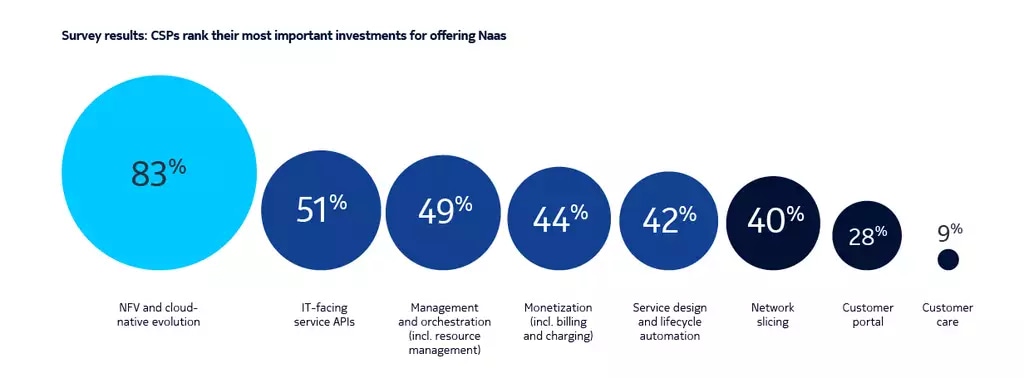
Telecommunication providers today spend billions of dollars a year on cloud-native technologies, with most understanding those technologies are essential for NaaS. In a 2021 Nokia survey, 83 percent said network function virtualization and cloud-native evolution were the most important investments to enable and optimize NaaS.
To go “cloud-native” in the webscale way, telecommunication providers will need to break down their classical network function silos and rebuild them as containerized microservices.
Microservices are at the heart of the NaaS model. Rather than focusing on “blockbuster” offerings that are rolled out to the largest number of subscribers possible, NaaS is about providing targeted services to specific verticals or subsets of subscribers — and then upgrading or modifying those services very quickly in response to customer needs. Containers isolate applications and their dependencies into self-contained units that can be deployed almost anywhere, for greater agility. Both help conserve network resources because what’s activated is only what the customer needs.
Telecommunication providers NaaS Readiness survey
Nokia surveyed 100 telecommunication provider leaders in the Pulse community to understand their readiness to offer NaaS and the benefits of doing so.
- 91% of telecommunication provider leaders agree that offering NaaS is critical to successfully delivering 5G services to enterprise customers
- But many telecommunication providers aren’t aligned to what and how enterprises want to purchase NaaS.
Operating in a world where everything is software and every aspect of the network is eventually going to be coded and programmable requires telecommunication providers to adapt the ways they work, adopting agile DevOps processes, continuous delivery workflows and systems for orchestrating and managing containerized applications (such as Kubernetes).
Real-time, zero-touch automation — in everything from infrastructure and software lifecycle management to network, service and customer management — is also crucial to rolling out and orchestrating microservice NaaS offerings in a cost-effective way. Telecommunication providers know this, too: in the Nokia survey, 49 percent said management and orchestration is the most important investment area to enable NaaS while 42 percent gave top rank to automation investments.
“If you’re not automated behind it, you’re not going to be able to play in that market”
Chris Lewis, Lewis Insight
“The NaaS opportunity really comes down to how the telecom industry engages with its customers,” says industry analyst Chris Lewis of Lewis Insight. “If you're not automated behind it, you're not going to be able to play in that market.”
Make big bets on new technologies and capabilities
Telecommunication providers clearly “get” the importance to NaaS of cloud-native technologies and automation. As they continue along their digital transformation journeys, keeping their investments going in those areas will be key. That’s because they serve as the foundation for three other capabilities that might not yet be at the top of their digital transformation lists but are equally important to being able to offer NaaS.
A programmable network that’s open for business
Automated, cloud-native components make the network programmable. With an open architecture and “service as a code” methods (supported by tools such as Helm), new services can be created, scaled, redesigned or chained quickly and on demand so telecommunication providers can bring new ideas to market faster.
The openness of the architecture is critical. To provide full value to enterprise customers, NaaS has to be designed so services can be integrated into cross-cloud service chains and existing platform-/software-as-a-service offerings that customer DevOps teams can access and consume easily via their channels of choice and customize them to their specific needs.
That requires telecommunication providers to open their doors to customers and partners, using open application programming interfaces (APIs) to expose certain network functions or capabilities. By implementing a service mesh, telecommunication providers can remove the barriers that might prevent microservices from getting what they need from each other via bidirectional APIs, such as a slicing function asking for an enterprise’s policy definitions.
In the Nokia survey, 51 percent of telecommunication providers ranked IT-facing open APIs as a critical NaaS investment. Companies are increasingly recognizing that a big plus of this openness is it makes diversifying the business much easier by replicating services or service templates across different verticals.
“As you standardize and begin to expose the business functions or capabilities via open APIs, you can start to grow your business by moving into adjacent industries,” says George Glass, Chief Technology Officer at TM Forum.
Taking self-service out of the walled garden
The openness provided by APIs, supported by high levels of automation, plays a huge part in delivering exceptional self-service NaaS interactions. And that starts by being alert to what the customer wants.
“Telecommunication providers should strive to make consuming NaaS as easy as it is to get compute resources from public cloud providers”
TL Viswanathan, Nokia
The Nokia survey found that while most telecommunication providers plan to offer NaaS through a branded self-service web portal, only 23 percent of enterprises would prefer that channel. Telecommunication providers need to think of self-service not in terms of building a “walled garden” of their own, but instead about making their capabilities easy to integrate into their customers’ purchasing channel of choice (including partners’ portals) via open APIs.
“Telecommunication providers should strive to make consuming NaaS as easy as it is to get cloud compute resources from public cloud providers,” says TL Viswanathan, Nokia Head of Digital Operations. “But most aren’t yet able to deliver that kind of experience. It’s going to be a big change in the way telecommunication providers do business.”
Enterprise respondents to the Nokia survey said a ‘lack of support or maintenance by their telecommunication provider’ was a big barrier preventing them from purchasing NaaS, yet just nine percent of telecommunication providers ranked customer care as a critical investment area for NaaS. That seems to signal a need on the part of telecommunication providers to rethink how they make themselves accessible to their customers and handle queries and requests.
Enterprise NaaS Survey
Nokia surveyed technology leaders from 100 enterprises in the Pulse community to understand the benefits they expect from NaaS and the top services they would likely purchase.
- Almost 50% of enterprises surveyed plan to purchase NaaS to achieve business benefits
- The most appealing NaaS features are network security (74%) and bandwidth-on-demand (47%)
To get all the survey insights, click here
A simpler approach to monetization
Automation also plays a vital role in the charging, billing, rating and account/balance management capabilities that will be key to enabling NaaS. The challenge for telecommunication providers is to make those processes as easy as possible for customers — which many recognize as an issue to address, with 44 percent of telecommunication provider respondents to the Nokia survey noting the need to beef up their investments in this area.
Simplifying charging and billing while building in the real-time flexibility for enterprise-focused NaaS offerings requires dynamic charging algorithms that can bill enterprises according to feature sets, key performance indicators, resource availability and other measurable parameters agreed on in advance. Those algorithms themselves can’t be too complex, either: too many options or an opaque billing process could put a damper on NaaS adoption.
The solution is to create a monetization suite that features a catalogue of available functions. Those functions can then be mapped to and aligned with various services defined and managed in the telecommunication providers' service catalogue. When a service is ordered, the corresponding functions are automatically attached to it.
When charging analytics are integrated with external service analytics and intelligence — and exposed to business and product management and ecosystems through open APIs — the charging for those functions can be updated dynamically and automatically as needed.
The returns will be worth the effort
Investing in NaaS-enabling technologies and capabilities is just the beginning of the story for telecommunication providers. Bringing the full business potential of NaaS to life will require a certain level of maturity with these technologies and the webscale way of thinking.
For some telecommunication providers, that digital transformation journey may still have miles to go, but the investments they’ve already made in the cloud and automation are heading in the right direction. And with IDC estimating the total value of the NaaS market at $15 billion by 2025, the investment stands to pay off in a big way.
Of course, understanding the technical enablers of NaaS is just piece of the puzzle. Telecommunication providers also need to carefully identify the services and use cases they plan to deliver to ensure they align with enterprise needs and demand.