No network, no AI evolution
By Pallavi Mahajan, Chief Technology and AI Officer

The AI conversation is obsessed with models, chips and benchmark leaps. The truth is simpler: AI is only as powerful as the connectivity that links data, compute and users.
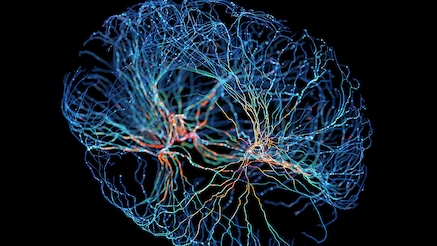
If AI is the brain, then connectivity is the nervous system. It’s what turns “intelligence” into something that can sense, coordinate and act.
A model in isolation is just ones and zeros with opinions, the value appears when it’s stitched into feedback; fed by live data from people, machines and systems, and able to push decisions back out quickly. It turns islands of experimentation, into an AI-powered organization, or even a country.
Nokia’s Build first, lead forever research makes the gap hard to ignore.
Most respondents said AI is transforming their business, with three in every four running or piloting AI today, however 88% believe the network threatens to inhibit future growth of AI. In plain terms, the brain is ready, but the nervous system isn’t.
That is the real challenge for the U.S. in the AI supercycle.
Report
Build first, lead forever
Why AI infrastructure is America’s next advantage.

What is the AI supercycle?
Artificial intelligence is entering a transformative multi-decade phase known as the AI supercycle, where it will become integral to all industries and technologies, driving exponential innovation and economic growth through pervasive automation and data optimization.
Without the right connectivity, there is no future evolution of AI
Infrastructure can look “good enough” right up until the moment it isn’t.
Connectivity networks were designed for the way we have used digital services over the past 20 years. We downloaded files, navigated the internet and streamed. It is all downlink-heavy usage.
AI flips that logic, it needs to be fed. When was the last time you checked your home WiFi’s upload speed? 100 MBPS download speed with 10 MBPS upload is average today, but this won’t work for the AI evolution.
The flow of data becomes more bi-lateral and distributed, with far less tolerance for delay, jitter, packet loss and downtime. As consumers, we become frustrated with buffering, but AI won’t tolerate it.
AI changing the geometry of the internet and when the geometry changes, the network design must change with it.
Not just a faster network, but a new type of network
In Nokia’s research, it is clear that the current standards aren’t working.
Three out of four decision makers expect they’ll need sub-30ms latency for AI in the next 2–3 years, including 13% targeting sub-10ms. This is a new consideration for network design and delivery.
Recent analysis from Ookla suggests the U.S. network has work to do. Not a single state in the U.S. has latency below 30ms. At the high range is Hawaii at 108ms and the low range is D.C. at 37ms. Only 15 states had readings below 50ms.
Latency is the time in which networks take to respond. Generally speaking, the lower the better as when the delay grows it starts to feel like a bad video call where people talk over each other.
We’ve not had to be significantly concerned with latency to date as real-time responsiveness hasn’t been critical; we tolerate a small amount of buffering when streaming for example.
For AI systems making decisions in the moment, this is not acceptable.
Fraud detection and payment authorization, autonomous transport safety systems or keeping the lights on when the grid is under stress, these are examples where low latency becomes mission critical.
That’s why connectivity keeps surfacing as the real choke point. In Nokia’s research, 58% of decision-makers say the network is the single biggest barrier to scaling AI, not the models, but the ability to access them everywhere, in real-time.
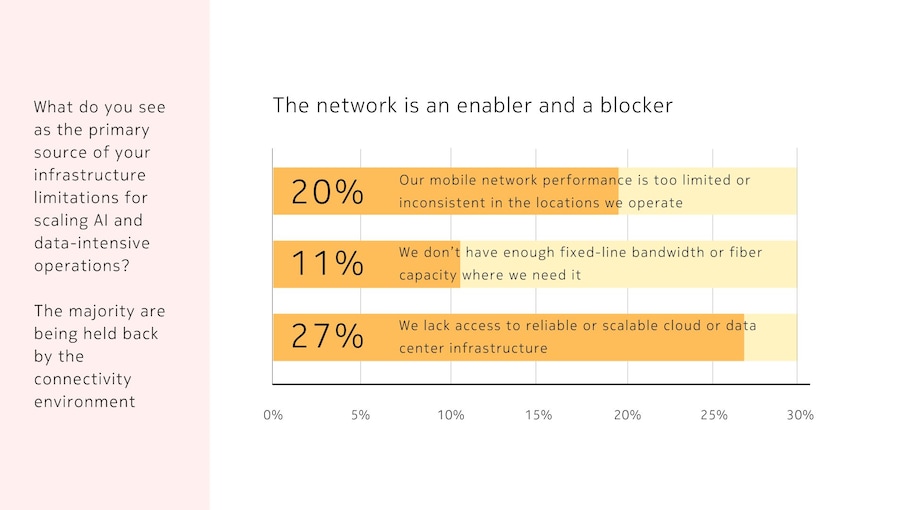
The result is a widening gap between AI ambition and AI delivery. Organizations can buy compute and can license models, but without stronger, more trusted connectivity between data, compute and users, AI stays impressive in demos and frustrating in real life.
If this new status quo is not built into networks now, the supercycle does not just slow down, it stalls.
Policy is the hidden throttle on US competitiveness
Connectivity doesn’t scale on innovation alone. It scales on certainty and trust; certainty that network upgrades won’t be trapped in permitting limbo, and trust that the infrastructure being deployed is secure, accountable and resilient.
That’s where policy matters most.
Washington can’t create the ecosystem and build the foundation to decide whether the U.S. builds AI on trust. The job is twofold: make it faster to modernize networks and make “trusted connectivity” a clear end-to-end standard, not a label reserved for one visible layer.
And the risk isn’t theoretical.
Nokia’s research shows that when constraints persist, companies shift behaviour. Many invest in private infrastructure, some narrow to only the highest-ROI AI use cases, and some move workloads to wherever infrastructure is stronger and more predictable.
That is how leadership erodes quietly, not with a single failure, but with lots of individual decisions that add up to a shift in where AI innovation, jobs and capital concentrate.
Trusted vendors must build the network
In the AI era, connectivity infrastructure is not just a delivery mechanism. It is a strategic surface for risk: economic, operational and national security. The same networks that move training data and inference results also carry sensitive enterprise IP, healthcare information, critical infrastructure telemetry and government communications.
As AI spreads, the ripple effect of a compromised network grows.
Nokia’s research reflects that anxiety. Nine out of 10 believe AI introduces new, complex security threats to America’s digital infrastructure, and 93% say digital sovereignty is very or extremely important to maintaining trust in the AI revolution.
The U.S. has already signalled where it stands on trust and supply chain, including via the Secure and Trusted Communications Networks Act. But here is what needs to change in the AI conversation - 'trusted vendor' cannot be limited to the mobile radio, switch, or routers based on one or two companies.
Governments must look across the spectrum at new and emerging threats under different labels.
Trust must extend end-to-end, from the backbone IP layer, optical transport, subsea and terrestrial routes, and the inter- and intra-data-center networks where the hottest AI traffic lives.
If data center interconnect becomes the nervous system of the AI economy, untrusted components in that system are not a technical footnote. They are a strategic liability.
The two-part test for staying ahead
If the US wants to stay ahead, it must do two things at once:
- Build the connectivity capacity that AI demands, across fiber, backbone, optical backhaul and data-center interconnect, engineered for distributed, east–west AI traffic and real-time performance expectations.
- Ensure the vendors building it are trusted, secure and accountable across the entire stack, not just the parts that are most visible.
In the AI era, the fastest way to sabotage innovation is to underbuild the network, or to build it on components you cannot trust.

About Pallavi Mahajan
Pallavi Mahajan, Nokia’s Chief Technology and AI Officer, leads Nokia Bell Labs, Technology and AI Leadership, and Group Security to drive innovation in core technologies, strengthen AI and security capabilities, and create differentiation through open ecosystems and strategic partnerships. With deep expertise in networks, software, and AI, she has scaled multi-billion-dollar portfolios and shaped industry-defining shifts at Intel, HPE, and Juniper Networks. A holder of six patents and a passionate advocate for women in tech and grassroots sports, Pallavi champions collaboration to unlock the next wave of growth.
Connect with Pallavi on LinkedIn