From network APIs to network AI agents — building the agentic future of connectivity with Google Cloud

The telecommunications industry is entering its most significant shift yet: the agentic era. We’re moving beyond siloed automation tools toward a fully agentic ecosystem that can automate entire workflows.
At Mobile World Congress (MWC) Barcelona this week, we’re announcing the integration of Nokia’s Network as Code (NaC) platform with Google Cloud’s optimized agentic AI stack, to transform from network APIs into a fully agentic ecosystem. This delivers AI agents to telecommunications companies that can autonomously observe, program, and optimize the network through natural language and goal-oriented task automation.
The three pillars of the AI-network evolution
To meet the demands of the agentic era, the relationship between AI and the network is shifting from a "connected" model to a "deeply integrated" one. This evolution is unfolding across three distinct fronts:
- The autonomous network: The network is transitioning from a manually managed utility to an autonomously orchestrated system with AI embedded directly into its control and data planes. By integrating intelligence into every phase—from initial build-out and planning to real-time fault detection and root cause analysis—the network becomes a self-healing fabric. This transition prepares the infrastructure for the programmable, high-fidelity data needs of the agentic era, ensuring that the network can anticipate and scale for demand before it impacts the enterprise.
- Networks optimized for AI: As AI agents take on the "digital chores" of our lives, networks must be architected for heavy uplink data and low-latency "time-to-first-token" requirements. To make technology feel like magic rather than work, mobile networks must become hyper-dynamic, proactively negotiating with the nearest compute nodes like Google Distributed Cloud (GDC) to process tasks at the edge. This localized orchestration manages traffic and compute latency in the background, ensuring that AI assistants respond instantly without the user ever noticing a lag.
- AI agents programming the network: While programmable networks have long promised to unlock value for enterprises and telcos, agentic AI is the catalyst that finally makes this accessible by transforming the developer experience. By exposing capabilities from the RAN to the core through a unified API framework, AI agents can now translate natural language prompts into complex, intent-driven network configurations. This shift enables autonomous systems to coordinate tasks and exchange data between agents, allowing the network to dynamically adapt to the specific needs of an application in real-time.
Nokia’s Network as Code platform — now connecting over 70 partners and 20+ network APIs — is becoming agent-enabled through integration with Gemini models and Google Cloud’s agentic framework. By leveraging standardized interaction protocols like A2A and MCP, these specialized agents move beyond simple automation to active reasoning—allowing them to interpret intent and manage complex network tasks autonomously.
The technical bridge: how Nokia and Google Cloud integrate
The shift from simple APIs to network AI agents is powered by a three-layer integration that connects Google Cloud’s intelligence to Nokia’s network expertise:
- The exposure layer (Nokia Network as Code): This platform abstracts complex 5G core and RAN functions into standardized, Northbound APIs (CAMARA/GSMA Open Gateway). By accessing these Nokia APIs via Google Cloud Marketplace, developers can tap into global mobile networks and utilize the Network as Code portal to gain standardized access to network functions without the need to navigate underlying technologies.
- The intelligence layer (Gemini with Network as Code): We are using Gemini to move from "calls" to "intents." Using MCP, Network as Code AI agents can autonomously identify and utilize network tools such as Quality of Service (QoS) or location verification to achieve specific business goals.
- The interaction layer (agent-to-agent): Through the A2A protocol, a business’s agent (e.g., a logistics coordinator) can communicate a goal to a network agent. The network agent then translates that goal into network-specific instructions, orchestrating the network in real-time without manual coding.
Extensibility via the Agent Development Kit (ADK)
To enable a truly bespoke enterprise ecosystem, organizations can use the ADK to extend these capabilities. The ADK allows developers to build and deploy custom multi-agent systems that integrate proprietary business logic with Nokia’s network intelligence. This modularity ensures that specialized business agents can autonomously negotiate network resources to meet unique mission requirements, securely bridging the gap between internal enterprise data and external network capabilities.
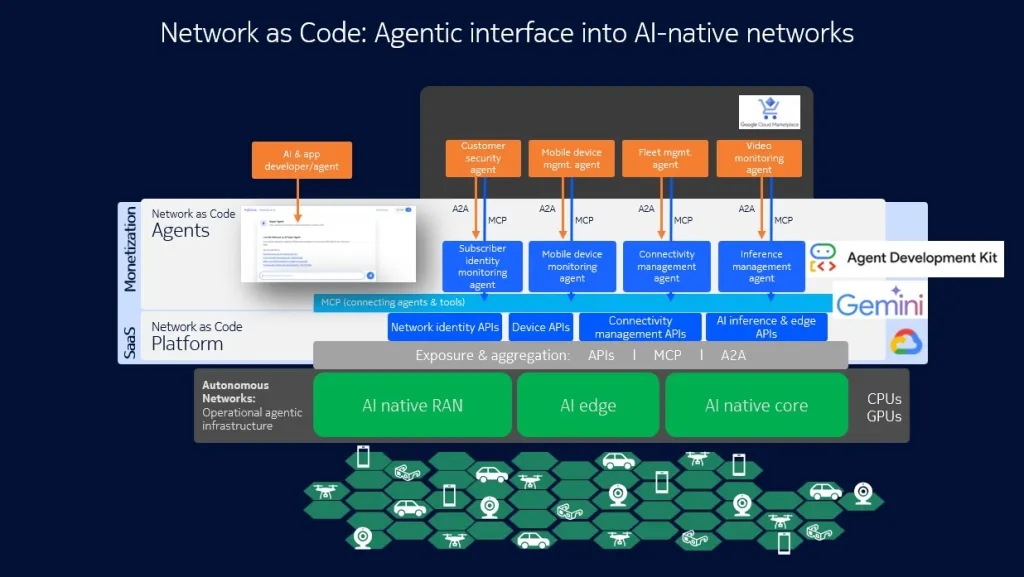
From programmable network to intent-driven enterprise
The true power of this integration lies in how it bridges the "API gap." While Network as Code provides the essential programmable foundation, the addition of Agentic AI allows for a zero-code user experience. Developers no longer need to master low-level telco protocols; they simply define the business intent, and the agentic framework handles the underlying code execution.
The agent-enabled enterprise in action
By sensing real-time conditions—like a drop in mission-critical connectivity—the agentic ecosystem can autonomously resolve issues or provision resources before a service is impacted:
- Autonomous logistics: A fleet management agent can request optimized connectivity for a future drone mission. The Network as Code agent automatically ensures coverage, quality, and priority throughout the flight path.
- Enhanced security: An enterprise device management agent can ask a Network as Code agent to flag any customer subscription, device, or location anomalies in real-time, instantly hardening the security posture of mobile assets.
- High-precision monitoring: A security agent can request a dedicated network slice to support multi-modal AI inference from mobile device feeds, ensuring the bandwidth is there exactly when the data starts flowing.
Why this matters for the telco ecosystem
This partnership bridges the gap between the complex world of network standards and the fast-moving world of cloud developers. For telco providers, it provides a clear path to transform the network from a cost center into an innovation engine. By making network capabilities discoverable and actionable within the Google Cloud Marketplace, telcos can finally monetize their 5G investments at scale.
“The network is no longer a bottleneck or a black box — it is a programmable, intelligent partner in our AI journey. With an intuitive intent-driven interface built into Nokia’s Network as Code, developing and deploying innovative services that leverage the network intelligence is possible at a much quicker pace, reducing time-to-revenue significantly.” - Vladimir Liulka, CEO, Blocksport
“Unlocking a seamless, intuitive developer experience is critical to the growth of monetizable services that leverage the full power of programmable networks and network APIs. Agentic AI framework, with agents providing the developer interface, provides the critical infrastructure to enable this experience. Nokia’s Network as Code platform, which is already integrated with Deutsche Telekom Network APIs, is a pioneer in enabling the transformation for programmable networks to the agentic world.” - Dr. Chathurangi Wickramasinghe, Senior Vice President, Magenta Business API, Deutsche Telekom
Experience the future at MWC
The shift to building the agentic future of connectivity is happening now. We invite you to join Nokia and Google Cloud at MWC to see these live use cases and discover how the Network as Code platform is turning the complexity of the network into a competitive advantage for the agentic era.