

AI Networking Innovation Lab
A new approach to network innovation for the age of AI

In this new world of AI, the network plays a pivotal role. Minor networking inefficiencies slow apps, stall training, waste valuable GPU minutes, and drive-up costs. High latency can cause AI inferencing to malfunction. The network has become a major constraint on AI performance, scale and ROI.
Innovate. Collaborate. Validate.
Why does AI change the networking game?
The game-changing impact that AI has on the network is best understood through understanding the requirements for AI training and AI inferencing. AI training runs on large GPU clusters and depends on lossless, deterministic networking fabrics to handle massive traffic spikes to complete jobs within tight timeframes. AI Inferencing is emerging as a unified framework that can exchange intelligence across a network of xPUs requiring ultra-low-latency to deliver real-time responses and coordinate model execution in microseconds.
What are the key factors needed for AI networking?
Faster speeds and feeds won’t meet AI’s demands. Nor will best-effort congestion techniques tuned for north–south traffic. AI operations require a foundational networking reset that focuses on:
- Ensuring reliability and eradicating human error.
- Choosing network predictability over best effort.
- Scaling networking fabrics for multidimensional traffic (north–south and east–west).
- Engineering hardware and software as one synchronized system.
- Ensuring that automation understands the AI network and its state in near-real time.
- Validating AI networks in realistic conditions across a verticalized stack within a multivendor ecosystem.
How did Nokia react to these new networking requirements?
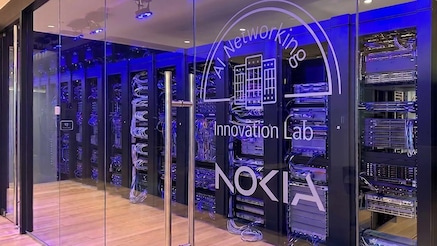
The Nokia AI Networking Innovation Lab – located within our Executive Briefing Center in Sunnyvale, California – is a purpose-built hub dedicated to advancing the next generation of AI-ready networking.
We created this facility in recognition of a simple reality: AI cannot be treated as just “another workload” running on a background network. Now more than ever, it’s clear that the underlying network must be re-architected as an active performance system capable of directly influencing how efficient and reliable AI is when it’s operationalized at scale.
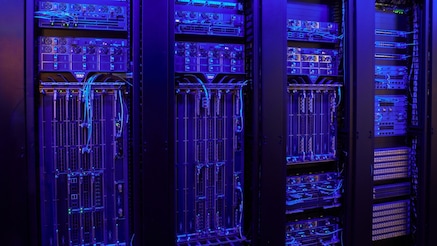
The Nokia AI Networking Innovation Lab is a center of excellence where we drive innovation across these AI-ready active performance systems from end-to-end. It’s where we invite a global ecosystem of partners to integrate their solutions with ours. And it’s also where we test and validate the efficacy of our designs under realistic AI conditions.
As a leader in the AI Supercycle, Nokia established the Lab to spearhead three critical pillars of networking development: Innovation, Collaboration and Validation.
Nokia AI Networking Innovation Lab

Brochure
Nokia AI Networking Innovation Lab


Resource
Nokia Validated Designs (NVD)
Innovate
Boldly experiment with developing next-gen solutions across the entire AI networking stack. Drive emerging standards forward with pioneering approaches to new protocols, switching silicon, congestion control, real-time telemetry, and automation.
Collaborate
Work with leading AI and cloud ecosystem partners to test new capabilities, ensure interoperability, and optimize design configs and architectures. Coordinated development reduces integration risk, shortens release cycles and ensures customers can deploy future-proof, ecosystem-ready solutions.
Validate
Emulate the conditions of modern AI data centers allowing us to create Nokia Validated Designs (NVDs). NVDs are architectural blueprints that have successfully stood up to the scrutiny encountered of rigorous testing across all layers of hardware and software of a pre-integrated AI deployment.
Learn more

Blog
Article

Article

Blog

Blog

Article
Blog

Article