

Our approach

Intelligence is moving across networks, devices, and data centers — and Nokia is at the center of it. Our presence across 130 countries gives us the opportunity – and privilege – to make a positive environmental and social impact on a global scale.
We continue to uphold the highest standards in compliance, governance, and sustainability leadership which remains the bedrock of Nokia’s reputation and trustworthiness in the market.
At the same time, customer demands, regulatory requirements as well as stakeholder expectations are rapidly evolving. Sustainability now directly influences procurement decisions and is a key expectation from both customers and investors.

Our sustainability strategy
Four strategic impact areas supported by four enablers
Customer demands, regulatory requirements as well as stakeholder expectations are rapidly evolving. This creates significant market opportunities. Our aim is to become the most trusted connectivity partner by focusing on customer value and innovation. Our sustainability strategy centers on four impact areas and four enablers.
Our four impact areas
Decarbonization and the circular transition
We will accelerate the decarbonization and circular transition within Nokia and throughout our footprint.
Bridging the digital divide
We will enable our customers and those who are unconnected and underserved to bridge the digital divide through digital adoption and access to connectivity.
Supply chain resilience
We will continue strengthening our resilient supply chain by amplifying existing programs that already have a solid foundation in our operations.
Responsible use of technology
We will differentiate ourselves against the competition as a trusted and responsible producer of technology including disruptive technologies like AI, 6G, and quantum.
Our efforts are supported by four key enablers
Drive sustainability through customer engagement
This reflects the increasing importance of ESG criteria in customer purchasing decisions.
Drive systemic ecosystem collaboration
Meaningful business and sustainability outcomes require collaboration across the ecosystem.
Invest in impact innovations
We aim to accelerate the development of non-linear sustainability innovation through research and customer co-creation.
Digitalize sustainability data and operations
We aim to improve ESG data management by digitalizing and automating processes with AI, and advanced reporting tools.
Our handprint and footprint
We believe the technology we provide enables environmental and social benefits to individuals, industries, communities and economies that can outweigh potential negative impacts. These benefits are the handprint of digitalization and connectivity. We have both a social and an environmental handprint. We maximize this handprint.
We must, however, continually strive to minimize any potential negative impacts of technology. This is our “footprint”. We have both an environmental and a social footprint. We collaborate throughout our value chain to continually minimize our footprint.
These two aspects of our approach are underpinned by responsible and ethical business practices. We strive to be a trusted, ethical company that our employees, customers, suppliers, partners, governments and investors are proud to work for and with. As part of our responsible approach, we aim for:
- Robust practices, procedures and policies that minimize risk
- Management accountability for sustainability and responsibility throughout the organization
- Trust, accountability and ethical behavior as foundations on which we operate
- ISO-certified and audited management systems
- A robust people strategy and mature processes to attract, retain and develop talent.

Governance and materiality
Our governance model
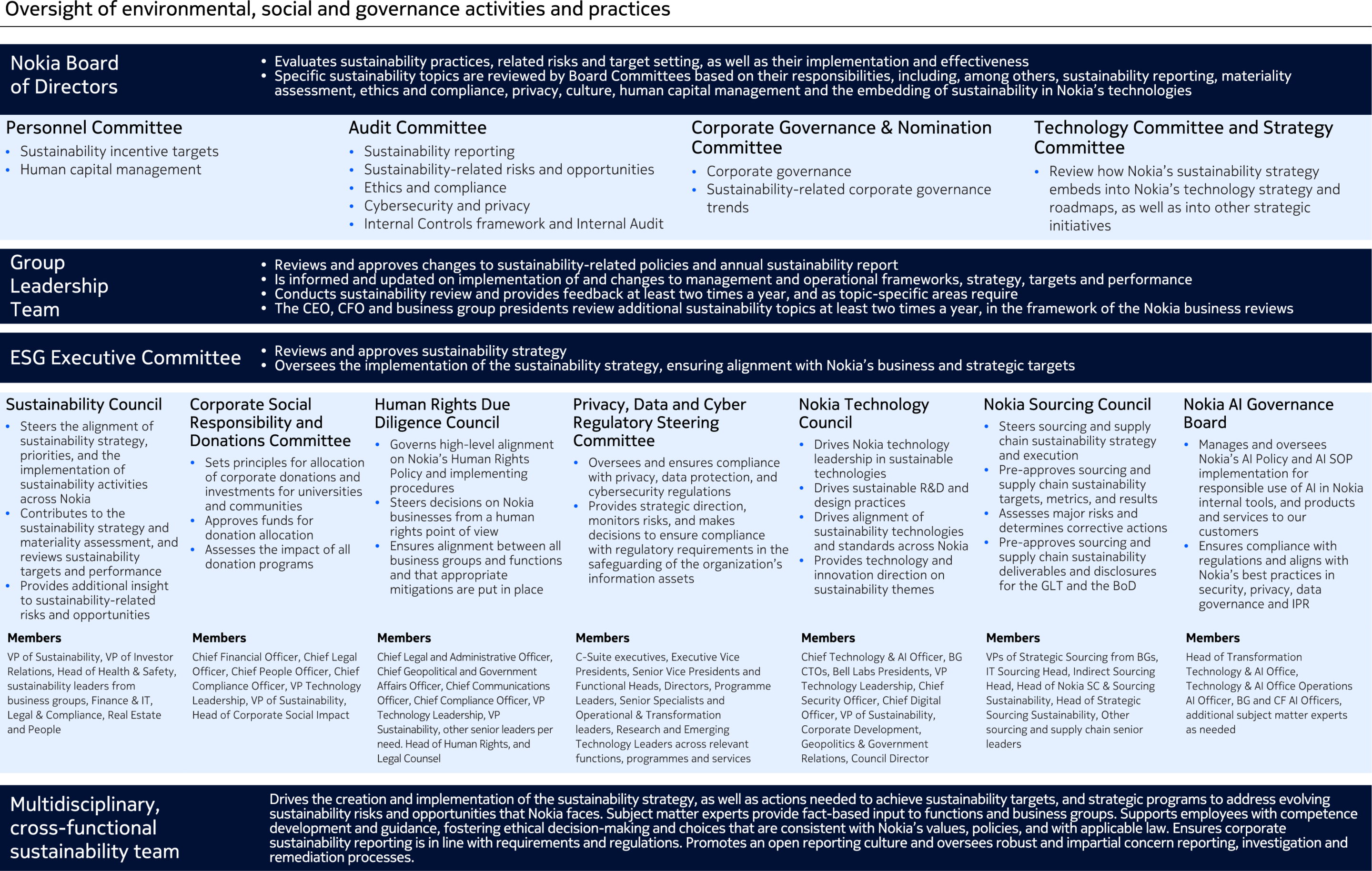
Sustainability issues are reviewed regularly at all levels of the company. We will continue to strengthen our governance structures and the processes we have established to manage ethical business practices and corporate responsibility, reflecting the significant change in our mode of operation implemented in the company during 2023. Our 2025 governance model is shown below. Read more about our governance model
Materiality
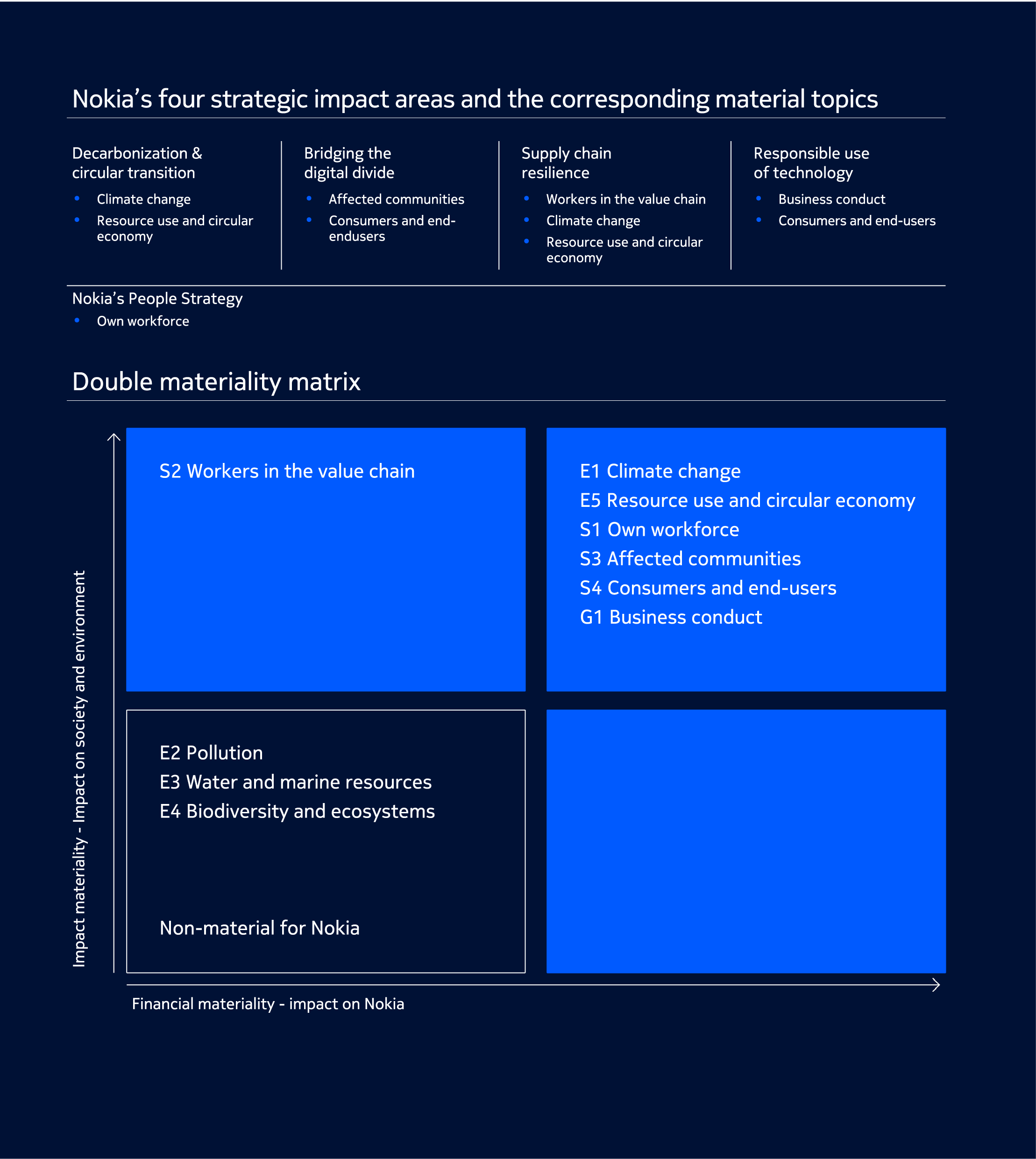
Nokia’s double materiality assessment considered both the financial materiality of sustainability topics, as well as their impact on our stakeholders and the environment. In 2025, the double materiality assessment was re-evaluated to reflect the changes that had occurred in Nokia’s business, operations, value chain and in the markets where Nokia operates, as well as updated regulatory guidance since the initial assessment concluded in January 2024.
Based on the assessment, Climate Change, Resource Use and Circular Economy, and Social and Governance topics were identified as material. Further detailed information can be found in the Sustainability Statement.
Sustainability reporting
We have published annual corporate responsibility reports since 1999 and the reports are available in digital format from as far back as 2003 at our report archive.
Our 2025 Sustainability Statement is included in the Annual Report. This statement includes data and related impact narrative that cover all material aspects of Nokia's sustainability journey across environmental, social and governance in 2025. It is based on the renewed assessment and stakeholder engagement through the Double Materiality Assessment. This Sustainability Statement is prepared for the first time in accordance with the provisions of the newly applicable EU Corporate Sustainability Reporting Directive and with the requirements of the European Sustainability Reporting Standards. The Statement reflects Nokia’s sustainability performance, impacts, risks and opportunities across environmental, social and governance dimensions. It is building upon Nokia’s long-standing sustainability report, People & Planet, as well as on its renewed assessment of sustainability matters conducted through impact analysis and stakeholder engagement.
Nokia's People & Planet : Impact Report 2025, provides a look at our performance in areas where we had a positive impact on our value chain, as well as how those areas have the potential to drive a sustained economic and social transformation.

Our priorities and targets
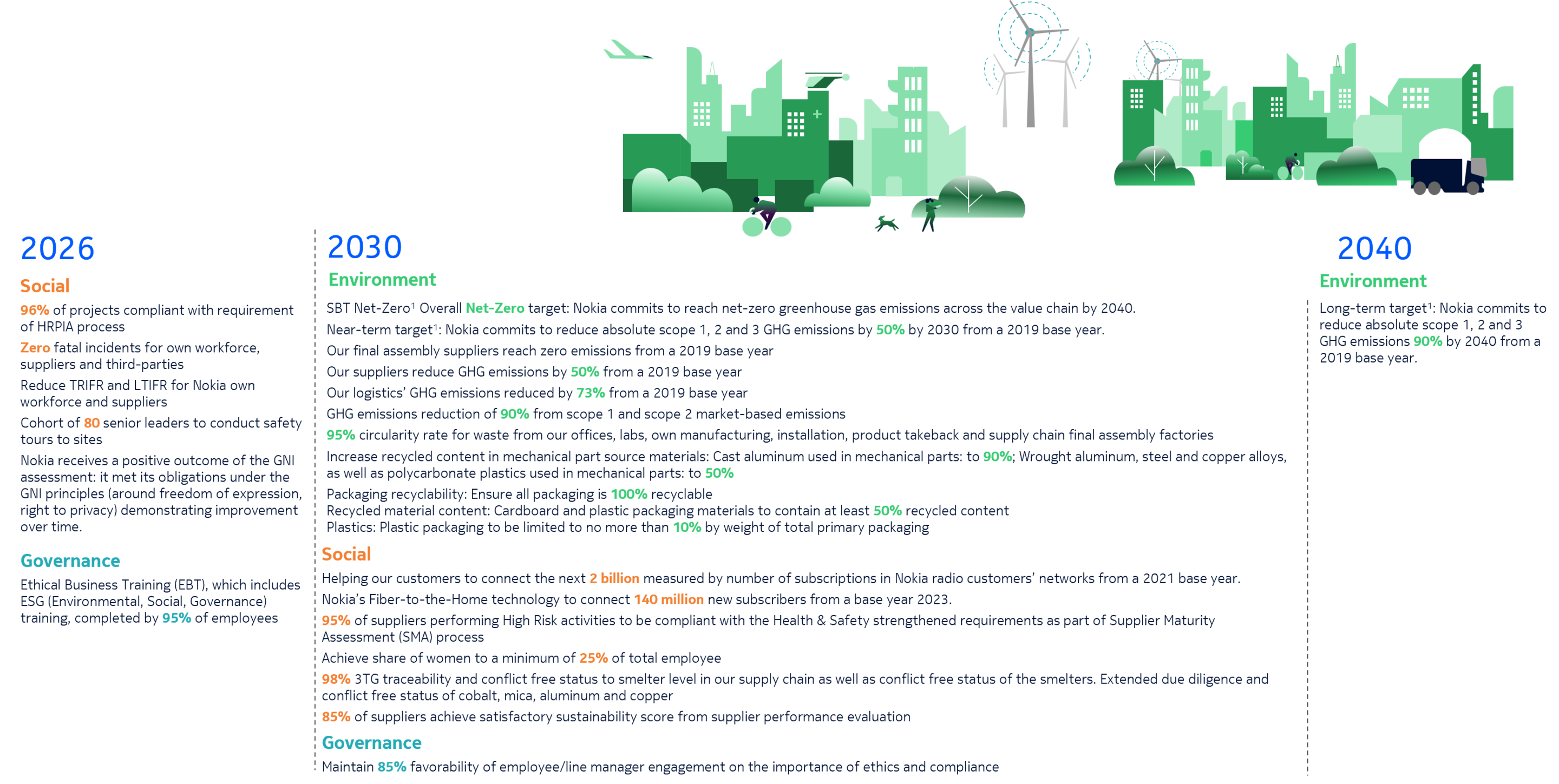
We set short-, medium- and long-term sustainability targets and report progress on all of them annually in our sustainability report.
Ratings and recognitions
In 2026 we were recognized by TIME magazine as the 4th most sustainable company in the world, building on our recognition in 2025 as the 37th most sustainable company in the world. In 2024 we received the e& Sustainability Award in their annual Partner Recognition Event.
In addition to customer recognitions, we have won several prestigious awards (iF Design Awards and Red Dot Design Award) for our sustainable packaging design, demonstrating peer recognition, and we are a member of RE100, which gives us a framework to report our renewable energy related activities transparently.

In January 2026, Nokia maintained its Top 2 position among 69 companies in the communications equipment industry. In February 2026, Nokia was listed as 21st out of the Corporate Knights Clean 200. The Clean200 is selected from 8,229 eligible companies examining total sustainable revenues at public companies worldwide.

In May 2025 we were again certified as a ‘Nasdaq ESG Transparency Partner’ for our engagement in market transparency and in raising environmental standards.
In March 2026 we were named for the tenth time by Ethisphere as one of the World’s Most Ethical Companies®.
Nokia is the only Finnish company and just one of two companies in our industry to be recognized in 2026.
Nokia has been recognized as the overall leader in ABI Research’s competitive ranking for Telco Scope 3 Emissions Management. Nokia was awarded with the highest scores in both the implementation and innovation categories. This ranking assesses top telecom vendors based on their efforts, progress and long-term commitment in reducing Scope 3 emissions, the largest contributor to their carbon footprint.
In October 2025, the Joint Alliance for CSR (JAC) recognized Nokia with a Gold Climate Award (awarded to suppliers with an overall maturity level of 5 and an overall score of 90% or more) as part of JAC’s Scope 3 Supplier Engagement Program (SEP).

In September 2025 Nokia was assessed by Sustainalytics to be at low risk of experiencing material financial impacts from ESG factors. In January 2024 Nokia was included in Sustainalytics’ 2024 Top-Rated ESG Companies List.
Copyright ©2022 Sustainalytics. All rights reserved. This section contains information developed by Sustainalytics. Such information and data are proprietary of Sustainalytics and/or its third party suppliers (Third Party Data) and are provided for informational purposes only. They do not constitute an endorsement of any product or project, nor an investment advice and are not warranted to be complete, timely, accurate or suitable for a particular purpose. Their use is subject to conditions available at https://www.sustainalytics.com/legal-disclaimers.
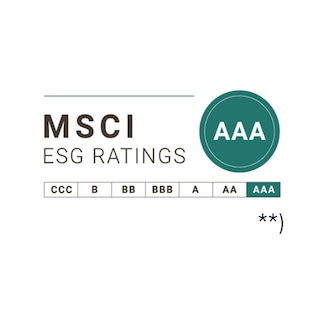
In July 2025, we received a rating of AAA (on a scale of AAA-CCC) in the MSCI ESG Ratings assessment.

FTSE Russell (the trading name of FTSE International Limited and Frank Russell Company) confirms that Nokia has been independently assessed according to the FTSE4Good criteria, and has satisfied the requirements to become a constituent of the FTSE4Good Index Series. Created by the global index provider FTSE Russell, the FTSE4Good Index Series is designed to measure the performance of companies demonstrating strong Environmental, Social and Governance (ESG) practices. The FTSE4Good indices are used by a wide variety of market participants to create and assess responsible investment funds and other products.
In June 2026 we were awarded a Gold EcoVadis Medal. This places our company among the top 5 percent of companies assessed by EcoVadis, with especially high scores for environment and sustainable procurement.
In December 2025 we received an A from CDP for our work on and disclosure of climate change data. Separately, in May 2026, we received a score of A from CDP Supplier Engagement Rating (SER). It evaluates companies’ work with suppliers to reduce emissions and lower environmental risks in the supply chain.
In June 2026, Nokia was rated ‘Prime’ with rank B- by ISS ESG Corporate Rating.
In January 2026 we were again recognized by the World Benchmarking Alliance in their Digital Inclusion Benchmark as one of the 200 most influential digital technology companies on 15 indicators across five digital inclusion measurement areas: access, skills, use, innovation and sustainable value creation. The benchmark measures how the world’s most influential technology companies are helping to advance a more inclusive digital society.
Engaging with stakeholders
We work with a range of stakeholders and look for where we can increase collaboration and respond to requirements in building sustainable solutions. Collaboration is key to moving the needle on many sustainability topics – from protecting the environment to bridging the digital divide and improving security.
Supporting our customers’ sustainability goals
We work with our customers, Telecommunication providers, AI and cloud providers, and mission critical enterprises, on sustainability topics ranging from energy and materials efficiency to supply chain transparency, human rights and community involvement. We have ESG Customer Advisory Councils covering Asia and India, and the Middle East and Africa regions, complementing the existing council for Europe. We also engage with the broader ecosystem, for example on climate issues.
The following table summarizes how we engage with key stakeholders.
Our approach
Nokia's business account teams engage with customers on sustainability through a diverse set of channels. This includes direct interactions such as executive meetings, ongoing sales discussions, requests for information, ESG customer councils, and responses to specific data and reporting needs.
Engagement is further shaped by benchmarking outcomes, industry events, emerging market insights, and evolving regulatory and compliance requirements. Internally, Nokia’s sustainability governance structures also contribute to initiating and guiding these discussions.
Key topics raised in 2025
- Connectivity and digitalization
- Energy and material efficiency, circular products and services, recycled materials, life cycle assessment
- GHG emission reduction
- Resilient operations and value chain, human rights
- Resilient infrastructure, climate adaptation of connectivity
- Public safety and health, data security, privacy, and responsible AI
Our approach
Nokia engages with its workers through statutory and voluntary
mechanisms that ensure regular consultation, feedback on decisions and planning without fear of retaliation. Employee engagement is carried out via multiple channels, such as Nokia’s intranet, surveys, town halls, trainings, regular meetings and manager-employee dialogue, as well as grievance mechanisms. In jurisdictions where legitimate Employee Representative Bodies (e.g. Employee Forums, Works Councils, Unions) operate, Nokia engages constructively and transparently with them through statutory information, consultation and, where applicable, collective bargaining, in line with applicable employment laws and Nokia’s governance processes.
Key topics raised in 2025
- People Agenda and Nokia essentials
- Well-being, health and safety
- Future ways of working and flexibility policies
- Inclusion
- Leadership development and technical career development
- Training and skill building
- Ethical business practices
Our approach
Nokia has regular discussions with its shareholders and the investor community on sustainability topics. The annual sustainability roadshow brings together top shareholders and Nokia experts, and sometimes Board members. Throughout the year, Nokia maintains ongoing engagement with investors via face-to-face and Teams meetings, and digital channels. Nokia also participates in industry questionnaires and ratings such as Sustainalytics, MSCI, and CDP to support transparent information sharing.
Key topics raised in 2025
- Sustainability targets and achievements
- Net-zero strategy and roadmap
- Sustainable supply chain
- Human rights
- Health & Safety
- AI governance
- EU regulations including CSRD and CS3D
Our approach
Nokia engages and collaborates with suppliers through direct supplier management channels, meetings, dedicated events, industry organizations like the Responsible Business Alliance (RBA), and Nokia’s partner management teams. However, there was no direct engagement with suppliers’ or partners’ workforces specifically for the double materiality assessment.
Key topics raised in 2025
- Inclusion and diversity
- Health and safety
- Ethical recruitment practices and prevention of modern slavery
- Responsible minerals sourcing
- Climate change and circular materials
Our approach
Nokia shares its expertise by leading industry best practice discussions, advising policymakers, and participating in industry initiatives. Engagement is organized with industry organizations through Nokia Business owners, dedicated stakeholder owners and subject matter experts, ensuring participation on key topics. Nokia contributes to industry initiatives, like the International Telecommunication Union’s (ITU) Green Digital Action program, the Coalition for Sustainable Artificial Intelligence and activities at the COP climate conferences. Nokia is leading the EU SNS-JU SUSTAIN-6G project enabling collaboration initiatives with ICT and other sectors.
Key topics raised in 2025
- Environmental impact assessment and circularity standards, incl. Digital Product Passport for ICT in ETSI and ITU-T
- Responsible use of AI standards in ISO, data spaces and fair data sharing standards (CEN/CENELEC)
- Modernization of EU standardization governance to improve speed, inclusiveness, and digitization
- Energy-saving and resilience related 3GPP features
Our approach
Nokia partners with leading universities and research institutes in Europe, North America, and Asia on innovative projects. Engagement channels include Nokia-led research and standardization programs, university collaborations and memberships, Nokia University Donations program, training, internships, PhD programs, innovation events, and recruitment of top talent from partner institutions. Examples of projects with university collaborations include: Sustain 6G, 6G Power, 6G ANNA and SUSTAINET.
Key topics raised in 2025
- Sustainability strategic impact areas covered under university donation program projects
- Environmental projects focusing on sustainable and energy efficient computing, climate intelligence and environmental stewardship
- Social projects on digital inclusion and accessibility
- AI ethics and governance, Explainable AI (XAI)
Our approach
Nokia partners with NGOs and community organizations, such as UN Women and UNICEF, which serve as a primary communication channel, leveraging their expertise and direct connections with the affected communities at the grassroots level. Nokia committee members participate in key social and human rights organizations, such as the Business for Societal Impact (B4SI) and the Global Network Initiative (GNI).
Key topics raised in 2025
- Freedom of expression
- Potential misuse of technology
- Positive impact of technology on communities, digital skills building, gender topics
- Environmental protection and biodiversity
Our approach
Regulatory authorities and standard-setting organizations" PLease replace "cities" text with this: "Nokia actively participates in policy discussions to promote a connected society and encourage the global adoption of new technologies. Nokia engages in dialogue, public consultations, standardization bodies and industry and trade associations, often taking leadership roles in working groups of organizations, such as DigitalEurope, Responsible Business Alliance (RBA), ConnectEurope, Telecommunications Industry Association (TIA), Bitkom and others.
Key topics raised in 2025
- Digital and broadband policies, such as broadband rollout and adoption, the digital transformation of society and industry (incl. spectrum for broadband)
- Regulation of emerging technologies, such as AI and quantum
- Effective regulation on sustainability topics such as forced labor, or due diligence in supply chains
- Policies for trusted and reliable international connectivity and secure digital infrastructures
- Policy frameworks unlocking innovation
Nokia and the United Nations Sustainable Development Goals
The United Nations Sustainable Development Goals (SDGs) and their targets remain a key framework for our sustainability work and for many of our customers and partners. Goals 8, 9 and 13 are the most relevant to our business, but we believe that digitalization and enhanced connectivity will continue to play an important role in accelerating and achieving all 17 SDGs.
Climate change remains the most significant sustainability challenge for our business and for the planet. Through the technology we provide, we help customers, other industries, economies and individuals decarbonize through the digitalization of industrial processes and society, so they become more predictive and productive, with reduced emissions.
To minimize our own footprint, we focus on both climate and circularity, where we aim for leadership in the energy efficiency of our products and circular practices. In early 2024, we again received a score of A- from CDP for our work and disclosures on carbon emissions.


8. Promote inclusive and sustainable economic growth, employment and decent work
We connect the unconnected through a broad product portfolio that enables greater digital inclusion across countries globally.
We deliver broadband to urban and rural communities through fixed and wireless networks and to businesses and educational institutions through private wireless and campus networks.


9. Build resilient infrastructure, promote sustainable industrialization and foster innovation
Nokia products and solutions bring improved efficiencies, productivity and digitalization to industries, providing platforms for innovation and decarbonization.


13. Take urgent action to combat climate change and its impacts
We focus on constantly improving the energy and material efficiency of our products across our portfolio.
This helps our customers – both communication service providers and enterprises – minimize their environmental footprints.