What is a patent? A practical explainer for technology innovation

Patents are behind-the-scenes building blocks—from the products in our pockets and homes to the networks that connect them. In this blog, I will break down what patents are, why they matter for innovation, and how companies such as Nokia help turn patented technologies into widely interoperable solutions through standards and licensing.
Patent meaning explained
Patents are all around us - behind the medicines we take, the devices we use, and much of the technology that powers modern life. So, what is a patent? Put simply, it’s an exclusive legal right granted for a technical invention.
A patent lets the inventor—or the current owner—prevent others from making, using, selling, or importing the invention without permission for a limited time. In return, the inventor must publish a clear description of how it works. At its core, a patent provides its owner the right to temporary exclusivity in exchange for public disclosure of the invention.
Patents can apply across many fields—from healthcare and life sciences to chemicals, manufacturing, energy, and telecom and digital technologies—as long as the invention is genuinely new and technical: a concrete solution to a practical problem, not just an abstract idea.
Finally, two quick ground rules:
- Patents aren’t global. They’re territorial, meaning they apply only where protection is sought and granted.
- Patents aren’t forever. They are time-limited, - typically 20 years from the filing date.
How technology patents power innovation
The evolution of technology
Everyday technology rarely comes from a single “Eureka!” moment—it arrives in waves building on the progress made by other inventions. Phones and electric lighting were forged in fierce competition and patent fights—Bell and Elisha Gray even filed rival telephone claims on the same day in 1876. A similar dynamic unfolded in early aviation, when the Wright brothers’ flight-control patents fueled years of lawsuits—but this, in turn, incentivized new inventions developed by others built on these foundational patents.
Fast-forward to today, and patents still shape how technology is adopted. The scale is enormous: in 2024, a record 3.7 million patent applications were filed worldwide, according to the World Intellectual Property Organization (WIPO).
Modern connectivity—from Wi-Fi to 4G and 5G—has been built on hundreds, and often thousands, of patented building blocks. Some of the most valuable advances are tiny tweaks, such as better interference handling or error correction, that add up to big real-world gains. You can see the impact in everything from wearables and connected cars to AR glasses. And now generative AI is following a similar path, with assistants and built-in features rolling out across widely used devices.
The patent trade-off
None of this happens overnight. Breakthroughs can take years of research and testing before they show up in everyday products—and patents help make that investment possible by rewarding risky research and development (R&D).
That’s why the purpose of a patent is often seen as twofold.
- Reward innovation. Patents help innovators earn returns through time-limited market exclusivity or licensing, which can fund the next round of innovation.
- Share knowledge. Because patents are published, they expand the world’s shared pool of knowledge, creating a global technical library others can learn from, improve and design around - so innovation spreads faster. They can also enable collaboration through shared technology transfers between patent owners or the inclusion of their protected inventions in a standard (e.g. Wi-Fi, 4G and 5G).
From connectivity to AI patents
Patents protect specific inventions—the technical features or methods that make something work in the real world. What does a patent cover? For simplicity, you can think of it in two buckets:
- Products are things you can make or use, from devices and materials to complete systems.
- Processes are methods of making or operating something, such as manufacturing steps, technical methods, or protocols.
In connectivity and digital technologies, patents often capture practical ways engineers make systems faster, more reliable and more secure. You can see that influence across many areas, including:
- Wireless communications (Wi-Fi, 4G/5G): more reliable and faster connections, wider coverage, and more devices
- Network infrastructure: faster routing, smarter traffic management, steadier data flow and better energy efficiency
- Video and multimedia: more efficient audio/video codec technology with higher quality for less data, streaming and better content recommendation
- Internet of Things (IoT) and cloud: easier device setup, secure connections, reliable device-to-cloud messaging
- Automotive: safer and more enjoyable driving experience, advanced driver-assistance systems, improved navigation and remote vehicle control
- Security and privacy: device identity, login and authentication, encryption, secure updates, better data protection
- AI and machine learning (ML): faster and more reliable models, easier deployment in real-world products
In many of these areas, key inventions are included in relevant industry standards, which act as the backbone / framework for many modern technologies. That’s where standard essential patents come in.
Standard essential patents, the key building blocks
Standard essential patents (SEPs) cover technologies that are needed to implement widely adopted standards—formally agreed technical specifications for products, processes or services—such as 4G/5G, Wi-Fi or audio/video codecs. If you want a device or service to be standards-compliant and interoperable—able to “speak the same language” as others—you generally need access to any underlying patented technologies that it relies on.
Because standards are meant for broad adoption and global compatibility, SEP holders typically commit to enable access to their patents on (FRAND) terms, for example through licensing. FRAND means fair, reasonable and non-discriminatory. In practice, SEP licensing works by giving implementers access to the patented inventions needed to comply with a standard. This helps companies to:
- Build compliant, interoperable products.
- Support the wider global adoption of standardized technologies.
- Allow innovators behind the standard to seek compensation for the use of their patented technologies.
SEPs aren’t just paperwork; they’re behind-the-scenes technologies that you may use every time you use a product that implements a standard, such as 5G. Nokia is one of the companies that develops those building blocks.
How Nokia patents help share innovation
At Nokia, patents are basically a record of the technical problems we’ve worked on over time. Since 2000, we’ve invested over €150 billion in R&D, and our portfolio today covers over 26,000 patent families worldwide.
A major share of Nokia’s patent portfolio comes from work on open standards. We hold SEPs across multiple cellular generations, including more than 8,000 patent families relevant to 5G. That scale reflects our contribution to 5G innovation, and we’re already leading research into 6G.
At Nokia, we see patents as a way to collaborate. We contribute inventions to standards and ensure access to them by committing to license them on FRAND terms.
Nokia’s patents show up across a broad range of sectors, from mobile and consumer electronics to connected vehicles, IoT, and digital services such as video and gaming. Nokia’s portfolio also spans immersive multimedia, security and location technologies, UI/UX and AI/ML, and many more. As my colleague Sami Saru (VP and Head of Nokia’s Patent Portfolio), said in an interview with Mobile World Live, Nokia technologies are implemented in around a billion new devices each year.
How to patent an idea: the full lifecycle
So how does an invention move from the lab to a granted right—and eventually show up on your wrist as a wearable? Here’s how to get a patent, step by step.
Research and development
Tech patents often begin in R&D, when engineers and researchers turn practical problems into inventions that can be built and tested. As we’ve seen, the patent system supports this process by rewarding innovation and encouraging knowledge sharing.
Nokia ties its patent output to long-term R&D, backed by steady investment over time.
Patent filing
Once an invention is made, it’s drafted into a patent application, a key step in obtaining patent protection. Most patent offices, such as the United States Patent and Trademark Office (USPTO) and the European Patent Office (EPO), require a clear explanation of how the invention works so someone skilled in the field can understand it. This is the core of the “patent bargain” - exclusivity rights in return for public disclosure.
Companies then file the application in the countries or regions where they want protection, using national patent offices and regional routes. There is even a global route via WIPO—one Patent Cooperation Treaty (PCT) application for 158 member countries.
Examination
After filing, the patent office checks whether the application meets the legal requirements. For example, the EPO will confirm novelty, inventive step and industrial applicability, prior to granting a patent, and the USPTO will apply equivalent requirements.
This stage may involve a back-and-forth: examiners may raise questions and objections, applicants respond, and the claims are refined until the patent scope is clearly defined and meets the necessary requirements for patentability.
Grant and maintenance
If the application meets those criteria, the patent is granted in that country or region. After that, the owner usually needs to pay renewal (maintenance) fees to keep the patent alive—how often and how much depends on the jurisdiction.
For innovators with large patent portfolios, maintaining the portfolios across multiple countries requires significant ongoing work and can be costly.
Business patent licensing in practice
How licensing works
Once a patent is granted, it’s not just a technical milestone, it also has meaning in business as a practical and financial tool. One common option is licensing. In practice, patent licensing allows patent owners to authorize others to use their inventions on agreed terms while ensuring innovators are compensated.
Licensing isn’t one-size-fits-all. The right setup depends on the technology, the market, and business goals. A typical license will define the:
- Scope: what the license covers (e.g. licensed patents, licensed product, territory, field of use)
- Deal type: one-way licensing (one company grants rights to another) or cross-licensing (companies exchange rights)
- Licensing model: direct bilateral licensing with an individual patent owner, or licensing through a patent pool
- Exclusivity: exclusive or non-exclusive rights (whether others can also get access to the invention)
- Royalty amount and structure: fees set per unit, as a one-time payment or a mix
Benefits for the technology ecosystem
Patent licensing contributes to the wider innovation ecosystem. In technology, 4 key benefits include:
- Rewarding innovation and supporting further R&D.
- Enabling collaboration through shared access to protected technologies.
- Gaining faster access to technologies without having to develop them internally through costly R&D
- Helping inventions reach the market more widely.
- Supporting interoperability and adoption in standards-driven sectors.
Nokia licenses its patents through a range of programs covering mobile devices, automotive, consumer electronics, IoT solutions, video services and gaming. For details, visit our patent licensing page.
Patents vs. other forms of intellectual property
Patents are only one type of intellectual property (IP). Think of IP as a toolbox, with each right covering a different part of what you may create.
- Patents protect technical inventions - how a product or process works.
- Trademarks protect brand identifiers such as names and logos.
- Copyright protects creative expression (e.g., text, images, software code), but not the underlying ideas or methods.
- Trade secrets protect confidential know-how, as long as it stays secret.
At Nokia, we use the full IP toolkit with patents central to protecting and licensing our inventions.
While patents can sound legal on the surface, in technology they’re deeply useful: they protect real inventions, share how they work, incentivize further R&D, and—through standards and licensing—help enable collaboration and turn great ideas into products people use.
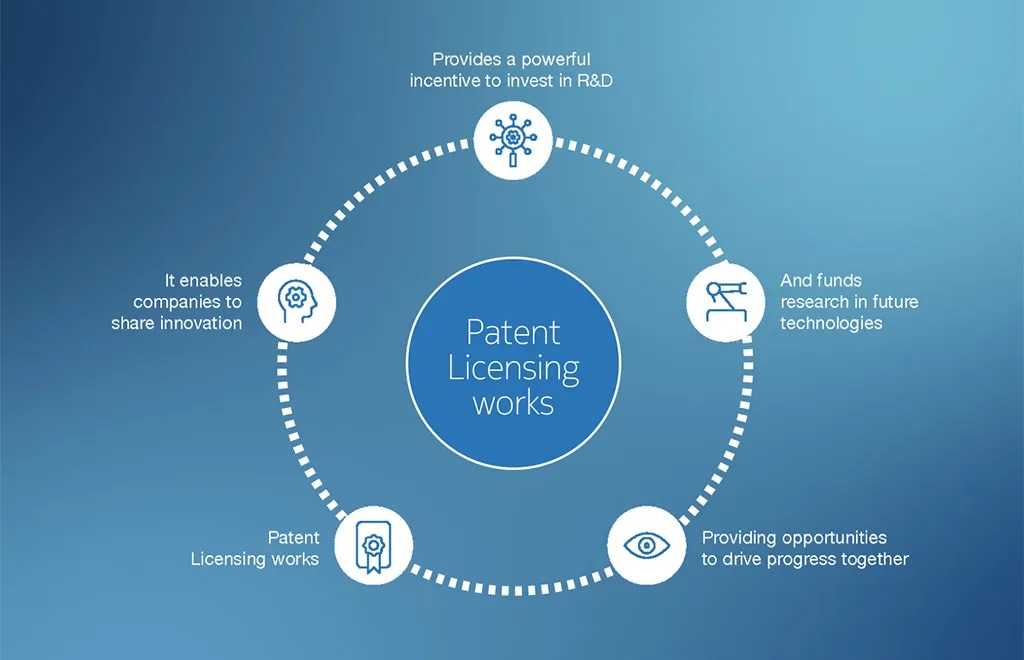
Together, these effects help create the virtuous cycle of innovation and open standards. Patent law provides the legal framework that makes this cycle possible. For it to be effective, that framework must be robust, reliable, and dependable—ensuring that innovation continues to benefit both creators and society.
Common questions about patents
How long does a patent last?
In many countries, a patent lasts up to 20 years from the filing date. This applies as long as renewal fees are paid and the patent is not invalidated in an administrative proceeding (e.g., an opposition at the EPO) or by a court. After this period, anyone is able to freely use the invention.
Can someone use a patented invention?
Yes. A patented invention can be used with permission, usually in the form of a license or another authorization from the patent owner. Without it, making, using, selling, or importing the invention may violate the owner’s rights.
Do patents apply globally?
No. Patents do not apply globally; they are territorial. Rights apply only in the countries or regions where the patent is granted, including through regional systems such as the European patent route.
What is prior art?
“Prior art” is any publicly available information—papers, products, websites, or earlier patents—available before the first filing date anywhere in the world. It is used to assess whether an invention is new and non-obvious.
Does Nokia enforce its patents?
Yes, Nokia enforces its patents when necessary. It seeks to reach licensing deals amicably, but if a patented technology is used without a license, Nokia may take legal action as a last resort.