

Cloud Packet Core (CPC)
Reach new heights in performance to deliver 5G services with confidence

Operators are deploying 5G Standalone networks while supporting multiple network generations and access technologies. Nokia Cloud Packet Core converges multiple network generations, access technologies, and packet core functions on a common cloud-native platform, reducing operational complexity and simplifying network evolution.
Built on containerized network functions and Kubernetes-based automation, the platform supports deployment across private, public, and hybrid clouds, on-premises infrastructure, and edge environments. This allows packet core functions to be deployed according to performance, operational, and regulatory requirements.
The solution integrates control plane and user plane functions on a common cloud-native platform that supports subscriber mobility, session management, traffic steering, local breakout, and edge deployments. A common operational and lifecycle management framework simplifies software upgrades, scaling, automation, and day-to-day operations across 4G and 5G environments.
Integrated AI and machine learning capabilities support anomaly detection, traffic forecasting, troubleshooting, and resource optimization. These functions help operators identify potential issues earlier and improve operational efficiency.
The platform also supports network slicing, API exposure, edge computing, and Network as Code capabilities. These functions enable enterprise connectivity, industrial networking, fixed wireless access, and other 5G services that require application-aware network behavior and programmable network capabilities.
Nokia Cloud Packet Core provides a common cloud-native platform for packet core operations, 5G Standalone deployment, and the delivery of consumer and enterprise services.
What is packet core?
The Nokia packet core provides key components needed for a webscale-class evolved packet core (EPC) and 5G core system (5GC). With its virtualized, cloud-native disaggregated and state-efficient design, it is well suited for multi-cloud environments. It is also infrastructure agnostic and independent of the underlying cloud infrastructure used for orchestration, lifecycle management (LCM) and infrastructure resource management.
Pre-integrated appliances offer network growth, deliver additional functionality and mitigate end of life challenges due to limited cloud infrastructure. The Nokia packet core can anchor both wireless (2/3/4/5G NSA and SA) and wireline (xDSL, PON, fiber) access technologies, forming a universal adaptive core.


Why Telcos should trust Nokia's Packet Core?
Capture new revenue opportunities by delivering a diverse range of exciting services. This requires a feature-rich, high-performing, capable and reliable packet core that can be deployed without limitations and evolved with confidence on any cloud and using any access technology (2G/3G/4G/5G).
Deploy with flexibility, ensure performance
Find out how Nokia’s packet core flexibility meets your needs wherever you are on your cloud journey.
- Minimized latency - a compact, high performance and distributed packet core for user plane slice selection and local traffic offload helps to meet the needs of ultra-reliable low latency use cases.
- Increased flexibility - packet core network functions can be introduced or expanded rapidly with a simple software upgrade or a pre-integrated appliance.
- Resource efficiency - the unified control plane can manage multiple wireless and wireline user plane functions located anywhere in the network.
Maximize throughput, minimize latency
Find out how Nokia’s packet core helps you to achieve industry-leading performance from integrated IP services and a high-performance IP forwarding engine.
- Cost-effective network - 3.5x greater throughput compared to dedicated external network elements.
- Improved customer experience - the high performance packet core gateway minimizes latency for the delivery of uRLLC use cases.
- Lower OPEX - fewer network functions need to be processed and maintained.
Observe your packet core performance
Find out how Nokia packet core's observation capability leads you to effective operations and monetization.
- Performance analysis - analysis of individual device sessions and behavior is enabled by packet core network function per call measurement data (PCMD) for detailed insights to help maintain service performance.
- Visibility at all levels - monitoring overall packet core network with per-interface and per-flow granularity enables you to get ahead of issues.
- Openness - open cloud native computing foundation (CNCF) components can be used for easy logging, tracing and monitoring.
How Nokia delivers more resilient networks for Telcos
Session Restoration Service (SRS): strengthening resiliency and optimizing resources
Nokia’s Session Restoration Service (SRS) is designed to help telcos keep the Packet Core network running smoothly even when individual nodes fail, while lowering total cost of ownership. In this unique solution, instead of traditional “one primary, one standby” designs that force operators to overprovision capacity, SRS uses a shared pool of resources where any node can restore user sessions from a common backup. This spreads recovery load across the cluster, so networks no longer need to be sized with ~50% idle headroom.
SRS also reduces unnecessary signaling between core functions. By only updating what has changed in the user context and streamlining acknowledgements, it cuts backup‑related signaling by about half and overall control‑plane signaling by roughly 20%. That translates into lower overhead, faster recovery, and more predictable performance during large outages or mass reattachments.
At the data layer, SRS uses a secondary database partition rather than stand‑alone backup nodes. This simplifies lifecycle management, removes the need for extra backup instances, and can reduce the overall core footprint by up to 30%.
The result for telcos is a more resilient cloud core network architecture that delivers higher availability, better efficiency, and lower operating costs.
Packet Core Appliances for achieving high performance at the edge
Nokia’s Packet Core Appliances give telecommunication providers a practical path to meet edge performance and capacity demands by delivering pre-packaged, production-ready software stacks for high-performance servers that enable network disaggregation, accelerate deployment, and simplify operations—helping reduce latency while improving reliability. They combine high throughput and low latency for demanding edge workloads with automated, customizable deployment workflows, reduce infrastructure and power consumption to lower total cost of ownership, and provide built-in resilience with consistent lifecycle management. Versatile applications include delivering Ethernet services over 5G Fixed Wireless Access (Eo5G FWA) with predictable performance and supporting resilient, low-latency connectivity for healthcare clinical applications and telemetry.

AI/ML in 5G Cloud Packet Core: driving performance and resilience
Nokia’s Cloud Mobility Manager (CMM), integrated with the Machine Learning Intelligence Service (MLIS), delivers a cloud‑native, real‑time learning Packet Core that leverages microservices, event streaming, and deep observability to power forecasting, anomaly detection, automated root‑cause analysis, mitigation, and predictive reachability. AI/ML use cases run as controllable pods with enable/disable options, and trained models drive closed‑loop automation across autoscaling, anomaly mitigation, and QoS tuning—advancing toward agentic AI in multi‑vendor, multi‑cloud environments. The result is measurable impact: more than 97% first‑attempt reachability through UE location forecasting, up to 50% reduction in peak paging fanout, optimized compute autoscaling for resource efficiency, and faster incident detection with resilient disaster protection—benefiting operations with proactive automation and reduced time to detect/resolve, architects with an interoperable and explainable AI‑native core aligned to open multi‑cloud designs, and business leaders with quantifiable improvements in user experience and cost that accelerate an AI supercycle.
Packet Core AMF: AI/ML based pool management
Non 3GPP interworking function (N3IWF) - Untrusted access security frameworks
The Non‑3GPP Interworking Function (N3IWF) is the 5G/6G gateway for untrusted access, such as Wi‑Fi and residential broadband, implemented as an NG‑RAN element that connects directly to the 5G Core. Building on and modernizing the 4G ePDG, it aligns non‑3GPP access with 3GPP procedures and call flows, centralizes authentication, and delivers NAS‑native services with encrypted IPsec transport. Security is strengthened through unified integrated authentication and encryption, use of temporary identifiers, end‑to‑end NAS protection. Service quality improves with consistent NAS‑based capabilities, 3GPP‑grade QoS, and exposure of slicing, policy, and analytics for monetization and low‑latency experiences (e.g., gaming, VR/AR). Signaling is optimized by eliminating re‑authentication during mobility between 3GPP and non‑3GPP access, reducing signaling load, energy use, and latency—especially beneficial for public and transport UEs.
Cloud Packet Core explained
Cloud Packet Core plays a fundamental role on 5G Packet Data networks, especially when it comes to Stand Alone Core and Service Based Architecture. 5G brings concepts that are new to the telecommunications world. Although some of them like Virtualization, Cloud Core and Cloud Native are mainstream by now, other ones may still raise questions. To help clarify some of these concepts, we created the videos below. Please watch them and leave your comments.

Cloud Packet Core - AI/ML: Use case results in 5G Packet Core networks

5G CPC – Improving performance with Intel® Xeon®

Appliances: Push network performance to the edge

5G Monetization with Ethernet over 5G FWA

Core Automation: Planning your network

Nokia Core Talk: Evolving Vodafone’s network to 5G SA with Cloud Packet Core

Achieving high performance at the edge with Packet Core Appliances

Connect multiple locations seamlessly with Ethernet over 5G FWA
Packet core products
The Nokia packet core consists of the Cloud Mobile Gateway (CMG), Cloud Mobility Manager (CMM) and Network Resource Director (NRD). These products provide key components of an evolved packet core (EPC), a 5G core (5GC) and 2G/3G mobile packet core domains for the creation of a single packet core network.
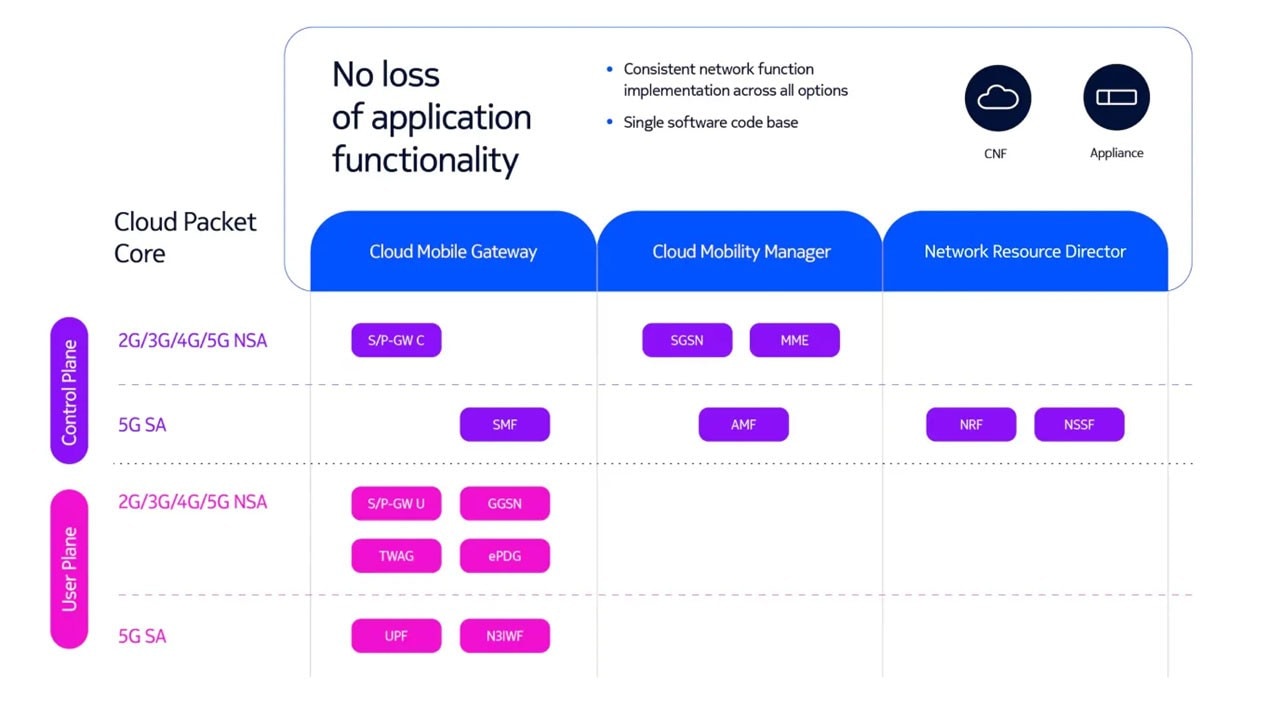
Cloud Mobile Gateway
The Cloud Mobile Gateway (CMG) supports multi-access connectivity by converging multiple mobile packet core gateway functions.
In 4G evolved packet core (4G EPC) networks this includes the serving gateway/packet data network gateway/ gateway GPRS support node (SGW/PGW/GGSN), policy control enforcement function (PCEF), subscriber services gateway (SSG) providing carrier-grade network address translation (NAT), TCP optimization, firewall and service chain steering capabilities, hybrid access gateway (HAG) for converged service delivery, home agent node (HA), evolved packet data gateway (ePDG) and trusted wireless access gateway (TWAG).
In 5G core (5GC) networks this includes the session management function (SMF) and user plane function (UPF).
Cloud Mobility Manager
The Cloud Mobility Manager (CMM) is a key control plane element of the Nokia packet core solution built to support the growth of diverse services as well as the evolution to a 5G core system (5GC).
In 4G evolved packet core (4G EPC) networks the CMM provides the mobility management entity (MME) function, and the serving GPRS support node (SGSN) function in 2G/3G mobile packet core networks.
In 5G core (5GC) networks the CMM provides the access and mobility management function (AMF).
Network Resource Director
The Network Resource Director (NRD) implements 3GPP-compliant services, laying the groundwork for a Services Based Architecture (SBA).
It facilitates two key functions: the Network Repository Function (NRF) and the Network Slice Selection Function (NSSF).
The NRF stores network function (NF) registration information, enabling these functions to operate as either service "producers" or "consumers."
Meanwhile, the NSSF manages network slice allocation by selecting suitable slices from predefined configurations and assigning them to specific devices. It also ensures the proper allocation of network functions and associated resources to meet device service requests effectively.
5G Packet Core energy saving
Nokia is committed to prioritizing energy efficiency in its products and solutions. The Cloud Packet Core leverages the latest chipset features, such as P-State and C-State capabilities, to their fullest potential. P-states allow for CPU frequency adjustment on a per-core basis, while C-states enable the CPU to enter various sleep modes. By combining these modes, Nokia effectively reduces power consumption.
Additionally, Nokia has integrated Artificial Intelligence and Machine Learning into its Cloud Packet Core, utilizing computational algorithms to learn and predict network patterns. This includes the implementation of a Traffic Load Prediction Model, which triggers the Kubernetes Horizontal Pod Auto-scaler based on machine learning results, using just the number of CPUs needed to serve the demand. In collaboration with Intel, Nokia is focused on achieving greater energy efficiency in 5G networks by utilizing Xeon processors and Intel's power management software. These advancements, built upon years of innovation, provide telecommunication providers with enhanced capabilities to reduce electricity usage and costs within their networks.
Video
40% power savings in the 5G Core network
Nokia strengthens strategic partnership with Intel
Nokia is committed to enhancing its solutions to provide more efficient networks for telecommunication providers. Building on our partnership with Intel, we recently benchmarked our Cloud Mobility Manager (CMM) software on Intel's latest Xeon 6 processor with E-cores. The results showed a 2.7-fold increase in performance and an 80% improvement in power efficiency compared to the most widely deployed 3rd Generation Xeon scalable processors. Nokia will introduce Intel’s Xeon 6 processor E-cores with it’s cloud-native Core solutions starting early 2025.

5G Packet Core security
Nokia Cloud Packet Core is cloud native by design. It provides high performance and latency thanks to modern architecture, enabling multi-cloud and appliances-based deployments. It also allows wireline (optical, fiber, cable) and wireless (2G/3G/4G/5G) convergence.
It is designed for privacy and security, with layered protection based on defense-in-depth design and zero-trust principles and tested against 5G-specific use cases. Telecommunication providers get full control to secure their 5G services, thanks to the pervasive and automated security management built into our design practices, 5G core software, and dedicated security solutions.

Related solutions and products
Product
Get the flexibility, scale, and performance you need for enhanced broadband, uRLLC and 5G services on any cloud
Product
Leverage cloud-native design to boost performance and scalability
Product
Take advantage of SBA's adaptable, scalable, and modular design to efficiently allocate network resources as needed.
Learn more about our cloud-native packet core
Video
Cloud Packet Core - AI/ML: Use case results in 5G Packet Core networks
Video
Packet Core AMF: AI/ML based pool management

Blog
Video
Nokia and Viti accelerate 5G rollout in French Polynesia

Blog

Blog
Video
5G CPC – Improving performance with Intel® Xeon®
Video
Appliances: Push network performance to the edge
Please complete the form below.
The form is loading, please wait...
Thank you. We have received your inquiry. Please continue browsing.