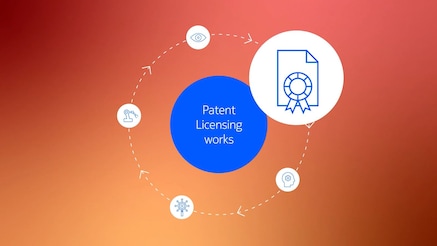
The virtuous circle of innovation explained
Nokia enables you to build upon our innovation by licensing our standard essential patents (SEPs) on fair, reasonable and non-discriminatory (FRAND) terms.

Every product or service that connects to a network or plays video incorporates standardized technology.
Standards, such as wireless communications and audio or video codecs, often include thousands of unique and patented inventions, each of which forms part of the standard.
FRAND licensing compensates innovators for the use of their standardized technologies and keeps the wheels of innovation turning.
For you. For everyone.
How does open standardization work?
Open standardization works because companies, such as Nokia, invest significantly in the development of new and advanced technologies for contribution to technology standards.
The objective is to create standards incorporating the best technology and make them broadly available for implementation through FRAND
licensing.
Countless companies may then benefit by implementing these technology standards to create new and transformative products and services that are interoperable, without making the massive investments required to develop the standards themselves.
What are the benefits of open standardization?
The benefits of open standardization are:
- enabling products and services with new and transformative
functionalities - increased competition and consumer choice
- industry growth.
Globally standardized wireless communications and multimedia technologies allow products from different manufacturers to communicate seamlessly with each other all over the world, with users sharing rich media content; and have enabled entirely new businesses using these new functionalities to flourish.
They also help meet environmental, social and governance (ESG) goals, enabling, for example, remote working and education, reducing travel and lowering carbon emissions.
What is a patent?
A patent is a legal property right granted to protect technical innovation. To be granted a patent, the innovation must be novel and inventive. The patent holder can license the patent to others for a fee, called a royalty.
Patents are a key ingredient in open standardization. Filing patent applications allows companies to share their inventions openly, for instance, by contributing them to technology standards, knowing that they will be protected and rewarded.
What is a standard essential patent (SEP)?
A standard essential patent (SEP) is a patented invention that has been chosen for inclusion into technology standards – like 4G and 5G wireless standards.
SEPs are patents that must be used, i.e., are essential, for a product or service to comply with these standards. Nokia’s patent portfolio includes SEPs in cellular and Wi-Fi communications, as well as video and audio coding technologies.

What is SEP licensing on FRAND terms?
SEP licensing on FRAND terms compensates innovators for the use of their standardized technologies and keeps the wheels of innovation turning.
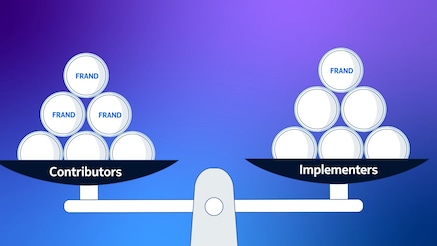
As both a major innovator and an implementer of other companies’ technologies, we believe in a fair licensing approach that strikes a balance between those who contribute to developing standardized technologies and those who implement them. This is achieved through fair, reasonable and non-discriminatory (FRAND) licensing of SEPs.
A balanced SEP licensing framework protects the value of new and advanced technologies and fosters the development of next-gen technology standards such as 6G.
Who benefits from FRAND licensing?
FRAND licensing benets everyone, including
Implementers
Licensing SEPs on FRAND terms allows implementers to use standardized technologies to create products and services without having to invest in fundamental R&D themselves.
Consumers
This delivers new and transformative functionalities to consumers, including seamless and abundant connectivity, greater competition and consumer choice, as well as new businesses based on these functionalities.
The planet
Rich connectivity enables, for example, remote working and education, and reduced travel, lowering carbon emissions.
Innovators and developers
Appropriate compensation for shared technologies generates royalties that can be reinvested back into the development of next generation technology standards.

Implementing standard essential patents (SEPs) in your products and services requires a license.

What happens if I don’t take a license?
If an implementer of a standardized technology doesn’t take a license on FRAND terms, it creates an uneven playing field. While the vast majority of patent licensing agreements between developers and implementers are concluded amicably, the possibility of litigation is necessary to support FRAND licensing and maintain a sustainable ecosystem. This ensures that contributors to standards development receive fair compensation, enabling continued investment in R&D and innovation. It also prevents implementers who license in good faith from being competitively disadvantaged by those who don’t.
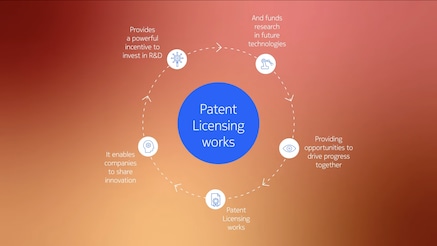
Powering the virtuous circle of innovation
The above process drives what we call the virtuous circle of innovation. It allows us and many others to invest in the next generation of innovative technology.
We could not access the Internet on our mobile phones, join a video conference call, stream our favorite movies or access critical remote education and healthcare services without standardized technologies.
Licensing SEPs on FRAND terms makes all of this possible. And, with open standardization, we can expand upon these possibilities to unlock a whole new horizon of future life-changing innovations.
A leading innovation portfolio waiting for you
Since 2000, Nokia has invested over €150bn in R&D. As a result, we have created one of the broadest and strongest patent portfolios in the telecommunications industry. That’s over 26,000 patent families – each comprising several individual patents with over 7,000 patent families declared as essential to 5G.
We are proud to share our patented inventions that power entire industries such as smartphones, consumer electronics, video streaming, gaming, automotive and the wider Internet of Things (IoT). In addition to our broad portfolio of SEPs, we also hold a range of other fundamental technologies for immersive multimedia, information security, location-based services, UI/UX, articial intelligence and machine learning (AI/ML), and so much more.
You can discover some of our most exciting inventions here.
Discover our patent licensing programs

Learn more about the virtuous circle of innovation
Licensing Standard-Essential Patents on Fair, Reasonable and Non-Discriminatory (FRAND) terms
Licensing and litigating on Fair, Reasonable and Non-Discriminatory (FRAND) terms