

Subscriber Data Management (SDM)
Navigating 5G and cloud
How to navigate the complexities of 5G and Cloud Transformation
The recent global rollout of 5G has introduced unprecedented operational complexities for network operators (data volume, velocity, variety, security, and real-time demands). A key challenge is the vast amount of diverse subscriber data across a landscape of legacy 2G/3G/4G and new cloud-native 5G core architectures. This requires a Subscriber Data Management (SDM) solution that not only meets the 3GPP standards but also seamlessly bridges network generations, enables easy service innovation, and ensures carrier-grade reliability in the new dynamic, virtualized environment. For operators it is crucial to discover new revenue streams from 5G while at the same time optimize costs and simplify operations in the increasingly intricate ecosystem.
What is Subscriber Data Management (SDM)?
Nokia Subscriber Data Management (SDM) is a comprehensive solution designed to centralize and secure all user data within telecommunications networks. It achieves this by:
- Unified Data Repository (UDR): A single, robust repository that stores all subscriber information, ensuring compliance with 3GPP User Data Convergence and 5G standards. The UDR hosts essential applications and guarantees SDM security.
- Unstructured Data Storage Function (UDSF): This component enables control applications to store their session data, allowing them to operate in a stateless manner. This improves scalability and resilience.
Nokia SDM, powered by Nokia Registers, provides unified subscriber access management across all network generations:
- For 5G Networks: The Unified Data Management (UDM) and Authentication Server Function (AUSF) handle 5G subscriber authorization, registration, and mobility management. Nokia AUSF_UDM offers true cloud-native capabilities for 5G.
- For 2G/3G/4G Networks: The Home Subscriber Server (HSS) and Home Location Register (HLR) manage legacy network access. These interwork seamlessly with the 5G UDM to support domain-spanning use cases and ensure continuous service.
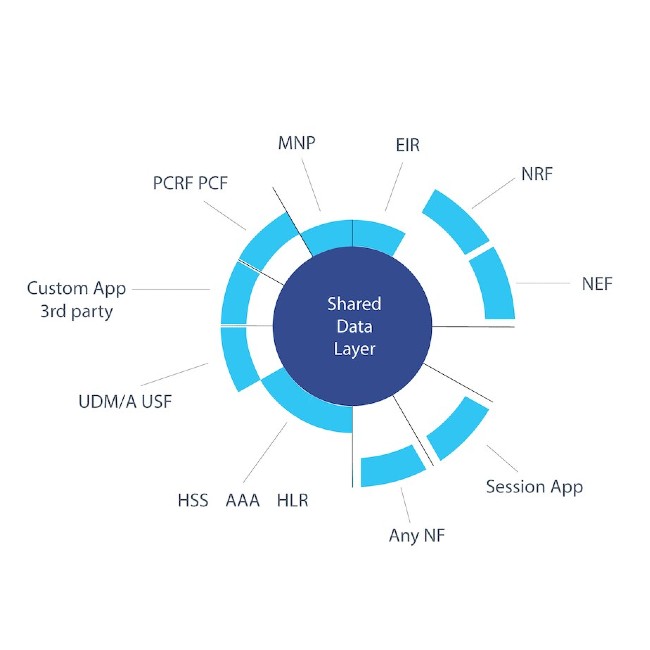
Nokia SDM: The differentiated foundation for 5G data management
- Suite of data and stateless, cloud-native applications, such as Nokia Advanced Registers (NAR), with support for all accesses, all network domains and all IoT verticals, integrated with a common User Data Repository for storing and sharing data.
- Highest services availability and robustness due to geo-redundant deployment with separation of service logic and data storage.
- Full support of new 5G service-based architecture with service-based interfaces enables a fast introduction of new services and devices.
- Unified and real-time data provisioning via single provisioning interface prevents redundant and inconsistent data.
- Open and standardized interfaces enable fast 3rd party application integration.
- A consolidated view of all subscriber profile data, shared across any application, enables an easy data exposure and monetization.
- Automated software delivery, test and deployment via a continuous integration and continuous delivery pipeline accelerates the introduction of new functionality for new services and saves operational cost.
- Robust security architecture, featuring telco-level access controls and multi-layer data encryption, ensures data confidentiality and integrity.
- More than 8 billion subscribers managed globally, 280+ customers across 130 countries.


Nokia SDM: Unified data repository for scalable 5G
With Nokia SDM, user data is centralized in a secure, highly scalable repository. As a single point of provisioning, this saves costs and substantially shortens the time taken to launch new technologies and services or to activate new customers.
The database is held in Network Directory Server (One-NDS) and Shared Data Layer (SDL) which provide a resilient and distributed data and application-hosting environment.
By combining several back-end repositories into one multi-use one, there are significant cost savings and minimised risk for down-time.
Nokia SDM Applications; Managing Subscriber Data
The Nokia SDM offers front-end functionalities that use the centralised SDM data, such as Nokia AUSF_UDM (Authentication Server Function and Unified Data Management). The 5G adapted AUSF_UDM architecture is influenced by the cloud-native principles and implements the Service Based Architecture as defined by the 3GPP. AUSF_UDM provides services/features like authentication and authorization, capability exposure, slicing support, security, carrier grade robustness and reliability, flexible scalability and a programmable interface.
The AUSF_UDM is developed with independent services providing functionality over the Service Based Interfaces. Building on this foundation of modularity and service-based architecture, the Nokia Advanced Registers delivery platform now enables operators to dynamically introduce new 5G, 5G Advanced, and future 6G network services into an already deployed Cloud-Native Function (CNF).
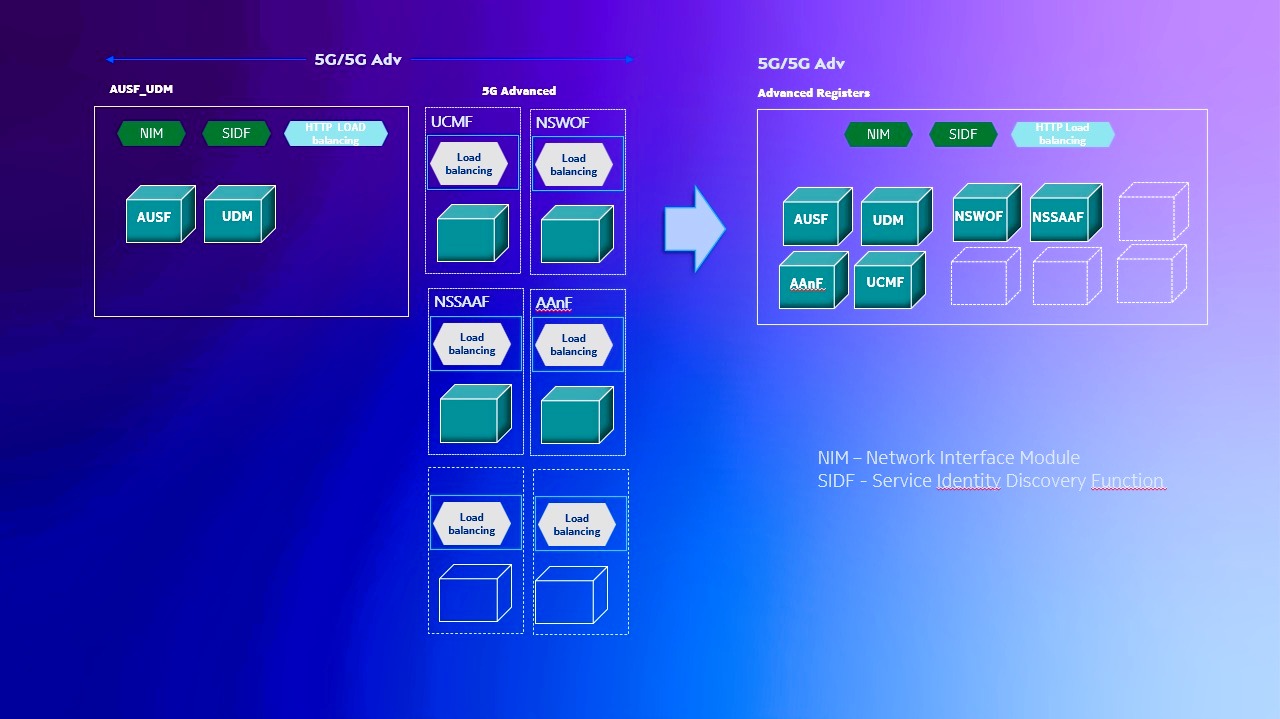
How to boost revenues with the new market opportunities using SDM cloud architecture
Nokia SDM is open and flexible to easily integrate third-party applications that meet new customer demands. Operators gain the reliability, scalability and flexibility they need to address a wide range of requirements when deploying IoT or new services for vertical markets.
Video
From Telco to TechCo: Core Insights with Vodacom
How to move SDM to 5G
SDM enables a seamless evolution to telco cloud and 5G. Existing 2G/3G/4G subscribers can be migrated to 5G efficiently by provisioning 5G credentials and updating authentication mechanisms. The decoupled SDM architecture allows operators to phase the introduction of 5G front-end applications and backend services, protecting investments while aligning network upgrades with business priorities
The SDM evolution to 5G
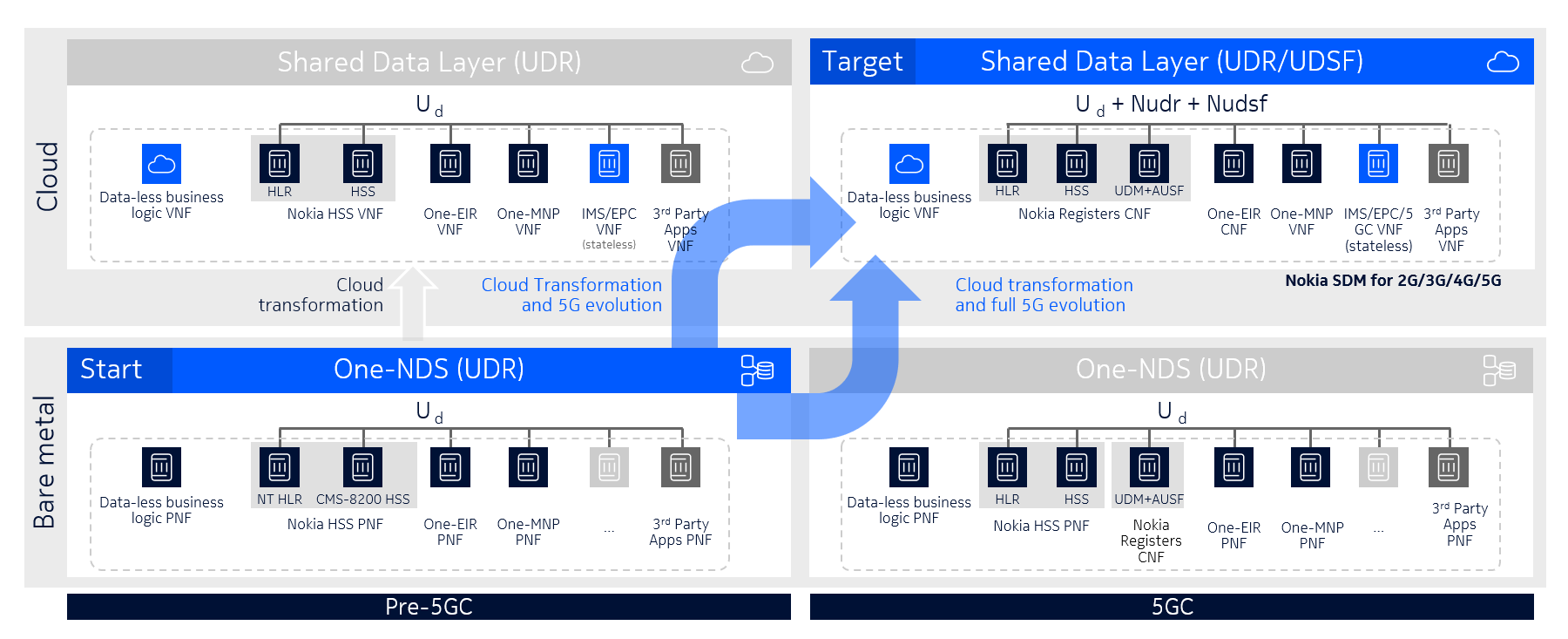
Geo-redundancy boosts operational excellence
With geo-redundancy and built-in mechanisms, our SDM solution is proven in the field to provide superior reliability. It also offers unparalleled scaling, from small deployments to networks with more than 450+ million subscribers.
Save costs and reduce time to market
Simplify your network and operations with a cost-effective converged solution and single point of provisioning. Whether your customers subscribe to fixed, mobile, cable or Wi-Fi services, or you offer multiple play services across fixed voice, mobile voice, broadband and video services, our SDM solution’s common subscriber data repository helps you achieve the highest operational efficiency.
Modernize your network with confidence
Our expert teams have the deep experience of network modernization and swaps needed to safely and efficiently upgrade your network in the shortest time. Nokia is the market leader in Subscriber Data Management and we have delivered our solution in more than 130 countries.
Want to know more about standards?
Unified Data Management (UDM) manages network user data in a single, centralized element. The technology is similar to the 4G network's home subscriber service (HSS) but is cloud-native and designed for 5G specifically.
Unified Data Repository (UDR) is a converged repository of subscriber information and can be used to service a number of network functions.
User Data Convergence (UDC) is a 3GPP initiative which seeks to rationalize the databases found across the key mobile technologies such as 2G, 3G, 4G, 5G and IMS.
UDM sometimes also referred to as Unified Data Function (UDF) acts as a front-end to store subscription data for the user in the Unified Data Repository (UDR) and executes essential functions on request from other Network Functions (NFs).
Unstructured Data Storage Function (UDSF) supports in 5G the data storage for stateless network functions. That is, rather than a given network function holding its own storage resources, it will instead store UE context data in the UDSF.
Related solutions and products
Solution
How to optimize telco cloud applications and architecture to achieve maximum benefit from the cloud
Product
Address new demands with the industry’s most powerful, reliable and flexible AAA platform
Product
For a programmable and open 5G
Product
How to unify your access management solution with Nokia Register
Product
Network directory server for subscriber data management
Service
Quickly realize foundational core network services
Learn more about data management core

Blog
Video
Securing the telecom core networks - Webinar replay

Brochure

Blog
Video
Citymesh – Agile B2B connectivity across Belgium

White paper

Blog
Video
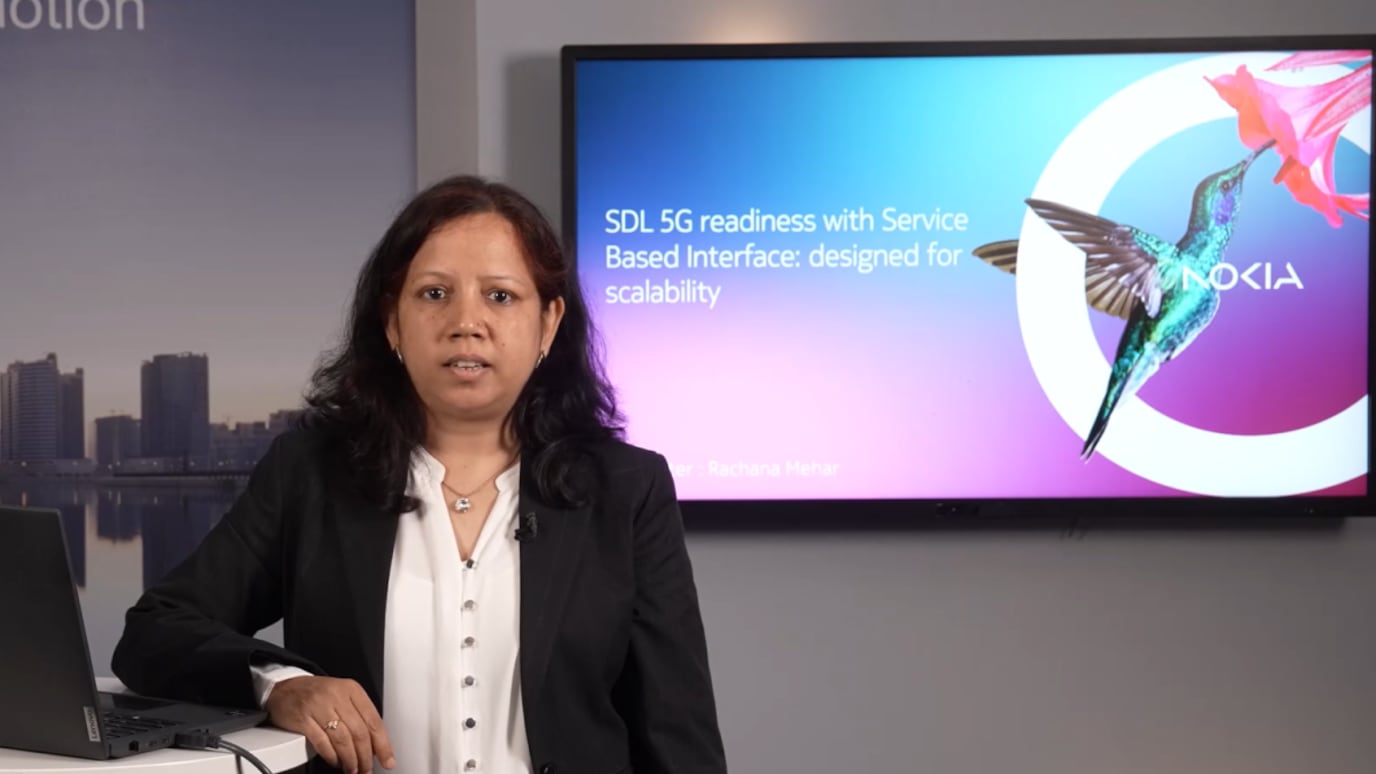
SDL 5G readiness with Service Based Interface
Please complete the form below.
The form is loading, please wait...
Thank you. We have received your inquiry. Please continue browsing.